
For most of my first year teaching, I painted on whatever was in the supply closet. Spiral pads, mostly. Thin sheets that cockled the second a wet brush touched them, hard edges that went soft before I could get the brush back to the palette, and a surface that started to pill if you looked at it wrong. I spent a long time assuming the problem was me. It was a little bit me. It was mostly the paper.
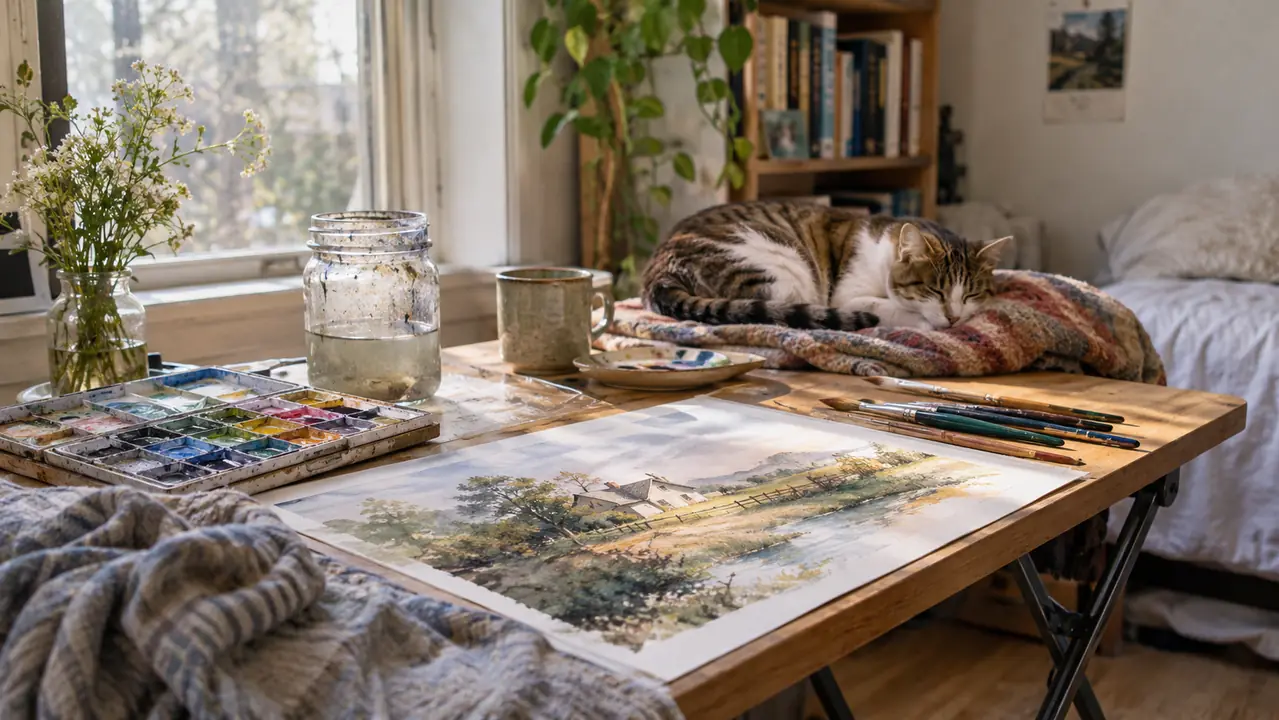
A colleague handed me a sheet of Arches cold press and told me to stop arguing and try it. That was over twenty years ago. I have painted on Arches blocks for about eight of those years, roughly one block a month, at the folding table in my spare room with the north light coming in and a cat asleep at the warm end. Here are ten things good cold press paper does for you. None of them will make you a painter. All of them stop the paper from working against you.
Twenty sheets is enough to find out whether it was ever your brush
The cold press block, 7 by 10, 140 pound, twenty sheets glued on all four sides so the top sheet cannot move while you work. If you already own paints, this is the simplest change you can make to how they behave.
Amazon Check Today's Price on Amazon →A wash stays open long enough to finish the sky
The first thing I noticed, and the thing my Thursday class notices first, is time. On a thin student sheet the water goes in and half of it is gone before I have reloaded the brush, so a sky comes out streaky and I sit there pretending I meant it that way. On a 140 pound block the wash stays open. I can take a loaded brush across the full width and the edge of the last stroke still melts into the one before it. That is not a small thing. It is the difference between a gradient and a set of stripes.

Blooms and backruns stop being accidents
You will still get blooms. I still get blooms, usually when I am talking to a student instead of watching the page. But on good cold press the water sits on the surface long enough that you can see the moment coming, and once you can see it coming you can decide whether to let it happen or lift the brush and walk away for a minute. On cheap paper the water sinks so fast that a backrun arrives already finished, like a stain, and the only move left is to soak the whole thing and start over. The paper gives you a second to think. A second is most of it.
You can lift color without scrubbing a hole in the sheet
Lifting is the move I use most: a damp brush, a clean paper towel, a light touch to pull a cloud back out of a sky or recover a highlight I painted straight over. On a thin pad, lifting takes fibers with it. Do it twice in the same spot and you get a fuzzy grey patch that never takes paint properly again. The cold press surface on a block takes a lift and keeps its tooth. I have lifted the same cloud three times in one sitting and the paper was still there afterward.
The block holds the sheet flat while you work
A block is twenty sheets glued on all four sides. You paint on the top sheet and it cannot move. No tape lines cutting across the middle of the composition, no corners curling up while the center stays wet, no chasing a buckle with a sponge between passes. I paint on the top sheet, let it dry completely, then slide a palette knife around the edge and lift the finished piece off. Twenty times per block. If you have ever watched a wash pool into the low corner of a buckled page, you already know what this is worth.
Granulating pigments settle into the texture
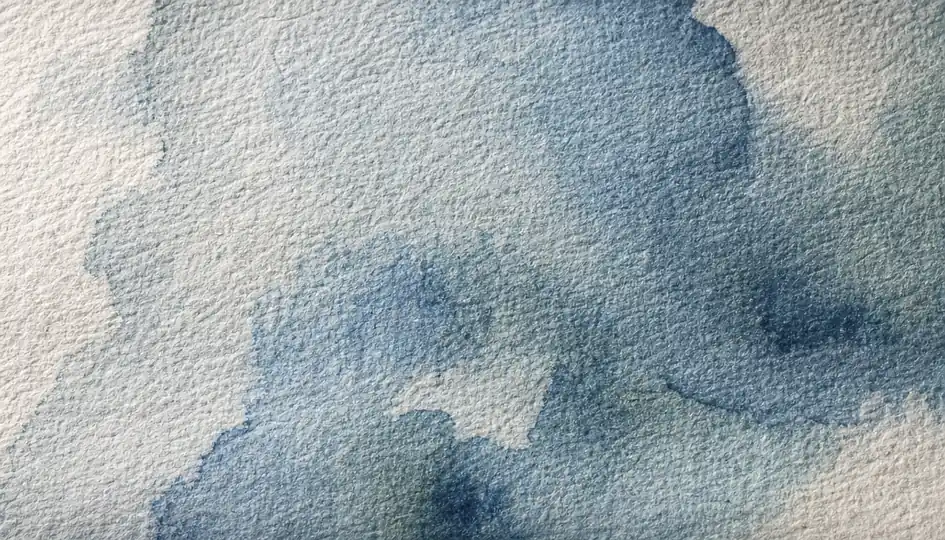
Ultramarine, burnt sienna, the earth colors generally, they want somewhere to land. The light texture of cold press gives them somewhere. The pigment drops into the low spots, the high spots stay a touch lighter, and you get the speckled settled look people mean when they say a painting looks like watercolor and not like a photograph of one. On a smooth sheet the same pigment lies flat and goes slightly grey. I am not going to tell you it improves the paint. It shows you what the paint was always doing.
I went through one Arches block a month for years before I could explain to a student why her washes kept drying with hard edges. It was never her brush. It was the pad.
It takes repeated wetting without pilling
Some paintings go down in one pass. Mine almost never do. I wet, I wait, I glaze over, I lift, I wet again, and a 140 pound, 300 GSM sheet takes all of that without going fuzzy. The student pad in my closet starts to pill around the third rewetting, and after that the surface is scarred and every later wash catches on the rough patch. The block keeps its surface. That matters most when you are learning, because learning is mostly repainting the same small area until you get it right.
Hard edges stay hard
You want a hard edge: the roofline, a window frame, the edge of a leaf. With paper that drinks, the paint creeps past where you put the brush and the edge goes soft before you can stop it. Cold press holds the shape of the stroke. I can put a stem line down with a small round and it stays the width I made it, and when I lift my hand the end of the line is where I intended it to be. Small thing. It is the whole difference between a stem that looks drawn and a stem that looks smudged.
You finally see the transparency of your own paint
The cold press finish reflects light back through the wash, and that is the quality that makes watercolor look like watercolor instead of colored paper. On a slick sheet the light bounces off the surface and everything reads a little chalky. On cold press the light goes down into the paint, hits the paper underneath and comes back up at you. I noticed this with yellows first, in the Cotman half pans I use most mornings, colors I had quietly decided were weak. They were not weak. They were on the wrong surface.
It teaches you what wet, damp and dry actually mean
Every beginner I have taught at the library branch runs into the same wall. They paint into a shine that is already half dry, the wash explodes, and they have no idea what they did differently from the last one. Good paper holds water in a way that makes the stages visible. The sheen goes off, the surface stops reflecting, and you get a window of maybe a minute where paint will still blend. Cheap paper rushes through all three stages in seconds. You cannot learn to read a surface that gives you nothing to read.
It makes the paint you already own look like better paint
This one stings a little. I spent a couple of years buying tubes and pans, hunting for pigment that would behave, when the paper underneath them was the problem the entire time. The same half pans that looked washed out on a spiral pad came up clear and rich on a block. Before you buy another color, buy the surface. Work through one block with the paints you already have and see whether the paint was ever the thing holding you back.
What I'd Skip
Skip the full sheet while you are still chasing consistency. Buy the 7 by 10 block and work through all twenty sheets before you decide anything about your brushes. A large sheet is a lot of surface to fill with a habit you have not built yet, and most of the students who bought one in my class left it in the closet until it went yellow at the edges.
Skip any block that is not glued on all four sides if you paint wet. The whole point is that the sheet cannot lift. And do not skip the cheap pad completely. I still keep a spiral student pad for practice sketches and for class demos, where the point is showing six adults where the brush goes, not making a finished painting. Use the good paper for the painting. Use the cheap paper for the thinking.
One last thing, and I say it to every class. I do not sell paintings. I paint for the pleasure of it and I give some away, and I have made every mistake in this article more than once. Better paper does not draw for you and it does not fix a weak composition. What it does is stop one whole category of failure, the paper fighting back, so the rest of your mistakes are actually yours and actually fixable.
Stop painting on a surface that is working against you
The Arches cold press block, 7 by 10, 140 pound, 300 GSM, twenty sheets glued on all four sides. Start the next sky on paper that holds still and holds water.
Amazon Check Today's Price on Amazon →