

The Winsor & Newton Cotman 45 Half Pan Studio Set has sat open on my folding table for about three years. I am 64, retired after 31 years of teaching middle school art, and I paint most mornings for about two hours in the spare bedroom with the north-facing window. The set replaced a 12-pan tin that had run down. I still keep a few older tubes for certain colors, but the Cotman set is what I reach for first, and it is what I tell my Thursday beginners to start with.
What I care about is not the box. It is what happens when the brush hits the paper. A set can look generous in the listing and still fight you on a damp sheet of cold press. This one mostly does not fight me. It has a few small annoyances, and I will get to those, but after three years I know where it helps a hobby painter and where it does not.
The Quick Verdict
A dependable everyday set with enough colors to learn mixing and a case that earns its place on a small table. The half pans are small, and a few colors stain more than I would like, but it has held up to near-daily use.
Amazon Check Today's Price →The set I point beginners toward, three years running
The Winsor & Newton Cotman 45 Half Pan Studio Set gives you a wide range of pans, a mixing tray and a case that closes. If you want one box for practice, class demos and garden sketches, this is the one on my table.
Amazon Check Today's Price on Amazon →How I've Used It
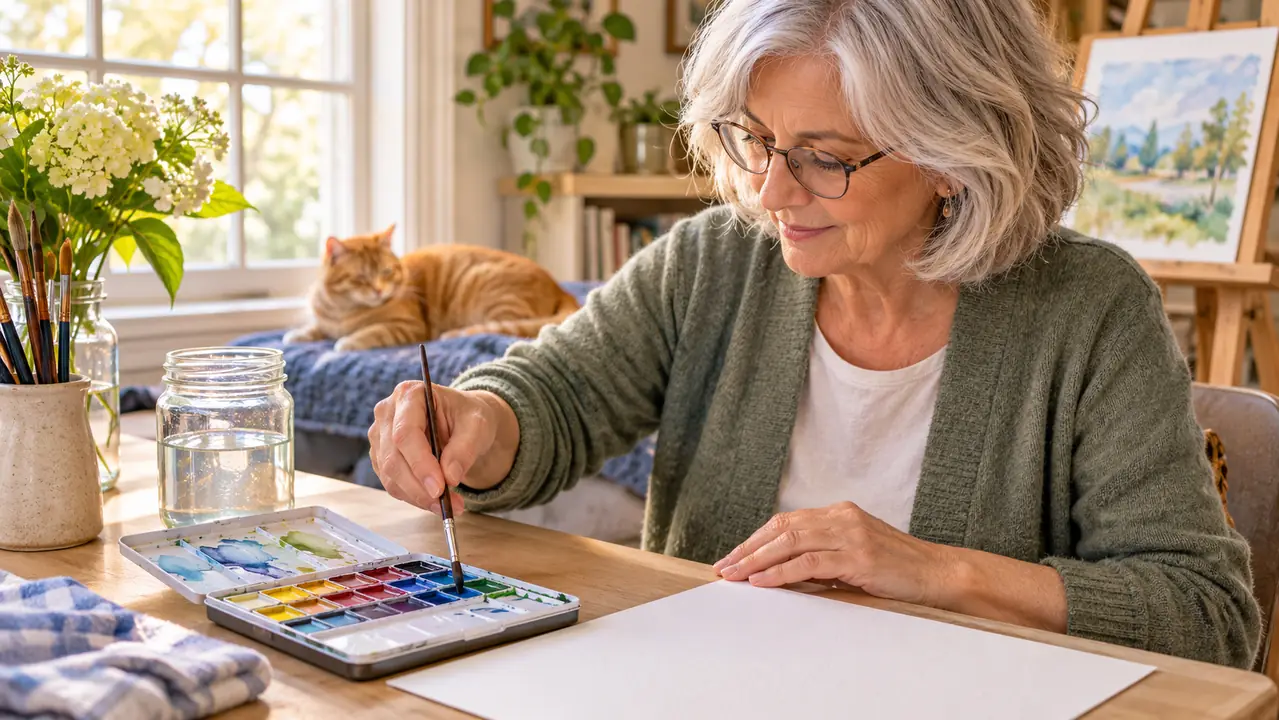
My studio is a folding table about three feet wide in the spare bedroom, tucked under the north-facing window. The Winsor & Newton case lives on the right side of it with a jar of water, a roll of paper towels and a 7 x 10 Arches cold press block. I have used that block setup for about eight years: paint on the top sheet, let it dry fully, then slide a palette knife around the glued edge to lift it. When I am working well there is a small clear zone in the middle of the table and clutter everywhere else.
Before this set I had a 12-pan tin. I painted out of that tin for years and by the end the pans were empty craters. The green was gone entirely, the blue had a hole in the middle, and I was mixing everything I wanted from about five colors. Replacing it with 45 pans felt excessive at the time. It stopped feeling excessive the first morning I mixed a sky and did not have to ration the blue.
A session usually starts with a wet brush and a dry pan. I touch the brush to the pan, load it, and mix on the tray. The paint wakes up quickly. I do not have to chip at it or soak it in water first. That matters more than any color chart, because if a pan is slow to rewet, I lose the first ten minutes of a two-hour morning just getting ready.
The first week I did what most people do with a new set. I tried to use everything. I painted a jar of zinnias from the garden with about twenty colors in it, and the whole thing went to mud by the third layer. Nothing was wrong with the paint. I had simply stacked too many tinted washes on top of each other and lost the paper underneath. I have gone back to six or seven colors for most paintings, and the set rewards that far better than it rewards a person trying to use every pan.
I have also carried the case to the library for my Thursday evening class of about six adults. The listed weight is 15.52 ounces, which is light enough to go in a tote with paper and a brush roll. At home it stays open while I work. When I leave the table, the case closes. That last part is not a small thing in a house with a cat. Biscuit likes the warm end of the table and has walked across a wet painting more than once.
What 45 Half Pans Actually Give You
The set is exactly what the name says: 45 half pans in a compact case with a mixing tray. For a hobby painter that is a lot of color in one place. I did not have to buy tubes one at a time. I could mix a sky, a flower and a shadow without opening a drawer. The listing says the paints have good transparency and excellent tinting strength, and that matches what I see on the paper. A small load goes a long way on damp cold press.
The half pans are small. That is the tradeoff. A half pan is enough for a garden sketch or a class demo, but if you paint large wet washes every day you will see the bottom of a few pans sooner than the rest. After three years, the pans I use most sit noticeably lower than the ones I do not. The set still has plenty of paint for the way I work, but I am not painting full sheets every morning.
The mixing tray is the part I use most. It is wide enough to keep three or four washes going at once without them all sliding into the same gray puddle. I keep the cool washes at one end and the warm ones at the other, and I leave the middle for whatever the painting needs that day. I wipe it with a damp paper towel between sessions. If I leave it dirty, the next morning starts with a film that gets into the first wash. That is not the set's fault. It is mine, and I have done it more than once.
The case is compact for 45 pans. It closes, it stacks on a shelf, and it does not take over the table. I would not call it a pocket set. It is a studio set that can travel. For the park or a waiting room I still take a water brush and a few pans in an old mint tin. For the library class, the Winsor & Newton case comes with me.
What the range really buys you is not 45 finished colors. It is the ability to keep mixing without stopping to go shopping. When I want a gray that leans warm I can pull a warm brown and cool it with a touch of blue, right there on the tray. When a student asks how to get the color of a wet slate roof, I can show them in about four touches. That is worth more to me than the number printed on the box, and it is the reason I have never felt the urge to build a big tube collection.
How the Paint Behaves on Paper
On Arches cold press the paint sits on the tooth of the paper and stays workable long enough to blend an edge. I have time to drop a darker value into a damp wash and pull it out again. I do not have unlimited time. If the paper is too wet the paint blooms and runs. If it is just damp the edges stay where I put them. That is watercolor in general, not a flaw in this set.
The transparency is good. I can lay a wash over a dried wash and still see the paper underneath. The tinting strength is also good, which means I have to be careful. A brush that looks almost dry can still leave a strong mark. I have ruined more than one sky by loading too much and touching it to paper that was already damp.
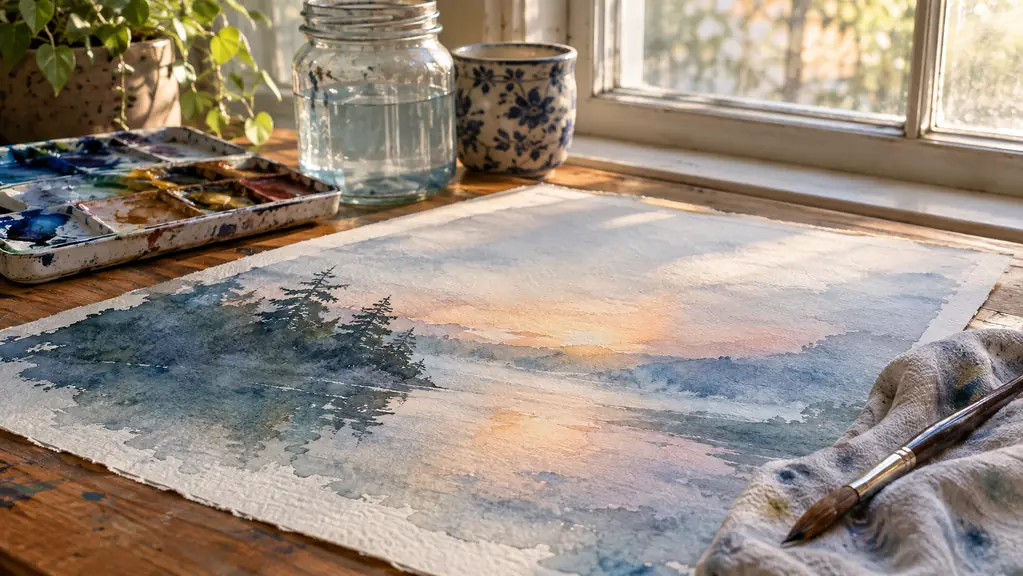
One morning last October I was painting the treeline behind the neighbor's roof. I had a pale wash down and I wanted a soft edge where the trees met the sky. I loaded a round brush, touched it to the damp paper, and got a backrun that spread the wrong way and pushed pigment into the light. I let it dry and lifted what I could. The fix was to rework the edge with a barely damp brush and a paper towel, not to add more paint. The set gave me pigment that would lift. It could not give me a steadier hand at seven in the morning.
Lifting is where the set is honest but not magic. Some colors lift almost cleanly with a damp brush and a blotter. Others leave a stain behind no matter how gently I work. I have learned which ones to use first and which to save for the final layer. If you expect every color to erase back to white paper you will be disappointed. If you plan your lights before you start, the set behaves well.
I do not get much granulation out of these pans. A smooth sky is easy with them, and smooth is most of what I want in a sky. When I want the speckled, settled look that some painters chase in a stone wall or a gravel path, I reach for one of the older tubes I keep in the drawer. That is not a complaint. It is a difference, and a beginner will not notice it for a year.
The listing gives a dry time of 15 hours and a semi-gloss finish. The finish is visible in the pan when the paint is dry, but it does not change how the paint handles on paper. The dry time sounds long until you remember that a thick wash on cold press in a cool room can stay damp for a while. I usually let a block dry overnight before I lift it. That is not a rule. It is what keeps me from smearing a painting I like.
Three Years In: What Holds Up and What Doesn't
The case has held up. The lid still closes, the tray still wipes clean, and the pans still sit where they should. I am not gentle with it. It rides in a tote, gets set down on a library table, and comes back home. After three years it looks used but not falling apart. That is what I want from a set I open every day.
The paint has held up too, with one caveat. The pans rewet easily even after weeks of sitting, and the ones I use least have been untouched since spring without going hard or chalky. But some colors are lower than others, and the small pan size means I notice it more than I would with a bigger pan.
Two years ago I bought a cheaper Mungyo half pan set for the class supply bin so six students would not have to share one box. I have used it enough to know the difference, and the difference is smaller than the price gap suggests. The Mungyo pans are perfectly workable. They just take a little longer to wake up under a wet brush, and the color is not as strong on the paper. When I hand a student the Winsor & Newton set, they are mixing confidently in the first ten minutes. That is the whole case for the better set, and it is a modest case, not a dramatic one.
The part I like less is the choice. Forty-five colors is a lot to look at when you are tired. Beginners in my Thursday class sometimes freeze because there are too many pans in front of them. I tell them to pick six and ignore the rest for a month. The set rewards that. It does not reward trying to use every pan in one painting.
If I could change one thing it would be the pan size. I would happily take 30 colors in slightly larger pans over 45 in these. Most mornings I use about a dozen, and I would rather have more of those twelve. That says as much about my painting as it does about the set, but a person shopping should hear it before they buy.
What I Liked
- 45 half pans give a wide working range in one case
- Case includes a mixing tray and closes for storage
- Paint rewets quickly and has good transparency and tinting strength
- Compact enough to carry at the listed 15.52 ounces
- Has held up to about three years of near-daily morning use
Where It Falls Short
- Half pans are small, so favorite colors run down faster
- 45 colors can overwhelm a beginner
- Some colors stain and will not lift cleanly
- Mixing tray needs wiping between sessions or the next wash turns gray
A half pan is not a lot of paint. It is enough for a garden sketch, a class demo, and the sky over the neighbor's roof, which is most of what I ask of it.
Who This Is For
This set is for the adult hobby painter who wants one box with a wide range of pans and a mixing tray, and who paints at a kitchen table, a folding table, or a class. It suits a beginner in a Thursday class because it removes the excuse that you do not have the right color. It suits a returning painter who wants to practice without building a tube collection. It also suits a painter like me, 64 years old, 22 years into watercolor, who wants to sit down in the morning and get to work.
If you paint small studies, garden flowers, landscapes, or a cat on a chair, 45 pans is more than enough. The set is not precious. You can use it hard and still have paint left. I have watched students who were nervous about wasting paint relax once they understood there was more where that came from, and that is worth something in a class of adults who are all a little afraid of ruining the paper.
Who Should Skip It
Skip it if you already own a set you like. More pans will not make you a better painter. Skip it if you only ever use six colors, because 45 is unnecessary and the small pans will not give you the volume you want for large wet washes. Skip it if you expect every color to lift back to white, or if you want a true pocket kit. This is a studio set that can travel, not a travel set. If you paint on the sofa with a water brush, the mint tin is still the better answer.
If you paint full sheets every day and need a heavy load of one color, tubes will serve you better. The half pan is a small dish. It is generous for a morning sketch and thin for a large wash. Know which painter you are before you buy, and be honest about how often you actually sit down.
One box, most mornings, three years of use
If you want a practical place to start, the Winsor & Newton Cotman 45 Half Pan Studio Set is the one I have used and the one I recommend to my beginners. It gives you enough color to learn mixing without turning your spare room into a supply closet.
Amazon Check Today's Price on Amazon →