
Most watercolor pads and I have a short, unhappy history. I load a sky with a wet wash, walk away for ten minutes, and come back to a sheet that has curled at the corners like a dried leaf. That is why I have painted on Arches blocks for about eight years. The Arches Watercolor Paper Block, cold press, 7 by 10, 140 pound, is the paper I reach for when I want a wash to stay flat and stay workable. It is not the paper I use for every sketch, and it is not the paper I hand a beginner for a five minute color study.
The comparison here is between that block and a Canson XL watercolor pad, the spiral bound pad I keep for class demos and practice. The short answer is this: the Arches block wins when the paper has to survive water, and the Canson XL pad wins when the paper has to be convenient. If you paint wet skies, layered fields, or anything you plan to keep, the block is worth the fuss. If you paint small studies, teach a class, or want to tear off a sheet and not think about it, the pad is the better tool.
| Arches Cold Press Block | Canson XL Watercolor Pad | |
|---|---|---|
| Wet wash | Holds a loaded wash flat without taping | Corners lift and the middle dips on a sopping wash |
| Prep | No tape, no board, no stretching | Needs tape or clips for a wet wash |
| Portability | Rigid block is fine at the table, bulky in a tote | Spiral pad flips open on a lap and slips into a bag |
| Releasing a sheet | Palette knife around the edge once the sheet is dry | Tear along the spiral, fast but a rough edge |
| Lifting color | Lifts cleanly enough to correct a sky | Pills after two passes with a damp brush |
| Drying flat | Dries flat on the block | Edges lift while drying unless taped down |
| Class demo | Too much paper for a five minute demo | Tear off a sheet and pass it around |
| Finished edge | Clean edge when released | Spiral holes or a torn edge |
| Practice volume | A block is a commitment | Easy to work through several studies in one sitting |
| Best for | Wet skies, layered fields, a painting you plan to keep | Sketches, color studies, classroom work |
Where Arches Wins
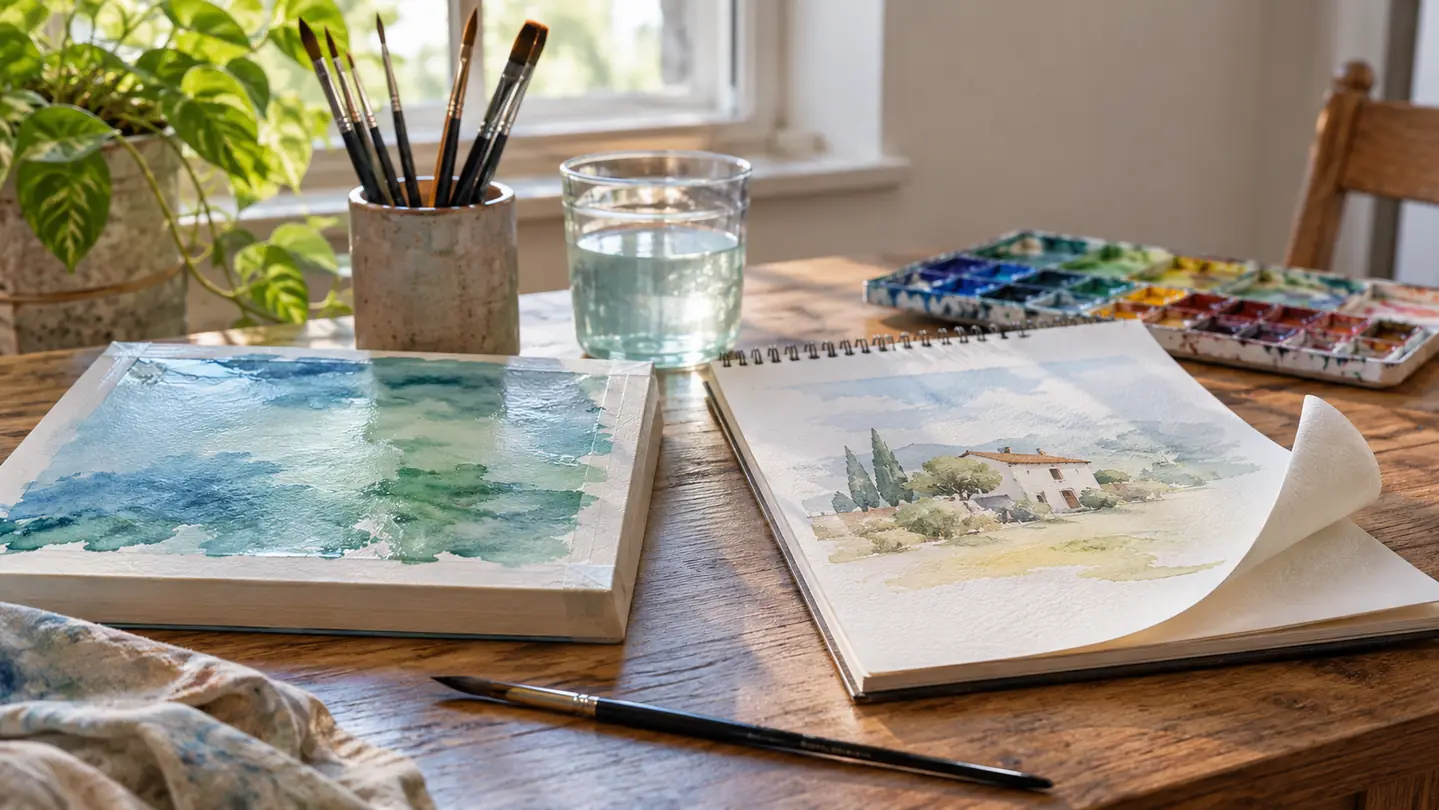
The first difference shows up the moment the wash goes down. On the Arches block, I can wet a wide area with a large round brush, tilt the block a few degrees, and the sheet stays flat. The block holds the paper at the edges, so the water does not pull the sheet into a bowl. The cold press surface has a light texture that reflects light without breaking up a transparent wash. The listing describes the paper as cylinder mould made and tub sized in a bath of natural gelatin, then air dried. I cannot verify the mill process from my table, but I can tell you the surface does not fuzz when I go back over a damp area.
The second difference is lifting. On a student pad, if I try to lift a cloud out of a sky, the paper pills and leaves a fuzzy patch that will not take paint the same way again. On the Arches block, a damp brush and a paper towel lift color and leave enough tooth to repaint. I still have to be gentle. I have scrubbed too hard and damaged a sheet. But the margin for error is wider, and for a painter who is still learning to control water, that margin matters. The block also gives me a clean edge when I release a sheet, which makes the finished piece easier to trim or frame.

Where the Canson XL Pad Wins
The Canson XL pad wins on speed and portability. It is spiral bound, so I flip it open on my lap, tear out a sheet, and start. There is no palette knife, no waiting for a block to dry, no rigid board in my bag. When I go to the park or to my sister's house in Hagerstown, I take the pad. When I teach my Thursday class at the library, I take the pad. A beginner can make a mistake on a pad sheet and not feel like they have ruined a whole block.
The pad also wins for practice volume. A block is a commitment. You paint on the top sheet, you let it dry fully, and then you slide a knife around the edge to release it. That is fine for a painting you care about. It is too much ceremony for a twenty minute study of a coffee cup. The Canson XL pad lets me do five small studies in a row and not think about the order. If I am testing a new color mix or showing a student how a wet in wet bloom behaves, the pad is the right paper. It is not the paper I would use for a finished painting that I plan to give away, but it is the paper I use to get to that painting.
If your wash keeps buckling, stop fighting the sheet.
The Arches block holds the paper flat while it dries. Lay the wet wash, walk away, and come back to a sheet that is still where you left it. See the size, sheet count and current details on Amazon.
Amazon Check Availability on Amazon →How I Tested These Two Papers
I did not run a lab test. I did what I always do on a Tuesday morning: I taped a sheet of the Canson XL pad to a board and painted a sky, and I painted the same sky on the top sheet of an Arches block. Same paint, same brush, same water cup. I used my Winsor and Newton Cotman set, a large round from my Transon set, and a mix of ultramarine and burnt sienna. I kept the washes the same wetness and I did not use a hair dryer on either sheet.
The pad sheet began to curl at the corners within a few minutes. I had taped it, so it did not lift completely, but the surface dipped in the middle and the wash pooled toward the low spot. On the block, the sheet stayed flat. The wash sat where I put it. That is the whole argument in one sentence, and it is the reason I keep buying blocks.
The next day I tried lifting a cloud from each sheet. On the pad, the paper pilled after two passes. On the block, the color came up and the texture stayed. I also tried a backrun on purpose, dropping clean water into a damp wash. The block gave me a softer edge and more control. The pad gave me a harsher edge and a slightly muddier result. Neither paper made the painting good. The paper only decided how much trouble I had while painting it.
What the Wet Wash Actually Does
A wet wash is not just water and pigment. It is a test of how the paper was sized. If the sizing is too light, the water soaks straight through and the sheet buckles. If the sizing is uneven, the wash crawls and leaves tide lines. The Arches block has a surface that feels hard enough to take a soaking, then soft enough to lift color. That is the balance I want. The Canson XL pad feels softer when wet. It is fine for a light wash, but when I load it with a lot of water, the sheet gives up sooner.
This matters most in skies. A sky is usually the largest wet area in a landscape, and it is the area most likely to show a buckle. If the paper curls, the wash runs to the edge and leaves a dark line. You can fix that with tape or a board, but tape adds a step and can tear the surface when you remove it. The block removes that step. The sheet is already held at the edges. I can wet the whole sky, tilt the block, and let gravity do some of the work.
It matters in gardens and flowers too, but for a different reason. Petals need a soft edge and a clean lift. If the paper starts to pill, the petal looks rough. The Arches surface lets me lift a highlight and repaint the shadow without the paper breaking down. That does not mean every flower turns out. I have painted plenty of muddy roses. It means the paper is not the reason they went muddy.
The Mistakes I See Beginners Make
The first mistake is buying a block and treating it like a pad. I have watched students try to tear a sheet off an Arches block. You cannot. The sheets are held as a block. You paint on the top sheet, let it dry completely, and then slide a palette knife around the edge to release it. If you rush that step, you will tear the sheet. I did it myself the first month. The paper is tough when it is wet, but it is still paper.
The second mistake is using too much water on a pad and blaming the paper. A Canson XL pad is a student pad. It is not designed to take a soaking without support. If you want a wet wash on a pad, tape it to a board and let it dry flat. If you do not want to tape, use less water or use a block. That is the trade. The paper is not bad. It is just doing a different job.
A Note on Lifting, Blooms and Backruns
Blooms and backruns are the two things my students ask about most. A bloom happens when wet paint hits a damp area and pushes outward. A backrun happens when water runs into a drying wash and pushes pigment back. Both are easier to control on paper that stays flat. If the sheet is buckled, the water runs to the low spot and the backrun goes where you did not plan. The Arches block gives you a flat field, so the water stays where you put it.
Lifting is the other side of the same coin. On the block, I can wet a small area with a clean brush, wait a few seconds, and blot with a paper towel. The color comes up. On the pad, the same move can leave a fuzzy spot. I still use the pad for lifting practice because it teaches me how little scrubbing the surface will take. But when I am painting a finished piece, I want the block. The difference is not dramatic in a photograph. It is obvious in the hand.
A pad is for practice. A block is for the painting you plan to keep. The paper decides how much of your attention goes to the water and how much goes to the sheet.
Who Should Buy Which
Buy the Arches block if you paint wet washes, skies, or layered landscapes, and you want the sheet to stay flat without tape. Buy it if you plan to keep the painting, give it away, or frame it, because the released sheet has a clean edge and the surface holds up to lifting. Buy it if you have already tried a student pad and got tired of buckled corners. The 7 by 10 size is big enough for a study and small enough for my folding table. I go through about one block a month, so I keep a spare.
Buy the Canson XL pad if you are just starting, if you teach, or if you want a stack of practice sheets that you do not have to baby. Buy it if you paint on location and do not want to carry a rigid block. Buy it if you are testing a new color or a new brush and you do not want to use a good sheet. The pad is not a lesser paper in every way. It is a different paper for a different job. I would rather see a beginner paint fifty studies on a pad than hesitate over one good block and never start.
The paper that stays flat while the wash dries.
If you are tired of taping, clipping and chasing buckled corners, the Arches cold press block is the paper I would hand you. Start with one block, paint a sky, and see what the sheet does. Check the current details on Amazon.
Amazon Check Availability on Amazon →