
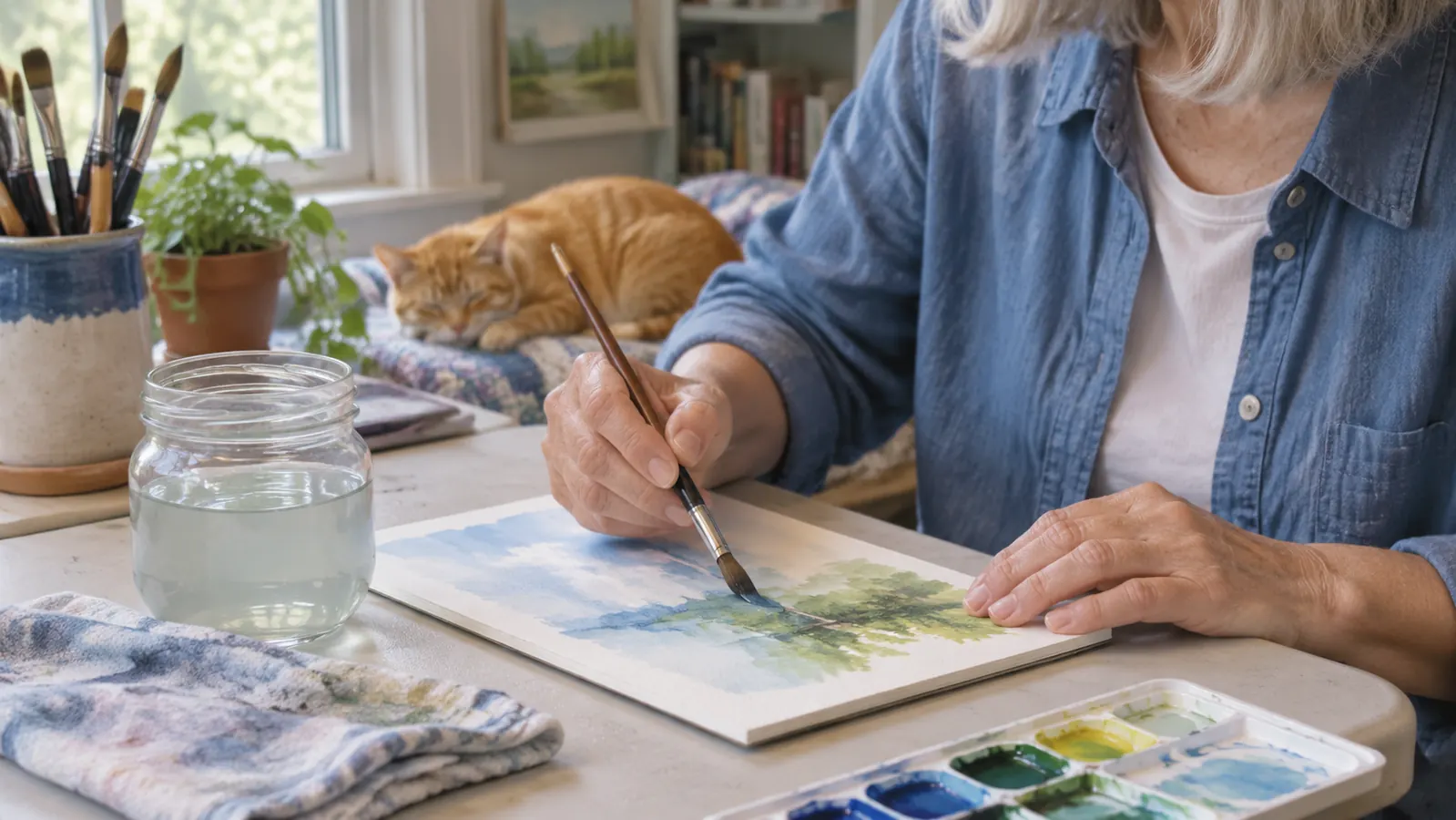
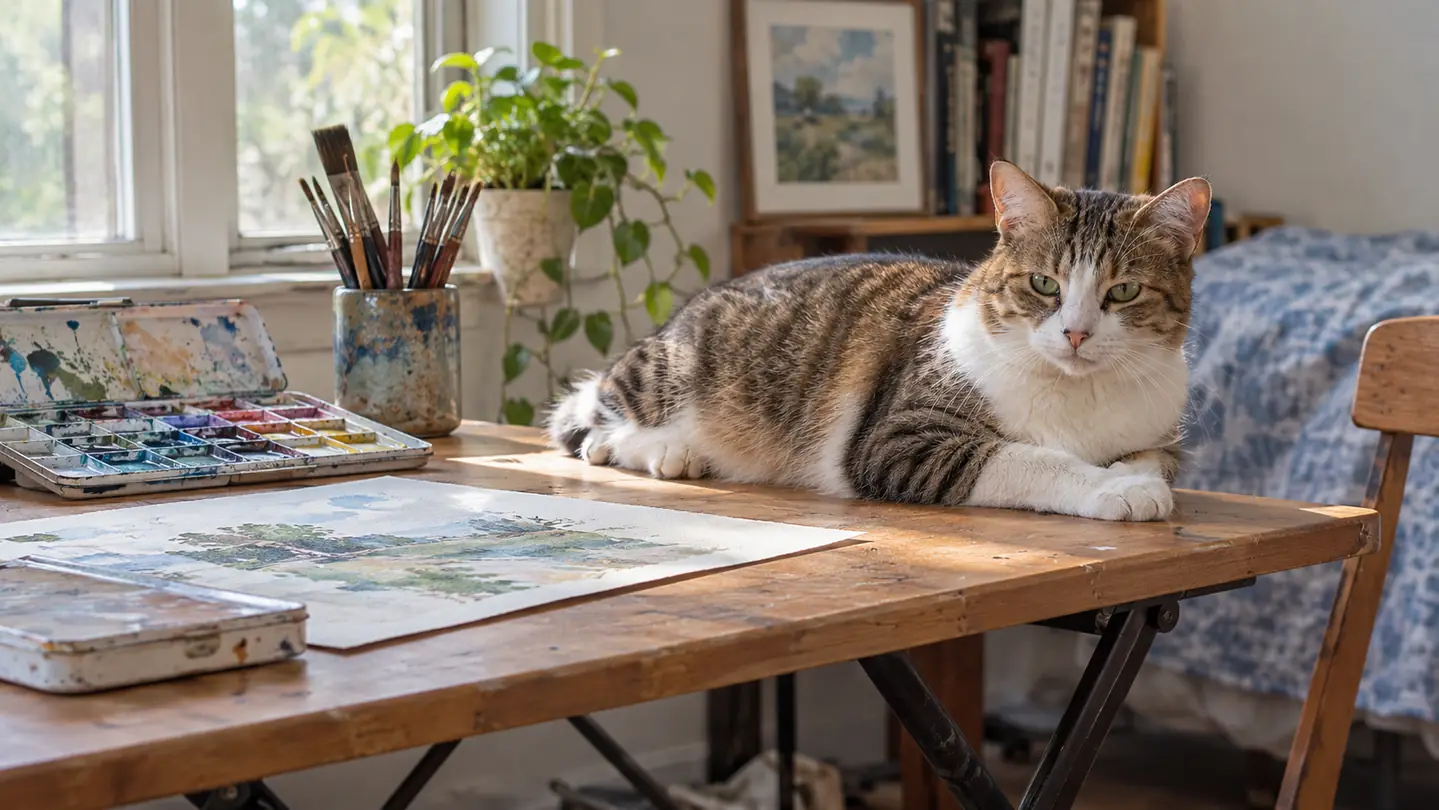
I taught middle school art for 31 years, and the mistake I saw in nearly every beginner's pencil box was the same one I made at the start: too many brushes, most of them flat, and not enough rounds. A round brush can make a wash, a stem, a soft edge and a fine line. It is the brush that earns its place in the jar. I paint most mornings now at a folding table in the spare bedroom, with a north window and my cat Biscuit nearby, and the brushes I reach for are almost always round. For about 18 months the ones in that jar have been the TRANSON 8 piece round goat hair set.
Here is what I mean by doing most of the work. A round brush is not one tool. The point draws. The belly holds. The side makes a soft shape. When the paint is wet, a round can lift a cloud or drop a bloom into a wash. When the paper is dry, the same brush can pull a thin line for a stem. You do not need a brush for every job. You need a few rounds that hold their shape and a hand willing to turn them.
One jar of rounds can cover the whole sheet
The TRANSON set gives you eight round goat hair brushes in sizes #1, #4, #5, #8, #10, #12, #14 and #16. The larger rounds carry a wash across a 7 x 10 sheet. The smaller ones make stems and edges. Rinse, reshape the point, and dry the brush flat.
Amazon See the TRANSON set on Amazon →Lays a sky wash with one brush instead of three
A sky is where beginners overwork the paper. I wet the sheet first, then load the #14 or #16 round with a weak blue and let the belly do the carrying. The large belly holds water and pigment, so I can cross the top of a 7 x 10 Arches block without stopping to reload. The stroke stays connected. If I switch brushes halfway, I get a seam and a backrun. One round keeps the wash even and gives me time to drop in a warmer gray before the paper sets.
Draws a fine stem with the same brush that made the wash
Once the wash is bone dry, I turn the same round to its point. The #1 and #4 in the TRANSON set make a line thin enough for a cosmos stem or a cat whisker. I do not have to hunt for a liner. A round point does this because the hairs come to a tip, and the belly gives the tip just enough spring. If the point is splayed, the line goes woolly. Rinse it, reshape it with your fingers, and it comes back.
Keeps a wash workable long enough to drop in color
The clock matters in watercolor. A wash that sets too fast gives you hard edges you did not plan. The large belly on a round holds water so the wash stays open. On a dry morning in Frederick, I can lay a pale green over the paper and still have time to touch in a darker leaf. The brush is not magic. The paper and the room matter. But a round with a full belly gives you a few more seconds, and a few seconds is often the difference between a soft leaf and a stain.
Lifts color with a clean, damp tip
Lifting is where a round earns its keep. I rinse the brush, squeeze most of the water out on a paper towel, then touch the damp tip to a dry wash. The point lifts a small highlight, a window, the shine on a leaf. A flat brush can lift a block, but it cannot get into a small shape. The TRANSON goat hair is soft enough that it does not scrub the paper unless I press too hard. I have pressed too hard. The paper tells you.
Covers a beginner's whole class with eight sizes
My Thursday evening class at the library branch has about six adults. Most of them arrive with one brush that is too small or a set with twelve shapes they do not need. I tell them to start with rounds. The TRANSON set runs from #1 to #16, so the same set handles a demo wash and a fine edge. A student can paint a whole small study with the #8 and #12 and never feel under-equipped. Eight sizes in one jar is a simple way to stop shopping and start painting.
Softens edges without scrubbing the paper
Goat hair is soft. That matters at the edge of a shape. When I paint a flower petal, I want the color to fade, not stop like a cutout. A damp round dragged lightly along the edge pulls the pigment out and leaves a soft turn. A stiff brush can do this too, but it is easier to damage the paper. I have a student who scrubs. Her paper pills. The softer round asks for a lighter hand, and the lighter hand is usually the right one.
Gives tired hands a steadier grip
I am 64. My hands are not what they were at 40. The gourd-shaped handle on the TRANSON brushes sits in the web of my thumb and gives me a place to hold without pinching. The weight is balanced, so the brush does not tip forward when I am making a slow line. That sounds like a small thing until you have spent an hour on stems. A handle that fits your hand keeps the line steady. A thin, slick handle makes you squeeze.
Cleans up in a minute at the kitchen sink
I rinse my brushes after every session. Goat hair does not need a complicated ritual. Lukewarm water, a little mild soap if the color is stubborn, and a gentle squeeze from the ferrule to the tip. Then I reshape the point and lay the brush flat to dry. I do not stand them up in a jar while wet. Water runs into the ferrule and loosens the glue. The TRANSON set has survived 18 months of this because I do the small thing every time.
Travels to the park and the library in one pouch
On Tuesdays I take a zip pouch to the park with a small sketchbook, a water brush and three rounds. The #8 and #10 do most of the work, and the #4 handles the edges. The brushes are light and the points hold their shape in the pouch. I have carried cheaper nylon rounds that bent and stayed bent. These have come back after a rinse. If you paint away from home, a few rounds in a pouch is a full kit. I keep the rest in the jar at home.
Replaces a drawer of specialty brushes
I have a drawer of brushes I bought for one job and never used again. A rigger for lines. A fan for grass. A flat for skies. Most of them are still there. The rounds in the TRANSON set do those jobs well enough for the paintings I make. The #12 makes grass with the side. The #16 makes a sky. The #1 makes a line. I am not saying a specialty brush has no place. I am saying a beginner can paint for a year with rounds and learn more about the paint.
The #14 round can carry a sky wash across a 7 x 10 sheet, and the #1 can still make a stem thin enough for a cosmos.
What I'd Skip
I would skip the 20 brush set with shapes you cannot name. I would skip a brush sold as a complete watercolor kit with no size on the handle. I would skip standing brushes in water. And I would skip buying a second set before you know your #10 round. If you already have a flat you like, keep it. You do not need to replace everything. The TRANSON set is the one I would put in a beginner's jar because it covers the sizes I actually use.
The round in your hand is the one that paints the picture
If you want a set that covers a wash, a stem and a lifted highlight, start with the TRANSON 8 piece round goat hair set. Rinse it, reshape the point, and dry it flat. The paper will tell you the rest.
Amazon See the TRANSON set on Amazon →