
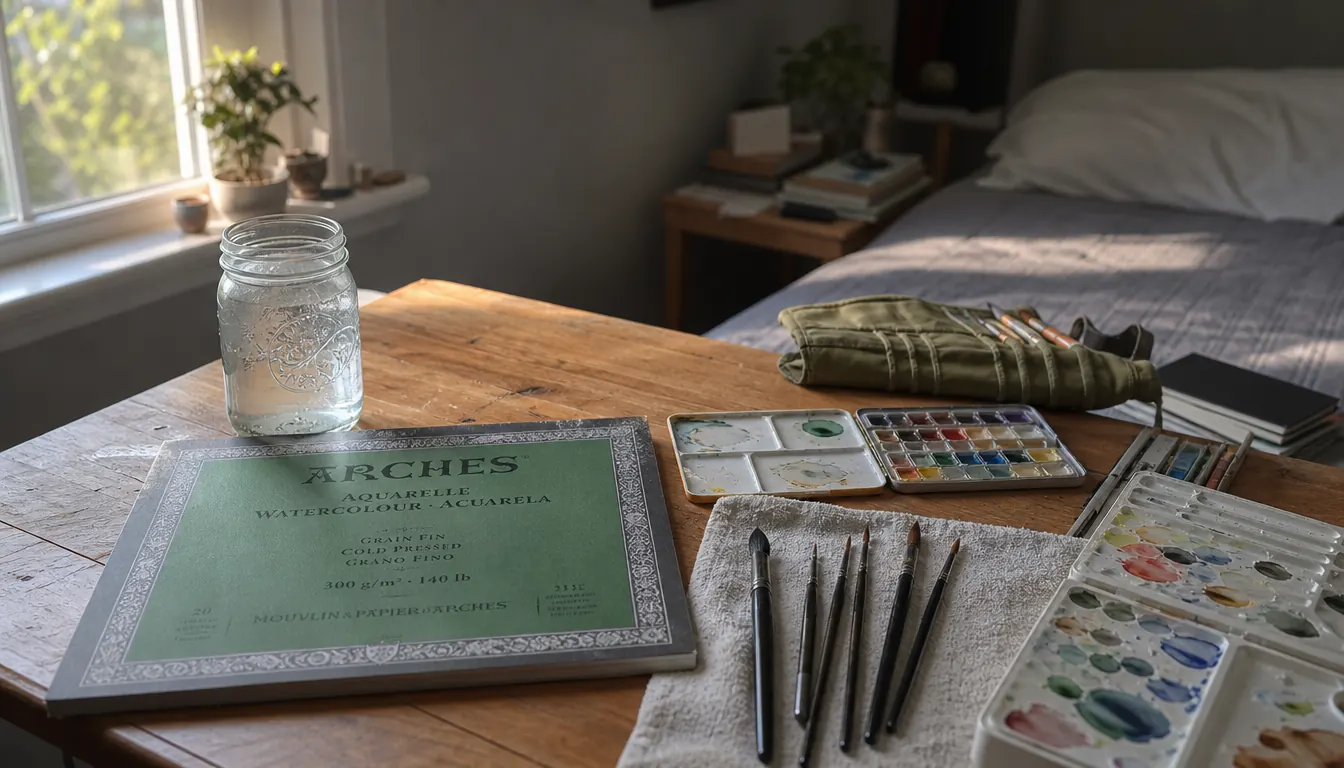
Short answer: for a set that can carry a sky wash across a half sheet and still come to a point for a stem, I reach for the TRANSON 8 piece round goat hair set. I have painted with it for about 18 months, most mornings for two hours at the folding table in my spare bedroom. The larger rounds do my skies and distant trees. The smaller ones do stems, seed pods, and the edges of leaves. It is not the only round brush I own, and it will not paint for me. It is simply the set that stays on the table because it does the everyday work without fuss.
The comparison in this article is with Nicpro round sets. I should be plain about my experience. I have never owned Nicpro brushes. What I know comes from the Nicpro listings I have read and from the sets students have brought to my Thursday evening beginner class at the library. So this is a working comparison, not a lab test. I can tell you what the TRANSON set does on Arches cold press, because I have done it. I can tell you what the Nicpro sets look like in a beginner's hand, because I have watched that. I cannot tell you how a Nicpro brush will hold up after 18 months of daily use, because I have not put one through that.
| TRANSON 8 piece | Nicpro round set | |
|---|---|---|
| What is in the set | 8 round brushes, sizes #1, #4, #5, #8, #10, #12, #14, #16 | Varies by Nicpro listing; check the size run before you buy |
| Bristle | Goat hair, round pointed | The Nicpro rounds I have handled in class were synthetic |
| Water holding | Large belly holds water for long washes | Synthetic hair releases water faster |
| Snap for fine detail | Soft hair, gentle point | Springy synthetic tip holds a crisp line |
| Handle | Gourd handle with balanced weight | Standard round handle on the class sets |
| Size range | One brush in each size from #1 to #16 | Varies by listing |
| Care | Rinse, reshape, dry flat; tip can kink if left standing | Tolerates rougher handling |
| Best for | Washes, skies, wet-in-wet, soft edges | Tight detail, small studies, dry brush |
| Durability after 18 months | My set still points after 18 months of daily use | I cannot say from long use; students' sets are newer |
Where TRANSON Wins
The first advantage is water. Goat hair holds a reserve. When I load the #14 or #16 and pull a long horizontal stroke, the wash stays wet long enough that I can drop in a second color and get a soft edge instead of a hard line. That is what lets me paint a sky in one pass on a humid morning. A synthetic brush can do a sky, but I find myself reloading more often, and every reload is a chance to make a seam. The bellies on these rounds are generous. The listing calls them large bellies, and that matches what I feel. They carry pigment and water together, so I am not chasing the brush with a spray bottle.
The second advantage is the point. A brush that holds water but will not come to a point is a mop, not a round. The TRANSON set, rinsed and reshaped, comes back to a point. The #8 is the one I use most for garden flowers. I can load it, touch the paper, and get a soft round petal, then turn it and draw a thin stem without changing brushes. The gourd handle has a balanced weight that sits back in my hand. I have arthritis in my thumb, and a thin straight handle makes me grip harder than I should. This handle does not. That is a small thing until you paint for two hours.

Where Nicpro Wins
Nicpro wins on snap. The synthetic rounds I have handled have a spring that goat hair does not. For a beginner who is trying to paint a two inch stem or the antennae on a butterfly, that spring gives control. The brush comes back to straight almost on its own. My goat hair rounds are softer. They will point, but they do not snap. When a student is fighting a fine line, I sometimes hand them a synthetic round from the class jar before I hand them one of mine. That is not a knock on TRANSON. It is a different hair for a different job.
Nicpro also wins on care and on forgiveness. Synthetic hair tolerates rougher handling. If a student leaves a Nicpro brush tip down in the water jar for an hour, it usually comes back. If I leave a goat hair brush tip down, the tip can kink and the point is never quite the same. I rinse my TRANSON brushes after every session, reshape the tip with my fingers, and lay them flat to dry. I do not leave them standing in the jar. That is not a hardship, but it is a habit. A synthetic set asks less of you.
Goat hair holds a pond of water and still comes to a point. Synthetic hair snaps back. Most painters need both, just not at the same moment.
How I Compared Them
I did not set up a test board or a stopwatch. I compared them the way I actually paint. I put a 7 x 10 Arches cold press block on the table, filled a jar with plain water, and squeezed out the same three colors I use most mornings: ultramarine, burnt sienna, and a green I mix from Prussian blue and lemon yellow. I painted the same small study twice, once with the TRANSON #10 and once with a student's Nicpro round of a similar size. Then I did it again on a second sheet. I was looking for four things: how long the wash stayed workable, how the brush released water at the end of a stroke, whether the point held, and how the brush felt in my hand after 20 minutes.
The wash test matters more to me than any spec sheet. A round brush can hold water and still dump it all at once. The TRANSON brush releases gradually. I can touch the paper, make a stroke, and lift without a puddle. The Nicpro synthetic releases faster at the start and then runs dry sooner. That is not a flaw. For a small shape, a fast release is useful. For a big wash, it means more reloading. On a humid morning in Maryland, the difference is smaller. In January, when the air is dry and the heat is on, the difference is larger. My studio has a north window and a radiator, and the paper dries from the edges first.
The point test was closer. Both brushes came to a point after a rinse. The Nicpro point felt stiffer and more predictable. The TRANSON point felt softer and had a little more give. When I painted a thin line with the #4, the TRANSON line had a slight variation in width. I liked that for stems. A beginner might not. A beginner might want the line to be the same every time, and the Nicpro will do that more easily. That is the honest trade. Soft hair gives you expression and asks for a steadier hand. Stiff hair gives you control and can make a line look a little mechanical.

What the Paint Does on the Paper
With the TRANSON rounds, my wet-in-wet edges stay open longer. I can drop burnt sienna into a damp ultramarine wash and get a soft bloom instead of a hard cauliflower. That is the behavior I want in a sky. The brush also lifts color well when it is barely damp. I use that for clouds and for the pale line of a distant hill. The goat hair does not scrub the paper. It releases what it holds and leaves the surface alone. On Arches, that matters. A stiffer brush can rough up the sizing if you work an area too long.
The Nicpro synthetic rounds are better for dry brush and for small, crisp shapes. The spring lets me flick a dry edge on a leaf or a blade of grass. The TRANSON can do that too, but I have to load it less and let it dry a little first. If I try to flick with a wet goat hair brush, I get a soft mark, not a crisp one. That is not a defect. It is the nature of the hair. I keep one synthetic round in my kit for those marks. The rest of the time, the TRANSON set does the work. I have not found a reason to replace it.
One more thing about sizing. The TRANSON set runs from #1 to #16, one brush of each size. That sounds like a small detail until you are painting a half sheet and you need a brush that is not too big and not too small. I use the #16 for the first wet layer, the #12 for the middle values, the #8 for most shapes, and the #4 for the fine work. The #1 is almost a detail brush. It is useful for the center of a flower or the eye of a bird. The Nicpro sets I have seen in class often have a different size run. Check the listing. Do not assume the numbers mean the same thing across brands.
What I Tell My Thursday Class
Most beginners in my Thursday class think they need more brushes. They do not. They need one round that holds water and one small round for detail. The TRANSON set gives them both, plus sizes in between, and that is enough to paint a small landscape. The mistake I see is not the brush. It is the paper. A beginner will buy a good brush and paint on a pad that pills after two strokes. The brush gets blamed. I would rather see a student put money into a 7 x 10 Arches block and use a modest brush than the other way around.
The second thing I tell them is to stop pressing. A round brush does the work with the tip and the belly, not with pressure. If you lean on a goat hair brush, it will splay and the point will go. If you lean on a synthetic brush, it will spring back, but the line will still be heavy. Light pressure, a loaded brush, and a damp paper will give you a better edge than a stiff brush and a dry paper. That is true with TRANSON and it is true with Nicpro. The brush is a tool. The water is the medium.
If your washes keep drying before you finish them, start with the TRANSON rounds
The 8 piece set gives you #1 through #16, goat hair, and a point that comes back after a rinse. I use the large rounds for skies and the small ones for stems. See the current listing on Amazon.
Amazon See the TRANSON set on Amazon →Who Should Buy Which
Buy the TRANSON set if you paint watercolor at a table, you like a brush that holds water, and you are willing to rinse and reshape it after each session. It is a good fit for an adult hobby painter who does skies, landscapes, garden flowers, and loose studies. It is also a good fit for a beginner who wants to learn what a soft round feels like. The set gives you enough sizes to find the one you reach for. It is not the set I would hand to a child who leaves brushes standing in the jar.
Buy the Nicpro set if you want a springy synthetic round for tight detail, mixed media, or a class supply bin where brushes get rough handling. It is also a sensible choice if you already have soft rounds and you want a firmer brush for crisp edges. I would not tell a student to avoid Nicpro. I would tell them to read the listing and know what hair they are buying. The brand sells more than one kind of brush. The set a student brings to class may not be the set you are looking at online.
The honest answer for many painters is one of each. A soft goat hair round and a springy synthetic round do different jobs. I keep the TRANSON set on the table and one synthetic round in the jar. If I had to choose only one, I would choose the TRANSON set, because most of my painting is washes and soft edges. If most of your painting is small and tight, choose the other. That is not a cop out. It is how brushes work.
The set I would put on your table first
Eight goat hair rounds, sizes #1 through #16, for skies, flowers, and the stems between them. Rinse, reshape, dry flat, and it comes back to a point. See the current listing on Amazon.
Amazon See the TRANSON set on Amazon →