

The Transon round set came into my house eighteen months ago because I had finally lost patience with a cheap nylon set whose points had curled like old brooms. Eight rounds, sizes 1 through 16, in a plastic roll. I figured I would use the 8 and the 12 and let the rest live in a jar with the pencils. That is not how it went. Within a month I was reaching for five of them in a single morning, and the two smallest had earned a place in the little cup by my water dish.
I paint most mornings, about two hours, at a folding table in the spare bedroom I turned into a studio. The window faces north, which gives me flat light and no moving shadows crawling across the paper while I work. My everyday paint is a Winsor & Newton Cotman 45 half pan set I have used for about three years, and I paint on an Arches cold press block, 7 by 10, 140 lb. That is the setup these brushes have lived in for a year and a half. Same paper, same paint, same window. It is the only way I know to tell whether a brush is doing its job or whether I am simply having a good morning. When a wash goes wrong, I want to know it was me and not the tool, and after eighteen months I can usually tell the difference.
The Quick Verdict
Goat hair rounds with real bellies that carry water across the sheet and come back to a point after a rinse. The two smallest sizes go soft first, and the set gives you rounds only.
Amazon Check Today's Price →The five rounds I reach for before I even sit down
Sizes 8, 10, 12, 14 and 16 do nearly all of my washes, skies and stems. Eight brushes in one roll, and today's price on Amazon is usually kinder than buying rounds one at a time.
Amazon Check today's price on Amazon →How I've Used It
Every session ends the same way. I rinse each brush in cool water, work the pigment out of the belly with my fingers, reshape the point by rolling it against my palm, and lay it flat on a towel to dry. No standing them up wet in the jar. I did that with my first set twenty two years ago and I flattened the points inside a year. These have been treated properly since the day they arrived. Eighteen months of morning sessions, plus a Thursday evening class most weeks, and the 12 still comes back to a point when I roll it.
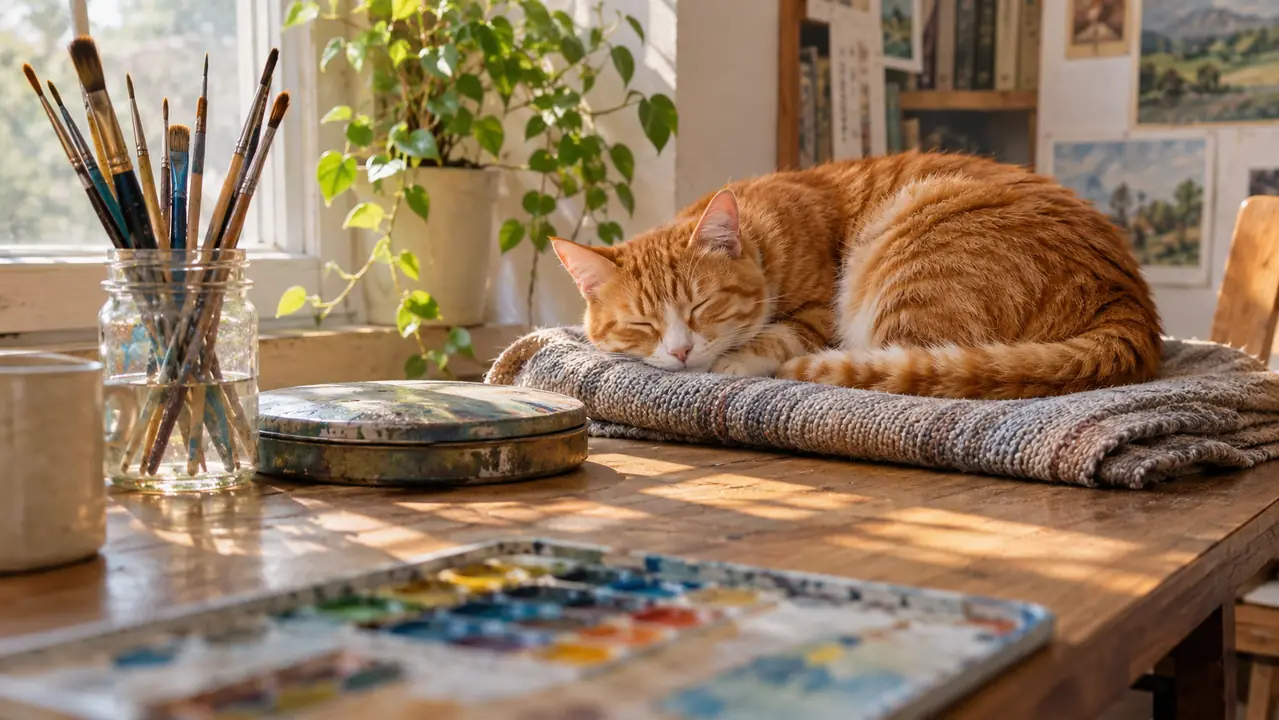
There is a cat in this story. My orange tabby likes the warm end of the table, and about a year ago he walked through an open palette and tracked ultramarine across a finished painting. These brushes survive that kind of morning because they clean up fast. A rinse, a wipe on the towel, and the belly is clear enough to load a new color. That matters more than people think. A brush that holds onto a color after a rinse makes you get up and change the water, and getting up is how a two hour session turns into forty minutes.
Thursday nights I teach a beginner class of about six adults at the library branch. I bring my own brushes and let people try them, which is the fastest way to explain what a round actually does. The mistake I see over and over is loading the brush like a mop and then scrubbing the paper. A round with a full belly does not need to be pushed. You touch the tip down, let the water move, and the stroke goes where the water goes. Once a student feels that, the whole idea of a wash changes for them.
When I want to know whether a brush is worth keeping, I do three things. I load it and drag a long line to see where the water runs out. I press it down to see how wide the belly opens. Then I rinse it, reshape it, and see whether the point returns without me fighting it. The Transon rounds pass the first two easily and pass the third most days. The exceptions are the 1 and the 4, which I will get to.
Load it, drag a long line across the paper, and the water runs out exactly where I want it to run out. That is most of what I ask from a round brush.

What Goat Hair Actually Does on Wet Paper
Goat hair is softer than the nylon I painted with for years, and it behaves differently in a way that shows up on wet paper. A synthetic round snaps back to shape and dumps its water fast. Goat hair loads slower, holds more, and lets it go gradually. On a damp sheet, that gradual release is the difference between a wash that stays workable long enough to blend an edge and a wash that sets before you get there. I noticed it first on skies. With nylon I was mixing two puddles and racing the paper. With these I can lay a band, tilt the block, and still have time to soften the bottom edge.
The large bellies are the reason. A round that carries a real reserve of water and pigment will pull a stroke across a good part of a 7 by 10 sheet without reloading. That is not a small thing when you are trying to keep a wash even. Every time you stop to reload, you risk a darker patch where the brush lands back down. Fewer reloads means fewer of those patches. I still get them. I got one last week in the upper left of a marsh painting and had to lift it while it was still damp, which worked, mostly.
Where these changed my habits is wet in wet work. A loaded 14 laid into a damp sky and pushed gently will drop pigment and leave a soft bloom exactly where the water is wettest, and I can steer that bloom a little by where I place the tip. With a stiffer brush the same move gives me a hard edge I did not ask for. Backruns are still backruns and they still go where they want. But I cause fewer of them now, because I am not fighting the brush to keep the paper damp.
Goat hair is also gentler on the paper than nylon. I paint on cold press, and heavy scrubbing raises the fibres and leaves a fuzzy patch that never takes paint the same way again. The softness of these brushes means I scrub less, because I do not have to. Lifting color is a different matter. If you press hard to lift, the soft hair bends instead of biting, and less pigment comes off the sheet. I keep one stiffer brush aside for lifting and use these for everything else.
The Sizes, and What Each One Is Good For
The set is sizes 1, 4, 5, 8, 10, 12, 14 and 16. That spread covers more ground than I expected. The 1 and the 4 do stems, the centers of small flowers, the thin dark line under a fence rail, and, in my house, the whiskers on a cat who insists on sitting where the light is best. The 5 is my signing brush and my small shape brush, the one I use for everything between the sizes. The 8 is the workhorse. If I could only keep one, it would be the 8, because it handles a small wash and a medium detail without complaint.
The 10 and the 12 handle foliage, tree masses and medium washes. The 14 and the 16 are my sky brushes. The 16 will load enough to lay a band across the full width of a 7 by 10 block in three or four strokes, which keeps a graded wash moving in one direction. That is the whole trick with a sky, keep it going. If you have to stop and reload, you can see it later. I keep a small notebook of what each brush did on which painting, and the 16 shows up in nearly all of them.
Eighteen Months Later: How They've Held Up
Nothing has fallen apart. No loose handles, no shedding after the first couple of weeks. Goat hair can shed a little at the start and these did, three or four hairs across the first few paintings, then nothing. The handles have a gourd shape that widens and then narrows, finished in a metallic champagne tone, and the weight sits back toward my hand rather than out at the tip. I notice that most on the 14 and the 16, where a tip heavy brush would have my wrist tired halfway through a wash.
The points on the middle and large sizes come back after every rinse. The 8, 10, 12 and 14 look about like they did in month two. The 5 is slightly softer than it was. The 1 and the 4 have started to bend about a third of the way up the hair, and once goat hair bends there it does not fully straighten again. They still work for short marks. They no longer hold a fine line for more than an inch or two. For what the set costs, I am not upset about it. But I want you to know before you buy.
Where They Fall Short
The smallest two sizes are the honest weak point. If your work lives in sizes 1 and 2, botanical studies or architectural detail, this set will not be your long term answer, because those two brushes soften first and fastest. The set is also rounds only. There is no flat, no filbert and no rigger, so if you want a flat wash brush or a fine liner you are buying it separately. And the hair is soft. If your habit is scrubbing and lifting hard on rough paper, these will bend where a stiffer brush would bite, and you will blame the brush for a technique problem.
One more thing, and this one is about me rather than the brush. Because the bellies hold so much water, I overwatered three paintings in the first month before I adjusted. That is not a defect. It is a brush that carries more than I was used to, and it took me a few weeks to stop treating it like nylon. If you are coming from cheap synthetics, expect a short relearning period. Load less than you think you need. You can always go back for more, and going back is easier than lifting a puddle out of a sky.
What I Liked
- Holds a real reserve of water, so washes stay workable long enough to blend an edge
- Points return after a rinse and a roll on the palm, on the 5 through 16
- Eight sizes covering fine detail through full width washes on a 7 by 10 block
- Light gourd handles with the weight back toward the hand, comfortable on the 14 and 16
- Soft hair is gentle on cold press paper, so I scrub less and raise fewer fibres
Where It Falls Short
- The 1 and 4 soften and bend first, and stop holding a fine line
- Rounds only, with no flat, filbert or rigger in the set
- Soft hair lifts pigment less effectively than a stiffer brush
- Carries more water than a nylon painter expects, so expect an adjustment period
Who This Is For
This set suits an adult hobby painter who wants one roll of rounds that covers both a wash and a detail without shopping one brush at a time. It suits the people in my Thursday class, most of whom show up with a single worn round and no idea that changing size changes what a stroke does. I tell them to start with the 8 and the 12 and leave the rest in the roll until a painting asks for something else. If you paint landscapes, garden flowers, or a cat on a windowsill, sizes 5 through 16 will carry nearly everything you do.
Who Should Skip It
Skip it if your work lives in the small sizes. Botanical painters, architectural detail, miniature work, you want a brush that holds a point in a 1 and keeps holding it, and these will not do that for long. Skip it if you want a complete set with a flat and a liner in the same roll. Skip it if you paint mostly heavy body acrylic and want a stiff brush to push texture, because these are built for water and they behave like it. And skip it if you cannot be bothered to rinse and reshape at the end of a session. Goat hair will forgive you a few times. It will not forgive you for a year.
One roll of rounds, from a fine stem to a full sky
I have painted with the Transon set most mornings for eighteen months. If your work sits between detail and wash, this covers it, and today's price on Amazon is worth a look before you buy single rounds.
Amazon Check today's price on Amazon →