
I taught middle school art for 31 years, and I have watched a great many beginners buy far more paint than they can possibly use. They order an artist grade set, a fistful of tubes, a block of the good paper, and by February the tubes have gone stiff and the box is on a shelf behind the vacuum. What nobody tells them is that the paint was rarely the thing holding the painting back.
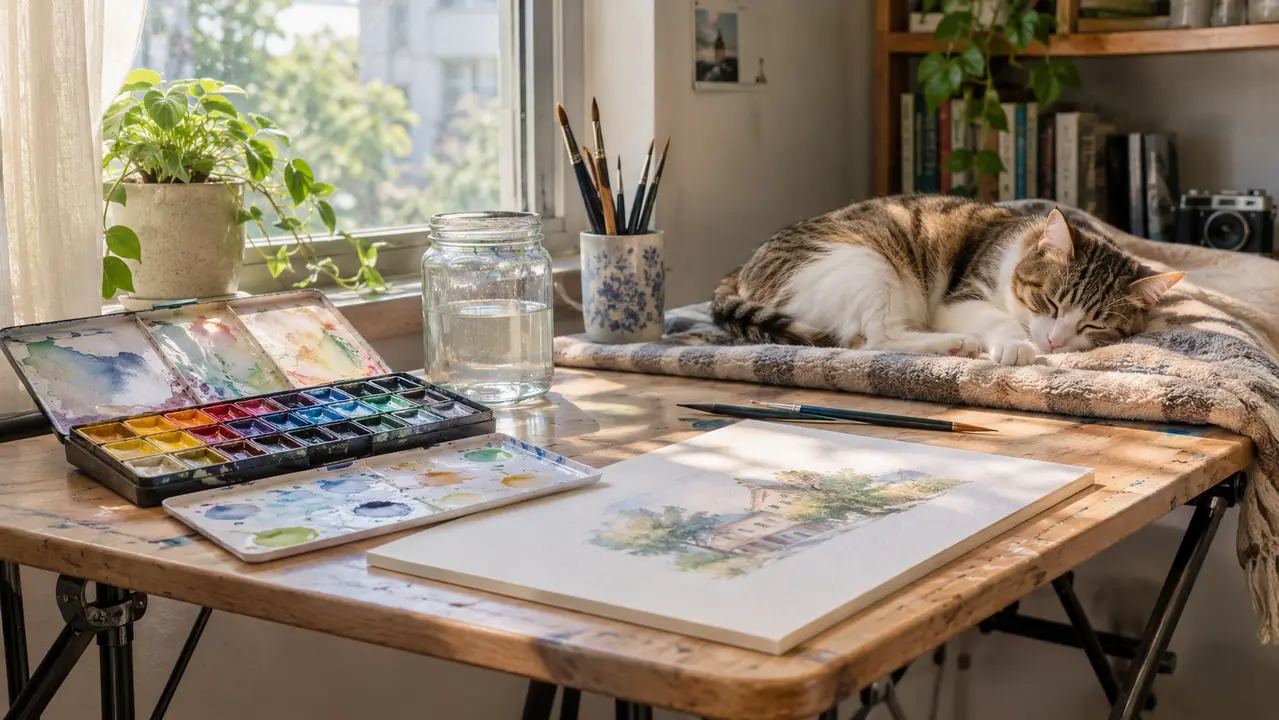
I have painted watercolor for about 22 years. For the last three, my everyday paint has been the Winsor & Newton Cotman 45 Half Pan Studio Set, sitting open on the folding table in my spare bedroom, next to a jar of water and a north window. I still keep a few older artist grade tubes for two or three colors I use constantly. But most mornings, that is the set I open. Here are ten reasons it is enough, and where I would still spend money elsewhere.
Forty-five pans, one case, three years of mornings
This is the paint on my own table and the set I hand my Thursday beginners. Good transparency, strong tinting, and a case that travels.
Amazon Check Today's Price on Amazon →Forty-five half pans ends the rationing
Twelve colors sounds like plenty until you try to mix a believable green for a Maryland summer lawn. My old 12 pan tin had run down to nothing and I was mixing across the same three blues every morning. With 45 half pans I reach for a color and it is already there, and the mixing tray in the case does the rest of the work. Half pans also mean the color sits in front of you dry, so you see it before you commit a brush to it.
A single touch of the pan carries a wash
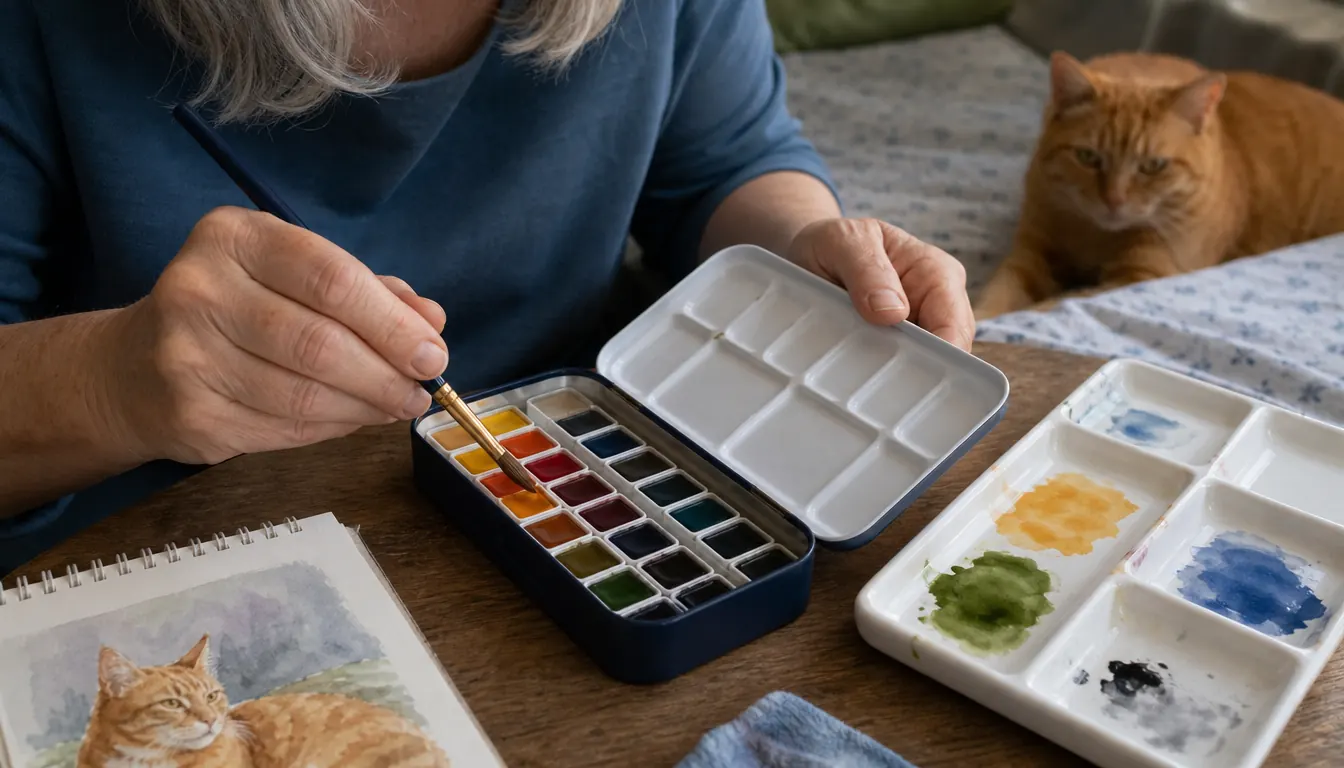
Excellent tinting strength is the phrase on the listing, and it is the thing you notice in the first five minutes. I touch a damp brush to a pan once and get color across a quarter sheet. That matters more than people expect, because it means a half pan lasts months and it means I am not scrubbing at the pan to load up, which is what wears a pan hollow inside of a year.
Good transparency keeps a glaze from going chalky
Cotman paints have good transparency, and that is what lets a second wash sit on top of a dry first wash without turning to mud. My students who come from acrylic press hard and go opaque immediately. Watercolor wants thin. Two thin layers of a transparent blue over a transparent yellow will give you a green you simply cannot mix in a well, and it will still glow when it dries.
You can see what the color dries to
A tube gives you one wet color and you find out an hour later what it becomes on the paper. Pans show you the settled, finished version every time you open the case. After three years with this set I know exactly what a given pan will do on Arches and what it will do on a cheap spiral student pad, which saves me a test swatch most mornings.
The whole setup goes to class in one hand
On Thursday evenings I teach about six adults at the library branch, and I carry the case, a water jar and a block of paper in one trip from the car. The case is compact, it holds the pans and a mixing tray, and there is nothing loose to spill on the stairs. I have hauled heavier setups up that staircase for years and I do not miss it.
Two thin layers of a transparent blue over a transparent yellow gives you a green you cannot mix in a well, and it still glows when it dries.
One mist of water wakes it up in thirty seconds
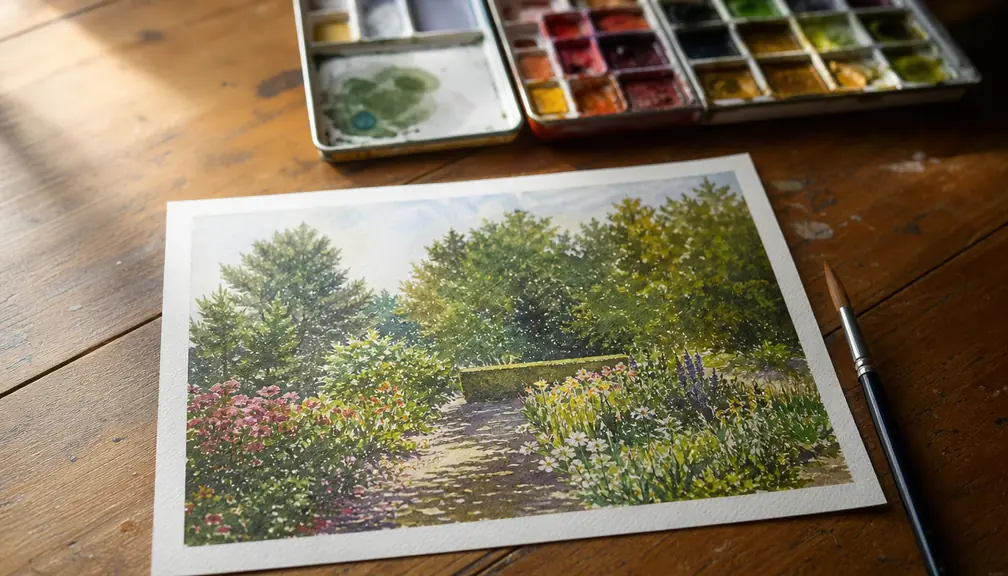
Dry pans need water before they will give you anything, and the fix is a small spray bottle and half a minute. I mist the pans I plan to use, put the kettle on, and by the time I sit down the paint has softened. Compare that to squeezing fresh tubes every session and then scraping dried paint off a metal palette. The setup is faster than most people expect.
Student grade gives you permission to waste paint
This is the part I wish someone had told me at 40. When every pan costs what an artist grade pan costs, you paint carefully, which means you paint timidly, which means your washes get small and safe. A student grade set is affordable enough to be careless with. The painters in my Thursday class who improve fastest are the ones who painted forty sloppy skies, not the ones saving the good paint for a special occasion.
It is the set I tell every beginner to buy
Every September somebody in the Thursday class asks what to start with, and I say the same thing. Buy the Winsor & Newton Cotman set and a decent block of paper, and put the rest of your budget into paper. Paint you can upgrade later. Paper you cannot rescue. I have watched people fight a bad sheet for two hours and then blame the paint for the result.
Three years on the table and nothing has gone off
My Winsor & Newton set has been open on that table almost every morning since I bought it, and no pan has cracked, gone hard or crumbled away. That surprised me. I expected to be replacing pans by now. It replaced a small 12 pan tin I had used for years, and it has outlasted what I assumed a student grade box would do in daily use. I still have not had to order a single replacement pan.
You can add artist grade later for two or three colors
I still keep older tubes for a couple of colors that appear in every painting I make, and that is the upgrade path I recommend. Paint with the set for a year or two, notice which two or three pans you empty first, and buy only those in artist grade. You end up spending a little on the colors you have actually learned instead of a lot on 45 you have not met yet.
What I'd Skip
If you are going to spend more, spend it on paper. I paint on Arches cold press blocks, 7 by 10, 140 lb, and I go through about one a month. The gap between an Arches block and a cheap spiral student pad is wider than the gap between student grade paint and artist grade paint. I say that as someone who sells neither and has simply ruined a lot of cheap sheets learning it.
The other thing I would skip is the big tube set. Tubes are for colors you use by the cup, and a beginner does not have those colors yet. I would also hold off on a second palette until you know how you actually work. I used a metal palette for about four years before I changed, and I only changed because the cat walked through an open one and tracked paint across a finished painting on the table.
Spend the extra money on paper. Paint you can upgrade later. Paper you cannot rescue.
The set I open most mornings, three years running
45 half pans in a compact case with a mixing tray, good transparency, and strong tinting that carries a wash from one touch. If you are starting out, this is where I would begin.
Amazon Check Today's Price on Amazon →