

Three years ago I replaced a twelve pan tin that had been scraped down to bare plastic with the Winsor & Newton Cotman 45 Half Pan Studio Set. I paint most mornings for about two hours at a folding table in the spare bedroom, and on Thursday evenings I teach a beginner class of six adults at the library branch here in Frederick. This case has been opened, closed, misted, dropped and wiped down more times than I could count. That is enough mileage to give you both halves of the story.
Here is the part the listing photographs cannot show you. The Cotman line is student grade paint with one very specific job: get an adult who has never held a watercolor brush to the end of a painting they are not ashamed of. Judged against that job, it does well, and I say so to every new student who asks. Judged as the only paint you will own for the next ten years, it starts to show its seams somewhere around the eighth month. Most of this review is about where those seams are.
The Quick Verdict
Forty five half pans in a compact case with a mixing tray, and the paint rewets and tints better than most student sets I have handled. The greens turn flat and similar too quickly, and the pans are small if you paint wet. I still hand it to beginners.
Amazon Check Today's Price →The set I put in front of every new student on the first Thursday
Forty five half pans, a mixing tray built into the lid, and paint that comes back to life with a mist of water after weeks of sitting shut. It is the least fussy way I know to start.
Amazon Check Today's Price on Amazon →How I've Used It
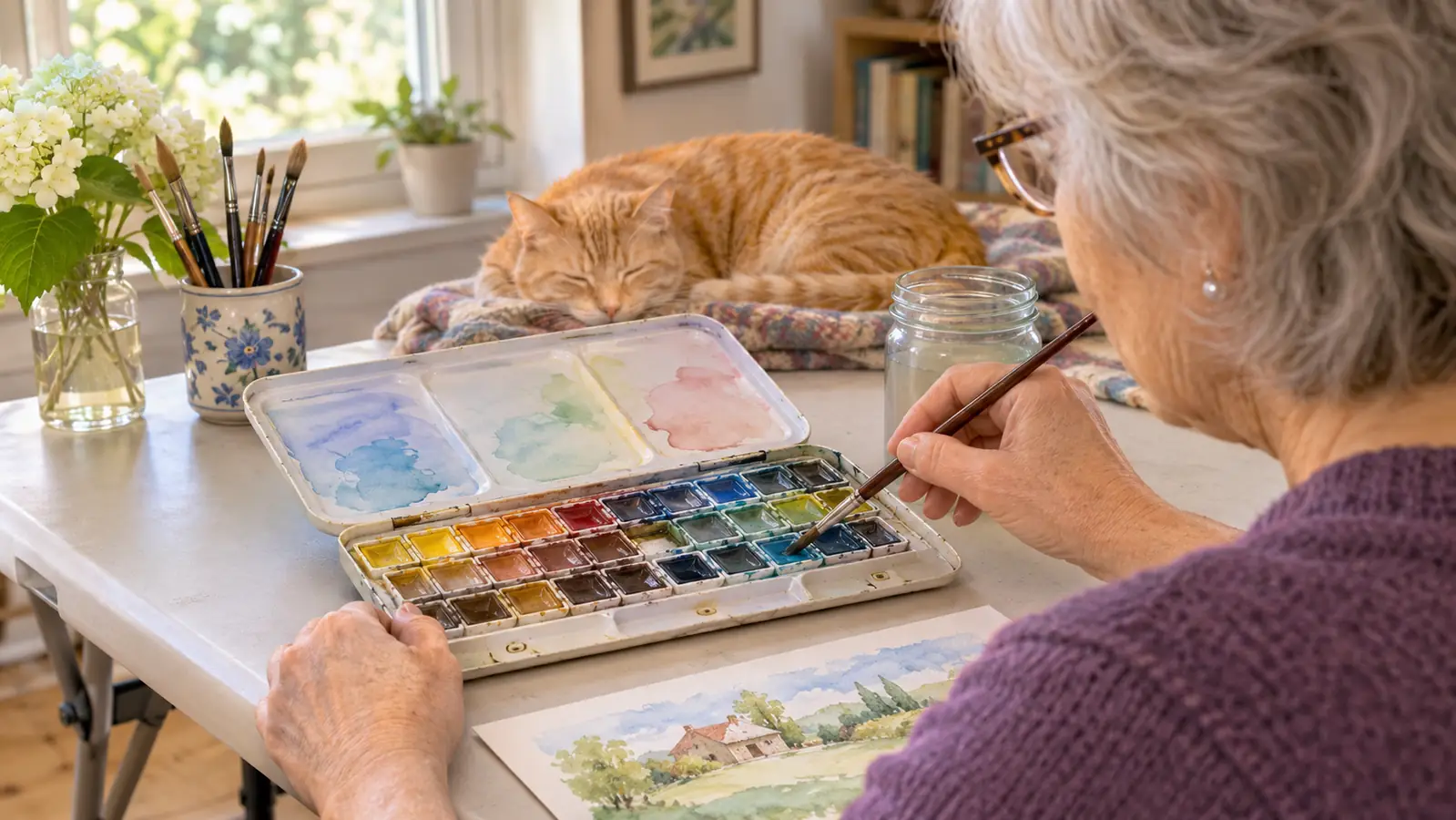
My studio is a spare bedroom with a north facing window. The light is even until about eleven in the morning and then it goes flat, so I do my real work early. I paint landscapes, garden flowers and my cat, who is an orange tabby and has walked across a wet sky more than once. The Winsor & Newton case sits open on the table for those two hours, and the lid, with its mixing tray, stays propped where I can reach it with my left hand while my right holds the brush.
The whole case is light. Winsor & Newton lists the weight at 15.52 ounces and my kitchen scale agrees closely enough that I stopped checking. It goes into a canvas tote with a block of paper and a water jar without pulling on my shoulder, which sounds like a small thing until you are sixty four and carrying your own supplies up a flight of library stairs every week.
I mist the pans before I start, wait about a minute, then load the brush. That minute matters more than any brush I own. Dry pans straight out of a cold car will give up a thin, stingy wash, and you will blame the paint when you should have blamed the temperature. I learned that one the hard way in a cold meeting room in February.
A two hour session with this set has a rhythm I have come to rely on. The first wash goes down wet and stays workable long enough that I can tilt the board and move it, which is about the only time I get a sky to do what I want. By the forty minute mark the paper has settled and I am into the middle values. The last half hour is edges and small darks. On the wall behind glass nobody has ever asked me what paint I used.
One more habit, because it saves me every week. I keep the case closed when I am not painting, and I keep it closed because the cat is twelve pounds of curiosity and the one time I left it open he tracked a blue print across a finished sky. If you have animals or small grandchildren, the lid is the feature you will appreciate most.
At class I open my own case on the demo table so students can see a set that has been used hard. Half the pans are hollowed in the middle, which is what happens when you load from the center of a pan instead of the edge. I show them how to work the edge and keep the middle intact, and their paint lasts noticeably longer for it.
What Nobody Tells You Before You Buy
Forty five colors sounds like abundance. In practice you will paint with about twelve of them and visit another eight now and then. The rest are there so the set can say forty five on the box. That is not a swindle, it is how every large set works, but you should buy it knowing that the number on the cover is not the number of colors you will actually use.
The pans are half pans, which is roughly half the paint of a full pan. A yellow or a blue that goes into every sky will thin out within a year of daily work. When a pan gets low you can top it up from a tube, and that is what I have done with two colors rather than buy another whole set. Nobody mentions that part either, that the pans refill and you are not throwing the case away when one empties.
The mixing tray is built into the case and it is shallow. For a study around seven by ten it is enough, and I have painted dozens of those. If you work larger and want three or four big pooled washes going at once, you will run out of room and end up mixing on a plate or in the lid of a jar.
One thing that surprised me is that the colors look duller in the pan than they paint. A pan that appears to be a flat brown can go down as a warm, almost rosy tone once it is wet and thin. That is normal for watercolor, but it means you should test every pan on scrap paper before you commit it to a sky. I keep a small chart in the back of my sketchbook for exactly that.
Two of my pans worked loose in the second year and rattled around under the tray. I set them back with a dot of white glue and they have stayed put. After three years of Thursdays the hinge has a looseness I can feel when I open the lid. I do not expect it to fail this year. I do not expect it to last fifteen, either.
And the part that matters most. Winsor & Newton builds this line to a lower pigment load than their artist grade paint, which is the whole point of a student range and also the thing nobody says out loud. Thin a wash down far enough and the color goes chalky instead of staying clear. You cannot fix that with technique, a better brush or heavier paper. You can only stop thinning it quite so far. I would rather you hear it from me now than discover it in month eight and decide you are the problem.
Where It Shines on the Paper
The transparency is real, and it is the reason I keep handing this set to beginners. Lay a blue wash over a yellow one and you get a clean green with light coming back up through it. A cheap set gives you a muddy one. On a landscape, that single difference is most of the painting. This is where the Winsor student range earns its keep, and no amount of clever brushwork rescues you if it is missing.
Tinting strength is the other half of it. A little paint goes a long way, so the pans last longer than their size suggests and you can reach a deep value without scrubbing at the pan as though you were trying to erase it.
It rewets beautifully. I left this case shut for five weeks in August, opened it, misted it, and had usable paint in under two minutes. That is not true of every student set. Some of them dry into little stones that refuse to give up color no matter how much water you drip on them, and you end up digging with a brush and ruining the point.
The earth colors and the blues are the strongest part of the range. If your work leans on skies, stone, tree trunks and shadows, you will be happy. Where it thins out is in the bright, clear reds and the stronger greens, which is where a landscape painter starts looking at tubes.
It also works well with the tray attached to the lid. I can go from a loaded brush to a clean puddle without reaching anywhere, and that keeps a wash moving when it needs to keep moving. Small thing, big difference inside a two hour window.
Portability is the last thing and it is underrated. Compact case, mixing tray attached, a little over fifteen ounces. I have carried it to my sister's kitchen table in Hagerstown and painted all afternoon with nothing else but paper, a brush and a jar of water.
I left this case shut for five weeks in August, opened it, misted it, and had usable paint in under two minutes.
Where It Falls Short
The greens. This is my real complaint and it has not changed in three years. Mixing greens from this set gives you a narrow family of them, all a bit similar and all a bit flat. My landscapes need a green that shifts from yellow green in the sun to a cool dusty green in the shade, and with these pans I have to fight for that. I keep two artist grade tubes on the shelf for exactly this reason, and I use them on every tree.
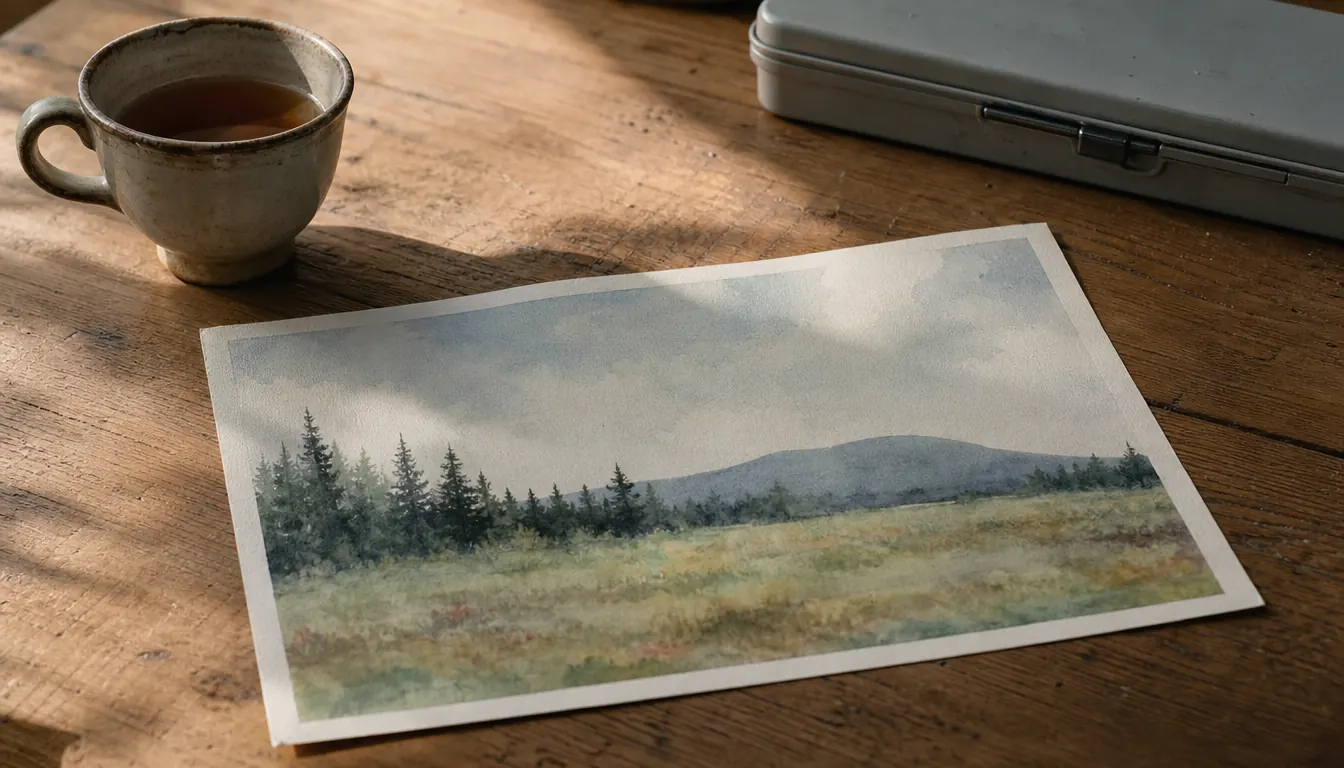
The pale tints go grey. When I want a wash so weak it is barely there, a distant treeline or a far hill, the color turns slightly dusty instead of staying clean. The same wash from an artist grade paint stays clear. This is the pigment load again, showing up where you least want it, in the quietest part of the picture.
Lifting is uneven from pan to pan. Some colors come up almost completely with a damp brush and a blotter, leaving the paper white again. Others have stained it enough that you will see a ghost no matter what you do. That inconsistency means you cannot plan a lift the way you can with paint you know well, and it took me a full year to learn which pans to trust for highlights.
A handful of the colors are near duplicates, close enough that I cannot tell them apart on the paper once they have dried. That is how a set reaches forty five without giving you forty five real choices. I am not angry about it. I would just rather you knew before you counted the pans and felt cheated.
Drying is worth knowing about too. A wash from this paint can stay tacky longer than you expect on a humid Maryland morning, and if you are impatient, as I am, you will reach for a hair dryer and blow a puddle across the sheet. Ten minutes with the window open beats three minutes of hot air. I have relearned that lesson more than once.
And the tray again, because it is the thing I bump into most. Shallow is fine for a small study and genuinely annoying for anything else. When I paint larger I lift the paper out and mix on a plate, which means the case is no longer doing the job I bought it for.
What I Liked
- Rewets from bone dry in about two minutes with a mist of water
- Good transparency, so glazes stay clean instead of turning muddy
- Strong tinting, so a small pan covers a surprising amount of paper
- Compact case with the mixing tray attached, a little over fifteen ounces
- Forty five pans give a beginner room to experiment without buying tubes
Where It Falls Short
- Student grade pigment load, so pale washes go chalky and slightly grey
- Half pans run thin within a year if you paint wet and often
- Green mixtures come out flat and very similar to one another
- The mixing tray is shallow for anything past a small study
- Lifting is inconsistent from one color to the next
Who This Is For
The adult who has decided to try watercolor at sixty and does not want to build a palette from tubes before they know whether they even like the medium. This set gives you enough color to finish a real painting in the first week, and the case means you can put it on the kitchen table, paint for an hour, and put it away before dinner.
It is also for the person who paints in short sittings. Because the paint rewets so easily, you do not lose your first ten minutes every session coaxing dry pans back to life. The hardest part of a short session is starting, and friction at the start is what kills the habit.
And it is for a class. I tell my Thursday beginners to buy this one because I can look across the table and know exactly what they are working with. When a wash goes wrong I know whether the problem is the paint, the water or the paper, and that saves us all a week of guessing.
If you are a grandparent painting with a grandchild on a rainy afternoon, this is also the set I would pull off the shelf. The lid catches the mess, the pans forgive a heavy hand, and a spilled water jar is the worst that happens.
Who Should Skip It
If you already know you love this medium and you paint four or five days a week, skip it. Put the same money toward a small set of artist grade paint. Twelve good colors will take you further than forty five student ones, your greens will behave, and your pale washes will stay clean. You will spend more per pan and less over three years.
Skip it if you work large. Past about a quarter sheet you will be queueing washes in a shallow tray, and the case stops being a convenience. A porcelain palette and a few tubes make far more sense.
And skip it if the thing you love most about watercolor is the way pigment separates and granulates on rough paper. Student grade paint is milled and blended to behave evenly, and evenness is the opposite of what you are chasing. That is not a fault in the set. It is a set doing a different job than the one you want it for.
One more. If you are buying this as a gift for someone who already paints, ask first. A painter with strong favorites will look at forty five pans and see ten they will never touch. Buy them a good block of paper instead. They will use it.
Three years in, it is still the case open on my table
Not because it is the best paint I own. Because it is the paint I reach for without thinking, and the one I can hand to a nervous beginner without a lecture. If that is the job you need done, this is the set.
Amazon Check Today's Price on Amazon →