
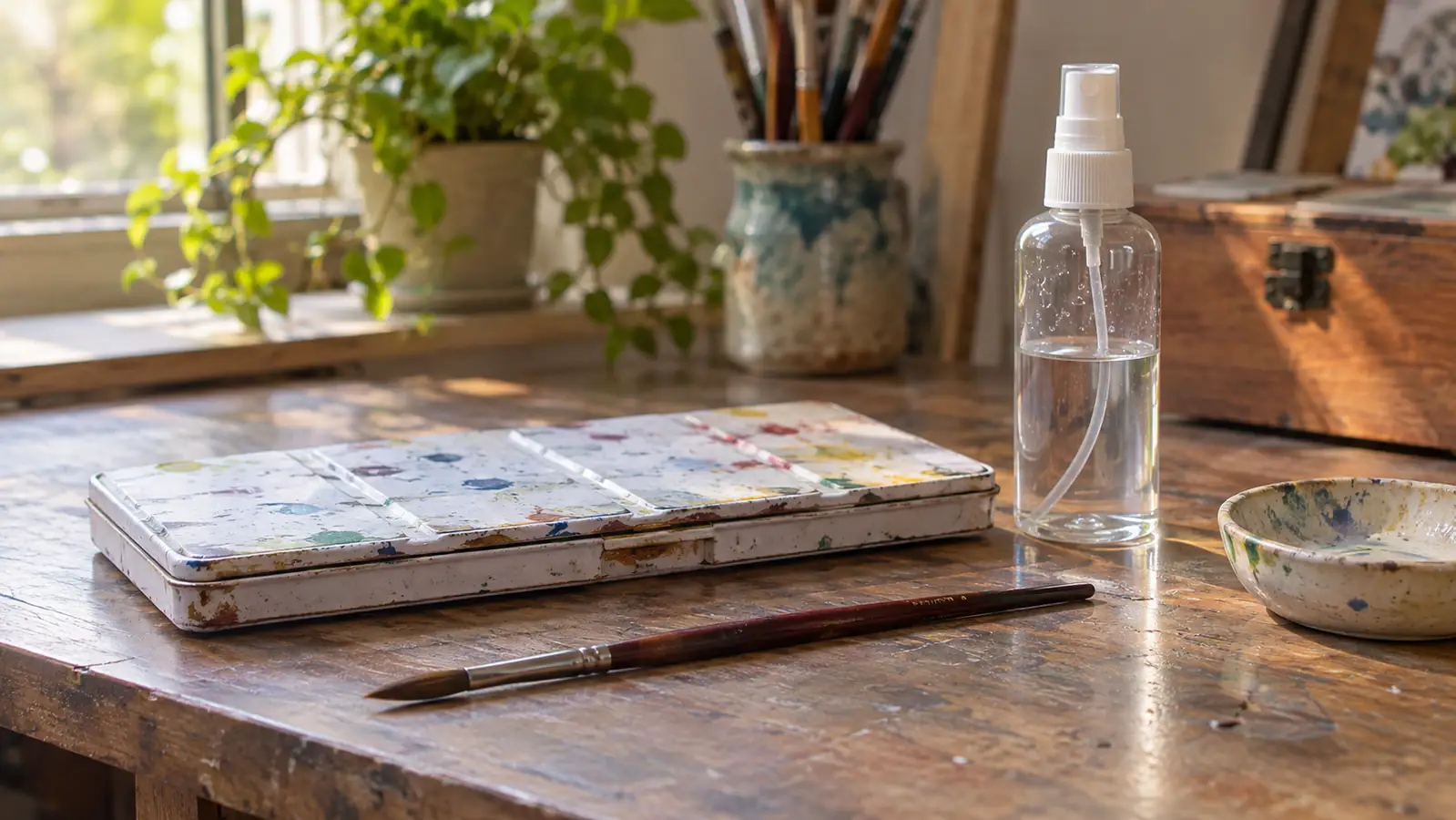
The first time I let a palette sit open overnight, I came back to eighteen little chips of paint that behaved like gravel. I wet them and they lifted in flakes instead of flowing. Nothing I did that morning could bring them back, and I ended up scraping the whole thing out with a palette knife and starting over. That was about twenty years into teaching, which is a long time to make a beginner's mistake, but there it is.
Here is what I have learned since, mostly by ruining paint. Keeping watercolor workable between sessions is not about buying a better palette. It is about three habits: how much water you put in, when you close the lid, and what you do in the first thirty seconds of the next session. A lid helps enormously. It does not do the work for you. I use the Mr. Pen airtight watercolor palette with a lid, the 18 well version, and it has changed my mornings, but only because I stopped expecting it to babysit the paint.
The palette I reach for every morning, lid shut between sessions
18 wells, two mixing areas, and a clasp that actually stays closed. It is what I squeeze tube paint into and leave on the table overnight.
Amazon Check Today's Price on Amazon →Why Watercolor Dries Out, and What Actually Slows It
Watercolor is pigment held in a gum arabic binder. When the water leaves, the gum arabic hardens and pulls the pigment into a solid. That part is not reversible in any pleasant way. You can re-wet a hardened pan and paint with it, but you will fight it. It takes longer to load the brush, the color releases unevenly, and staining pigments like phthalo blue or alizarin will not come back to the strength they had when fresh.
So the goal is not to prevent drying. Paint in a well is always drying. The goal is to slow it down enough that the paint stays soft and rewets instantly, and to keep the air around it humid rather than dry. Two things drive that: surface area exposed to air, and how fast the air moves over it. A closed lid deals with both. It traps a small pocket of humid air and stops the draft from the window or the furnace vent from pulling moisture out of the wells.
What a lid does not fix is a well full of water. If you leave standing water on top of the paint, the gum arabic starts to separate and you get a slimy film that lifts when you touch it. So the routine has two halves, and they pull in opposite directions. Enough moisture to stay soft, not enough to drown.
The Routine, Step by Step
Step 1: Fill the wells to the right level and let the paint set before you close anything
When you first squeeze tube paint into a palette, do not fill the well to the top. Put in enough to cover the bottom generously, roughly a third of the well depth, and leave it alone. I set mine on the shelf with the lid off for a full day. The surface skins over just slightly and the paint underneath stays soft. That skin is your friend. It slows further drying and it means the paint will not slide around when you close the lid or carry the palette.
If you are squeezing fresh paint into an already used palette, top off the low wells the same way and give them a few hours before you shut it. Closing a lid on paint that is still wet enough to run will smear it into the neighboring wells the first time you tilt the case. I learned that with ultramarine, which is happy to travel.
One thing worth knowing about the wells themselves: eighteen small wells sounds like a lot until you realize you can group colors. I keep blues together along one row and earths along another, which means when a well does dry out I know exactly which family needs attention. It also means I am not hunting across a crowded surface for the one green I actually want.
Step 2: Mist lightly before a session, not after
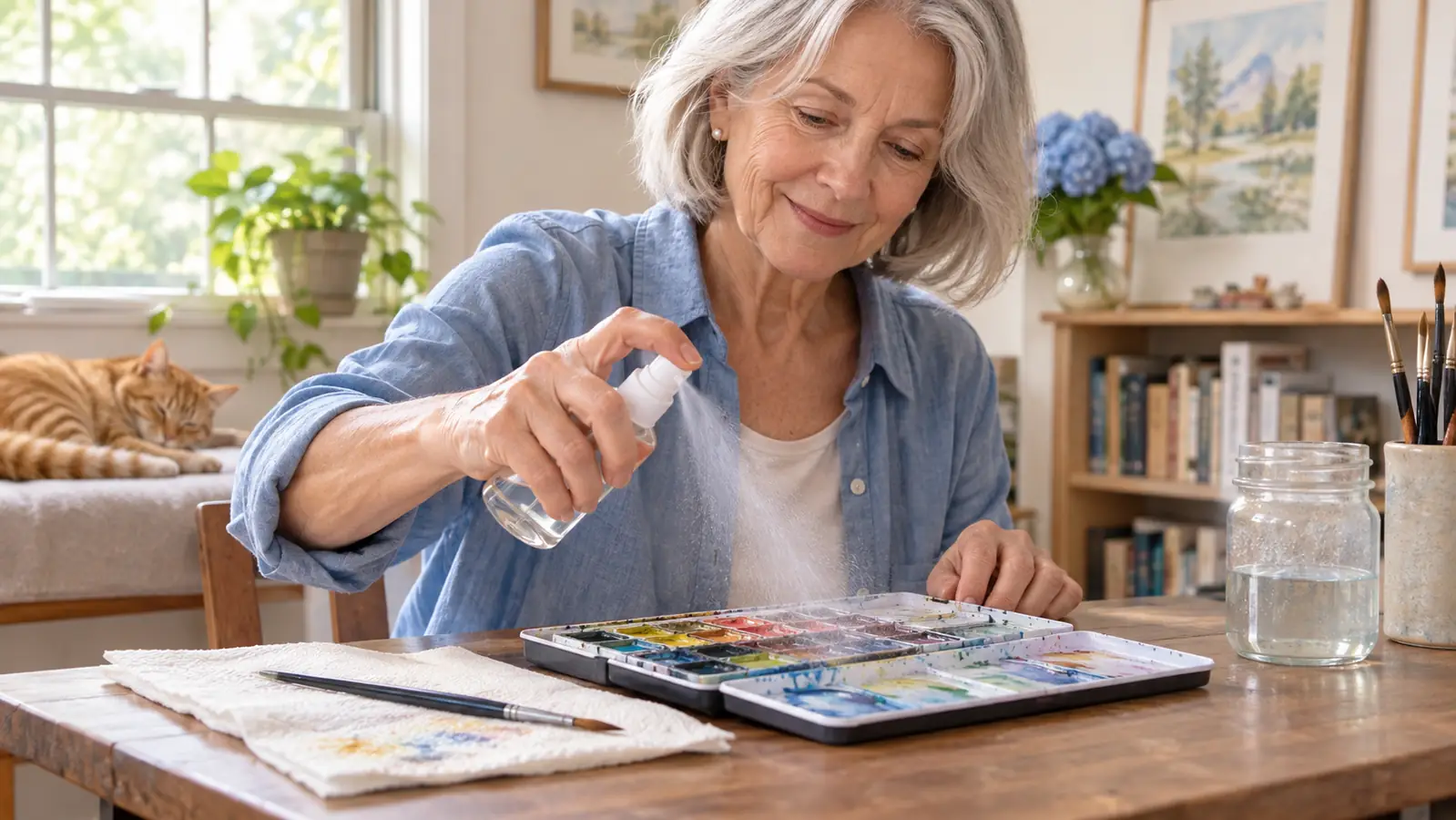
Before I paint, I give the open palette two or three passes with a fine spray bottle, holding it a good eight inches above the wells so it lands as mist rather than droplets. Then I wait about a minute or two while I set out my paper and water jar. By the time I pick up a brush, the surface of each well has gone from matte to slightly satin and the paint loads in one or two swipes.
The mistake I see most often in my Thursday evening class is misting too close and too much. A direct squirt on a well leaves a puddle, and a puddle is the beginning of a slimy well. If you do overdo it, do not close the lid. Leave it open for twenty minutes and let the excess settle, then pour off anything that will not sit on the paint.
I do not mist after a session. That was the habit that ruined my first few months with any lidded palette. Sealing a wet palette traps a lot of moisture against the paint and against the lid, and in a warm room you get condensation on the underside of the lid that drips back down. Mist before, close dry-ish, and let the trapped air do the rest.
I do not mist after a session. Mist before, close dry-ish, and let the trapped air do the rest. Sealing a wet palette is how you grow a science project.
Step 3: Wipe the rim and close the clasp every single time
The seal does not live on the lid. It lives on the rim where the lid meets the case. If there is dried paint or a smear of pigment on that rim, the lid sits proud by a fraction and the humid pocket leaks. So the last thing I do before closing up is run a damp fingertip or a corner of a paper towel around the rim of the palette, and around the inner edge of the lid.
Then I press the lid down and snap the clasp. Not set the lid on and hope. Press and snap. On the Mr. Pen there is a sturdy clasp on the front, and it takes a little push, which is exactly what you want. A lid that falls shut on its own is a lid that comes open in a tote bag.
This is the step that matters most if you have a cat. Mine is an orange tabby named Biscuit, nine years old, twelve pounds, and he likes the warm end of the table. He walked through an open palette once and tracked ultramarine blue across a nearly finished painting of the Catoctin hills. That was the week I bought this palette. Now the lid is closed the moment I stand up, and I have not lost a painting to a tail since.
Step 4: Store it flat, out of the sun, and away from heat
A lidded palette goes flat on a shelf, not on its side in a drawer. On its side, even a good seal will let moisture pool at the low end of each well, and the paint at the high end dries while the low end goes soupy. Flat keeps the water distributed where the paint is.
Keep it out of direct sun and off anything that gets warm. A window sill in August will cook a palette. So will the top of a radiator or a shelf above a stove. I keep mine on the second shelf of a bookcase in the spare bedroom, out of the light, and it stays soft for weeks at a time in that spot.
The dimensions matter here more than you would think. The Mr. Pen is about ten and a half inches by five inches by an inch deep, and it slides onto a shelf beside my paper block without taking the whole surface. I do not have a big studio. I have a folding table and a bookcase, and a palette that fits between two stacks of things is a palette I will actually put away.
Step 5: Revive a well that has dried instead of scraping it out
Some wells will dry out. That is not a failure, it is just what happens to a color you have not touched in a month. Do not reach for the palette knife. Put two or three drops of clean water on the well and walk away for ten minutes. Come back and work the surface with a damp brush in small circles. Most colors will come back to a workable paste in under a minute.
If a well has gone hard and glossy, add a drop of glycerin along with the water and give it longer, an hour or overnight with the lid shut. Glycerin holds moisture and will soften a stubborn well. I use it sparingly because too much changes how the paint handles on the paper, making it feel slightly greasy and slowing the dry time.
What you cannot fix is a well that has gone chalky and cracked all the way through. At that point the binder is gone and the pigment will not hold together. Scrape it, wash the well, and start fresh. It happens, and it is usually a color I squeezed and then ignored for six months.
What Else Helps
A few small things make the routine easier to keep. Keep a fine mist spray bottle on the table, not in a drawer. If it is in reach, you will use it. A tiny spray bottle from the travel section works better than a big plant mister because the mist is finer and you are less likely to blast a hole in a well.
Do not overfill the mixing areas. This palette has two large mixing areas and they are genuinely useful for a wash, but paint left pooled in them will dry into a film that cracks and flakes into your next wash. Mix what you need, then wipe the mixing areas with a damp cloth before you close up. I learned this from a student who could not figure out why her skies had dark specks in them.
Hand wash only, and do not soak it. A lidded plastic palette left to sit in a sink of water will let water work into the clasp and the rim, and the seal will suffer for it. Rinse, wipe, dry, done. That takes about a minute and it is the difference between a palette that lasts years and one that starts leaking humid air by spring.
I have had the Mr. Pen about a year now, opened most mornings and carried to the library on Thursdays, and the clasp is still tight and the rim still seals. I am not gentle with it. That matters more than any single feature on the listing, because a seal that gives out after two months is no seal at all.
And if you paint outdoors or carry a palette to a class, the clasp is the whole point. I have carried this one to the library branch in a tote bag, on its side, in the car, and opened it to find the paint exactly where I left it. That is a small thing until you have spent an evening scraping ultramarine out of the lining of a bag.
Eighteen wells, two mixing areas, one clasp that stays shut
If your paint keeps drying into chips between sessions, the problem is usually the air around it. Close the lid, keep it flat, mist before you paint. Start there.
Amazon Check Today's Price on Amazon →