

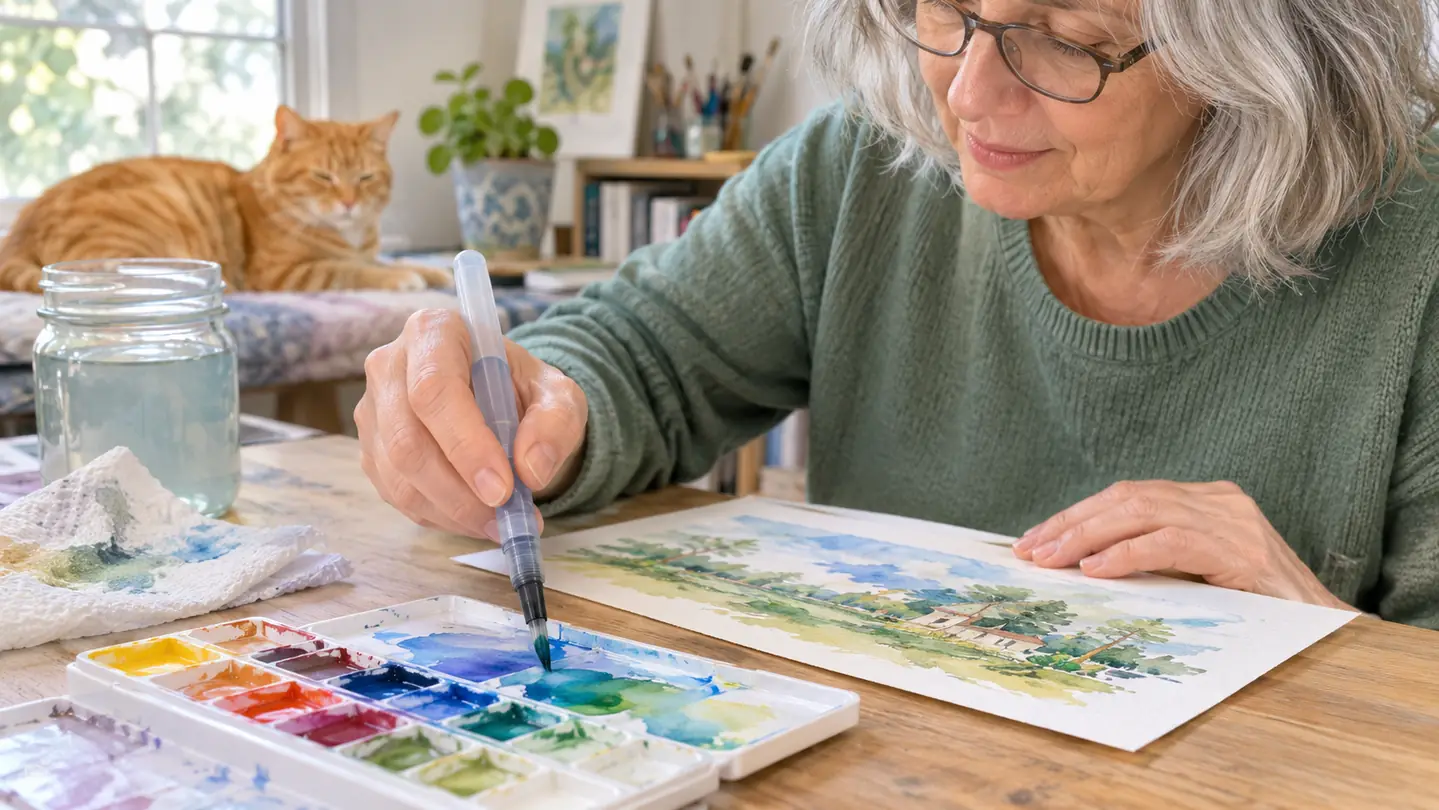
The palette I used for four years was a metal Meeden box, and I loved it right up until the morning my orange tabby walked through the open lid and carried ultramarine blue across a finished painting of the Catoctin hills. I am 64. I taught middle school art for 31 years, and now I paint most mornings at a folding table in what used to be the spare bedroom, about two hours before the light moves off the north window. Losing one painting to a cat is not a tragedy. Losing a pan of alizarin crimson because a lid never quite shut is just waste, and the waste is what finally pushed me to buy the Mr. Pen airtight watercolor palette with the 18 wells and the two mixing areas.
I have used it almost every morning for about a year now. Here is what I wanted to know before I ordered and could not find in the reviews: does the lid actually seal, or does it only look sealed? Does tube paint stay workable for a week, or does it skin over by Wednesday? And does a plastic tray feel cheap under a brush the way some of them do? Those were the three questions that mattered to me, so those are the three I answer below, along with the two things about this palette that still annoy me after twelve months.
The Quick Verdict
The lid seats and the clasp holds, and squeezed tube paint stays workable for a week or more. If your paint lives in wells rather than pans, this is the tray I would put in your hands.
Amazon Check Today's Price →The lid is the entire reason I switched palettes
Eighteen wells, two mixing areas, and a clasp that keeps the tray shut in a tote bag on the way to class. That is what ended four years of scraping dried paint out of a metal box.
Amazon Check Today's Price on Amazon →How I've Used It
My routine has not changed much in 22 years of watercolor. I squeeze tube paint into the wells, let it set overnight, and mist the tray lightly before I start. What changed is what happens when I stop. With the metal box I used to leave the lid hanging open for hours because closing it was fiddly, and by the end of a session the edges of every well had a skin on them. Now I press the lid down, flip the clasp, and walk away. It takes two seconds, which sounds like nothing until you have done the other version for four years.
The palette sits on the left of the folding table, the Arches block in the middle, a jam jar of water on the right. I load a Transon round for the sky, work down into the smaller rounds for stems and edges, and mix in the two large areas at the ends of the tray. When I finish, I wipe the mixing areas with a damp cloth, let everything dry open for about twenty minutes, then clasp it shut. That twenty minutes matters more than I expected. If I close it while the mixing areas are still beaded with water, condensation gathers on the inside of the lid and drips back down into the corner wells, and I come back to a puddle sitting on top of a color I had loaded thin. It is not damage. It is just a mess I made by being impatient, and now I set a kitchen timer and go put the kettle on.
On Thursday evenings I teach a beginner class of about six adults at the library branch, and the palette goes into a canvas tote with a sketchbook and a water brush. It has ridden in the car, sat through a rainy walk from the parking lot, and been knocked off a table once, by a student reaching for her water jar with an elbow. Nothing spilled. The tray landed lid down on the linoleum and stayed shut, and when I opened it two wells had shifted paint into each other but nothing had left the box. I want to be fair to it and note that I have never carried it loaded on its side in a backpack, which is a different kind of abuse and I would not expect any palette to enjoy it.
Does the Lid Really Seal
I tested this the way I would test it for a student who asked. On a Sunday in March I filled all 18 wells from tubes, pressed the lid down, flipped the clasp, and set the tray on the shelf next to the window. I did not touch it again until the following Monday, eight days later. No misting, no topping up, no cheating by opening it to check. Then I opened it and pressed a wet brush into three colors I had loaded heavy and three I had loaded thin.
The heavy dollops were still soft. Payne's gray, burnt sienna, and a phthalo blue all picked up on the brush the way they do on day two, and the phthalo still stained the mixing area when I swiped it. The three thin ones, a yellow ochre and two pale washes I had spread out flat, had pulled into a skin with a little shrinkage at the edges. They were usable after a few drops of water and a minute of patience, but they were not fresh. So the honest answer is that the lid buys you roughly a week of soft paint on thick dollops and maybe four or five days on thin ones, which for me is the difference between a tidy tray and a tray full of gravel. I ran the same eight day test again in July, on the shelf where the afternoon sun reaches, and again in November, and got the same result each time with a small drift: the July tray came back a shade firmer, the November one a shade softer, which I put down to the room and not to the Mr. Pen lid.
One thing worth understanding: airtight here means air stays out, not that paint stays in. When you press the lid down there is a soft change in resistance near the end, the way a lid feels when it has found its seat, and the clasp holds it there. Tip the tray on its side with a loaded well and gravity still wins. I learned that the second week, on the passenger seat of the car, and the folded paper towel I keep under the tray earned its keep that day. Now the tray rides flat on the floor behind the seat, and I have not had a repeat.
Eight days with the lid clasped, and the ultramarine was still soft enough to lift with one wet brush.
The 18 Wells and the Two Mixing Areas
The Mr. Pen tray is 10.5 inches long, 5 inches wide, and 1 inch tall, rectangular, made of plastic with a polished finish. Eighteen individual wells run in two rows, and there are two large mixing areas, one at each end. That layout is the part I have come to appreciate most, because it lets me set up the way I taught color for three decades: warm side, cool side, and a corner for the greens and neutrals I mix most often.
My arrangement has not changed in a year. Row one runs lemon yellow, cad yellow, yellow ochre, cad orange, two reds, alizarin, and a violet. Row two runs the blues and greens and finishes with the earths. When a beginner tells me their mixes go muddy, I can point at the tray and show them why: the mud comes from dipping into a well that already has three colors in it, not from the paint. Having 18 separate wells means an earth never has to share a home with a blue, and that alone cleaned up my greens. It also means I stop rationing. For years I would skip a color because there was no clean spot to put it, and half the reason a painting goes flat is that you left out the color you wanted.
The two mixing areas are generous for small work. I can lay a graded wash across half of one for a 7 by 10 sky, and I use the other end for skin tones or for the gray-green I use in tree shadows. On a good morning I can keep three separate pools going in a single mixing area before their edges start to touch, which is enough for a sky, a treeline, and the gray I use for distant hills behind them. What they will not do is hold a full-sheet wash. For anything larger than the block I paint on, I still reach for a ceramic dish. That is not a complaint, it is just what two mixing areas of this size are for.
How the Paint Behaves After a Week in the Wells
Rewetted paint is not identical to fresh paint, and I think this is the part most reviews skip. My ultramarine, once it has been sitting a week in the Mr. Pen wells and comes back with a mist, granulates more heavily than it does straight from the tube. On a rough press that is lovely and I lean into it. On a smooth wash it can look speckled when I did not intend speckle, so I stir it up with the brush and give it a moment before I commit.
The phthalo blue is the one that changes most. Rewetted, it wants to go streaky at the edge of a wash, and it lifts if I go back into it too soon. The quinacridones and the earths behave almost exactly like fresh paint. If you paint with a lot of phthalo or a lot of staining greens, plan on a slightly lighter touch on the second session. I learned that the hard way on a sky that came out with a hard line across the middle of it, which is also how I learned to test a color on scrap paper before I put it on the block. The fix took me a while to find and it is not a product fix: load the rewetted phthalo with a wetter brush than you think you need, lay it down in one pass, and then leave it completely alone until it is dry. Going back to tidy an edge is what creates the line.
For a 45 minute session, which is most of my mornings, the difference is not something I think about anymore. The paint comes back with a mist, the mixing areas are big enough for what I am doing, and I am not standing at the sink chipping dried cake out of a well. That was the whole point of buying it.
Where It Falls Short
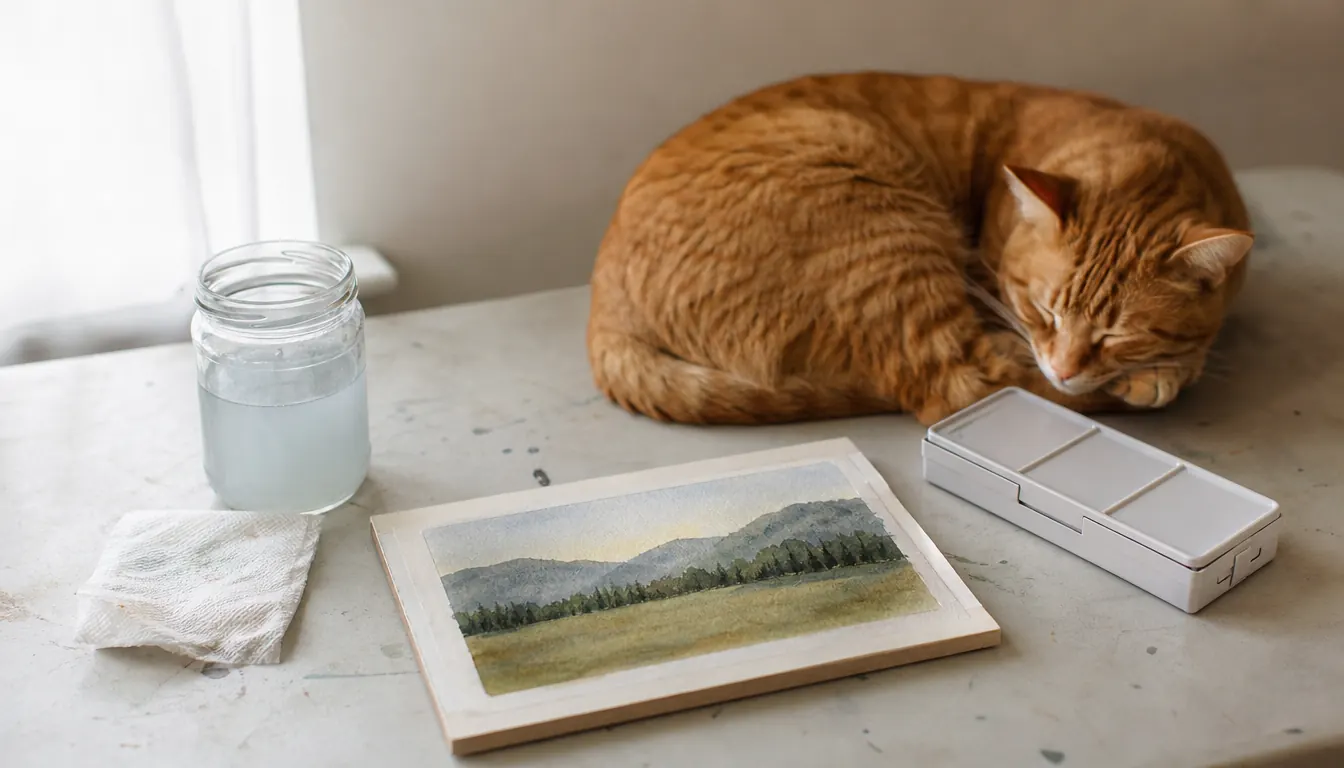
The plastic is light. That is good in a tote and less good on a table, because a loaded palette carried flat in one hand will slosh a little, and there is one clasp doing the work rather than two. I have not had it come open, and I have carried it to the library about forty Thursdays, but I carry it flat and I do not stack anything on top of it. If the clasp ever gives, I do not see a way to replace it on its own, which is the one thing I would change. The care instructions say hand wash only and no soaking, so cleanup is a wipe with a damp cloth, not a rinse under the tap. I follow that, and I would follow it whether or not the sheet said so, because a tray that lives full of paint does not need to go swimming.
The mixing areas stain. Mine have a faint blue-gray bloom in one corner from a phthalo that I left sitting for a week. It does not affect how the paint behaves, and I have stopped caring, but if a spotless tray matters to you, buy a white ceramic dish for mixing and keep this one for storage. And this is a tube paint tray. I fill the wells from tubes and I would not try to seat a half pan in one. If your paint lives in pans, this is not the tray for you, and there is nothing wrong with that.
What I Liked
- Squeezed tube paint stays workable for a week or more with the lid clasped
- 18 wells hold a full warm and cool setup with room left for greens and earths
- Two mixing areas are big enough for graded washes on a 7 by 10 block
- The clasp holds in a tote and through a knock off a table
Where It Falls Short
- Light plastic tray feels loose if you carry it loaded and flat
- Mixing areas stain over months, especially with phthalo blues
- Hand wash only and no soaking, so cleanup is a wipe and not a rinse
- Wells are for tube paint, not half pans
Who This Is For
This is for the painter who squeezes paint from tubes and paints in short sittings, an hour here, forty five minutes there, the way most of my Thursday beginners do once the novelty wears off and life gets in the way. It suits anyone who has scraped a dried well with a fingernail and decided never again. It suits a household with a cat or a curious kid, because the clasp turns a tray of wet paint into a closed box. And it suits anyone who wants a single tray that carries a whole split-primary setup to a class without needing three small boxes.
Who Should Skip It
If your paint is already in half pans, skip it, because the wells are built for squeezed tube paint. If you paint full sheets and need a mixing area the size of a dinner plate, skip it and buy a porcelain dish. If you paint standing at an easel outdoors, the metal folding palettes with a thumb through the ring still do that job better, and I say that as someone who used one for four years and still keeps it for the garden. This tray is a table tray. It is very good at being a table tray.
If the lid question was your question, the answer is yes
After a year of mornings, one cat, and a Thursday class, the Mr. Pen palette is still the tray on my table. Paint goes in soft, comes back soft, and the clasp does the rest.
Amazon See the Mr. Pen Palette on Amazon →