
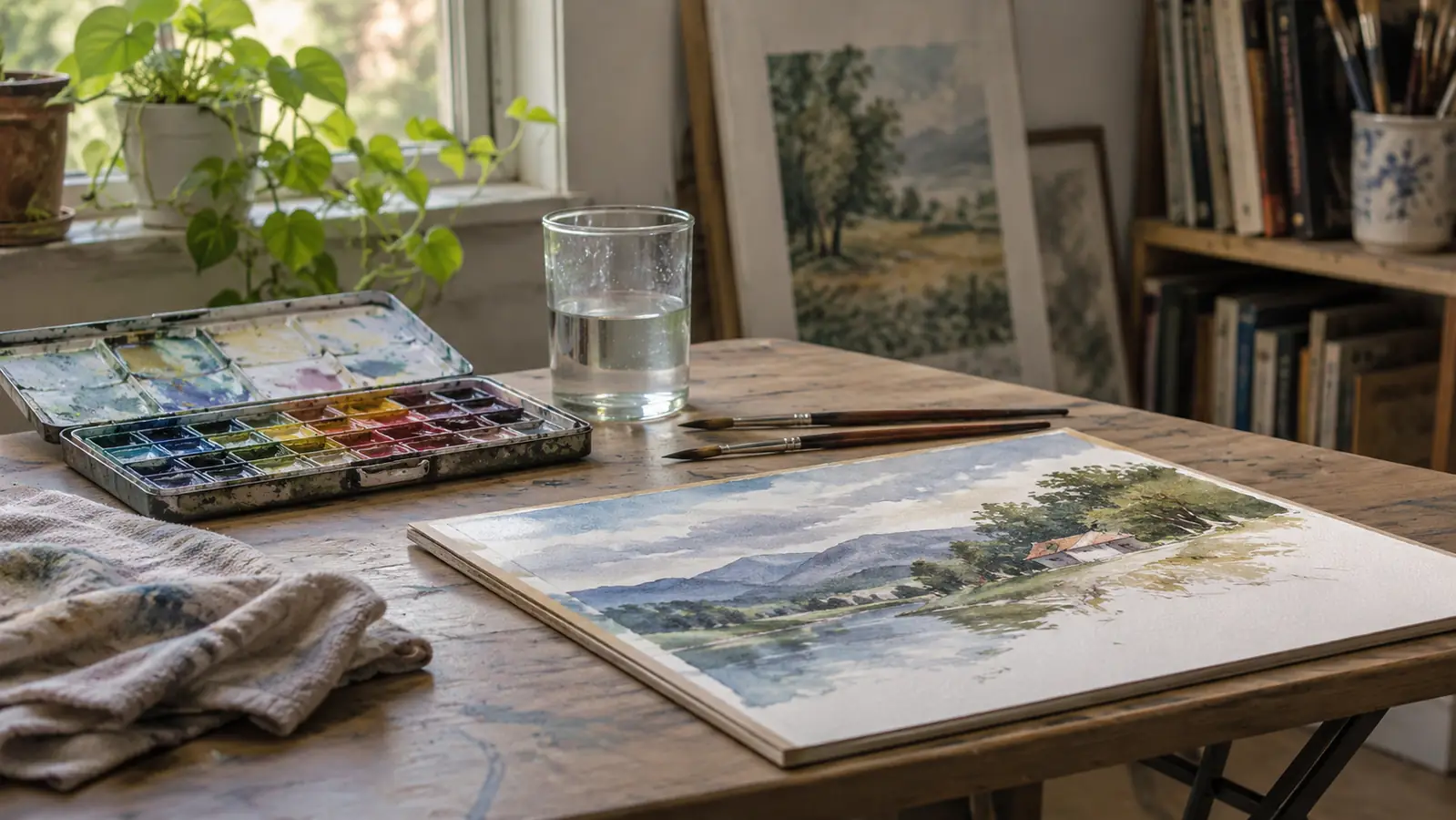
For four years my everyday palette was a metal Meeden. I liked it fine. Then Biscuit walked the length of an open palette on a Saturday afternoon and carried ultramarine from one corner of a finished painting to the other, and by Monday I had ordered a Mr. Pen airtight palette with a lid. That was about a year ago. Both palettes are still in this house. The Meeden rides in the tote I take to my Thursday class at the library branch, and the Mr. Pen sits on the folding table in my spare bedroom every morning from about seven to nine.
Short answer first, because that is what I would want. The Mr. Pen keeps paint usable between sessions, and at 64 with two hours a morning to paint, that is most of what I care about. The Meeden gives you a rigid metal panel to mix on and a body that survives being knocked off a table. If your paint comes out of tubes and your palette sits open for weeks at a time, take the Mr. Pen. If you work from half pans and want something that folds shut like a book and goes in a bag, take the Meeden. I use both, for different reasons, and I will tell you where each one annoys me.
| Mr. Pen airtight palette | Meeden metal palette | |
|---|---|---|
| Lid and seal | Airtight lid with a sturdy clasp that pulls it down evenly and keeps colors fresh | Hinged metal lid that folds back as a work surface, sits close but does not seal |
| Wells | 18 individual wells, enough for a warm and cool of each primary plus room for a color you are testing | Half pans set into a metal body, fewer places to hold paint |
| Mixing area | Two mixing areas, generous for a palette this size | The whole inside of the lid is one flat rigid metal panel |
| Weight and footprint | About 0.27 kg, 10.5 by 5 by 1 inches, slides into a shallow drawer and does not tip | Metal body with pans, heavier in the bag and thicker when closed |
| Cleaning | Hand wash only, do not soak. Plastic keeps a faint ghost of phthalo blue no matter how you wash it | Metal wipes down clean, though paint collects in the hinge and needs a soft brush |
| Durability | Plastic body, and the clasp is the part I expect to go first | Metal dents but keeps working, mine has four years on it |
| Best for | Tube paint squeezed into wells and left shut for weeks | Half pans and painting away from home |
Where Mr. Pen Wins
The lid is the whole argument, and I do not say that lightly, because a lid sounds like a small thing until you have thrown away a well of burnt sienna three Saturdays in a row. The Mr. Pen has an airtight lid and a clasp that pulls it down evenly. I squeeze tube paint into the wells, let it set overnight, and mist the surface before a session. Ten days later, a well of burnt sienna is still soft enough that a damp brush lifts color out of it. I have left it shut for most of August and lost maybe two wells to a hard skin. The same paint in the Meeden, whose hinged lid sits close but does not seal, has a leathery film on it inside of a week, and I am digging at it with a wet brush and losing a third of the well to the paper towel.
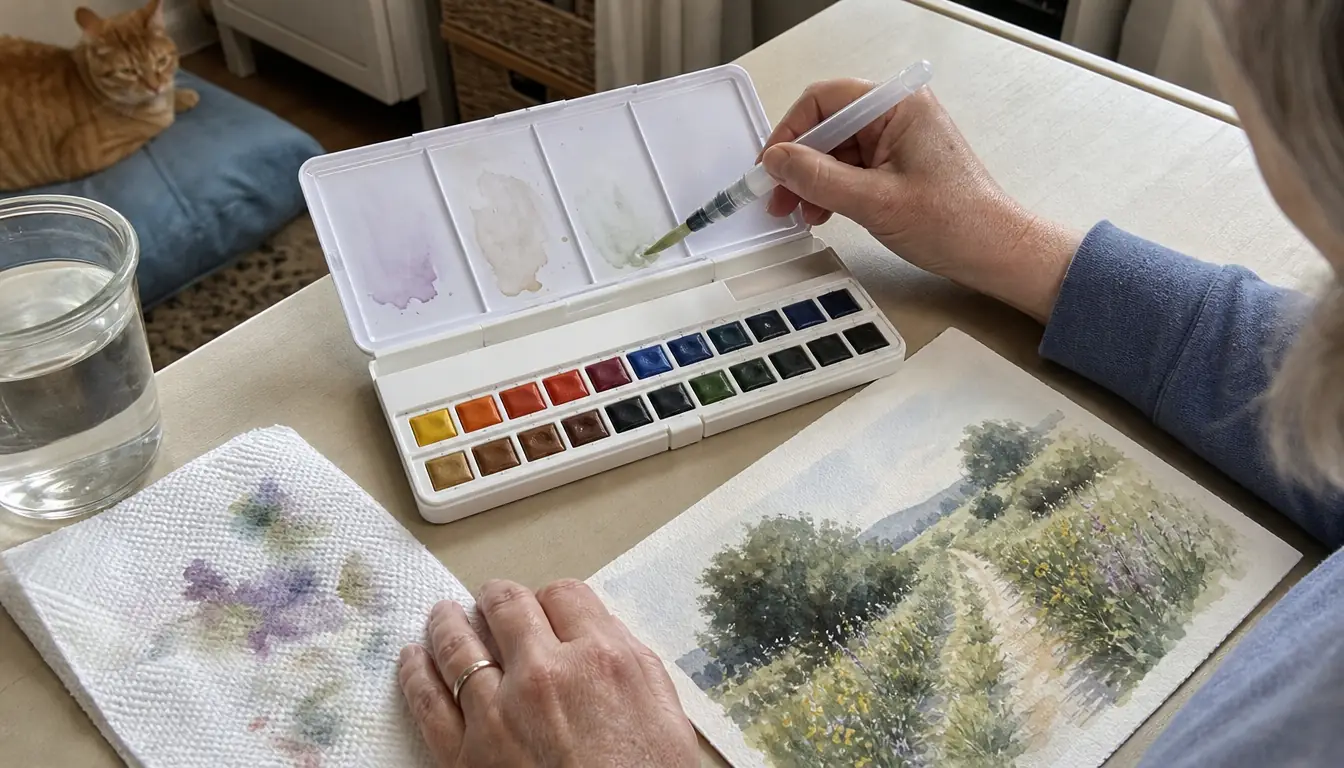
Eighteen individual wells is more than I thought I needed and now exactly what I want. I keep a warm and a cool of each primary, two earths, a couple of convenience greens I mix on purpose, and I still have empty wells for a color I am trying out or a student's question. The two mixing areas are enough for a sky wash and a foreground wash at the same time, which is all I ask of a palette this size. On the Meeden I was mixing in the lid and rinsing it between washes, and that rinse water goes somewhere. Now the mixing stays on the palette and the lid stays clean until I close it.
The footprint is the quiet advantage. The whole thing weighs about 0.27 kg and measures 10.5 by 5 by 1 inches, so it slides into the shallow drawer under my table and it does not shift when I load up one end of it. The clasp matters more than it should. I have carried this palette in a canvas tote to class with wet paint still in the wells and it has not opened on me once. My Meeden has come open inside a bag. I have washed a jacket pocket because of it.
Where Meeden Wins
The mixing surface, without question. The inside of the Meeden's lid is a flat metal panel, and a wash on flat metal behaves better than a wash in a molded well. It stays where you put it, the edge of the puddle is visible, and you can tilt the panel a few degrees to pull a gradient without the water running for a corner. In the Mr. Pen's mixing areas, water sits a little higher, more of a dome, and I have to keep the palette level or I lose the edge of the wash. That sounds fussy until you are pulling a graded sky across a 7 by 10 block, and then it is the difference between a smooth transition and a stripe.
Durability and cleaning go to the metal too. Mine has a dent in one corner from a fall off the table and it closes as well as it did the day I brought it home. The plastic on the Mr. Pen is holding up fine, but the clasp is the part I expect to fail first, and the care instruction is hand wash only, no long soaking. So I rinse, wipe, and leave it open to dry. Phthalo blue leaves a faint ghost in those wells that washing will not lift, and while that is cosmetic, I notice it every morning. The metal wipes cleaner. The trade is the hinge, which collects paint in a way that needs a soft brush and a little patience.
And I will say the thing that is not practical. The Meeden feels like an instrument. Metal in the hand, a hinge with a bit of weight to it, a body that makes a sound when you set it down. If you are the sort of painter who wants to enjoy the objects on the table, that counts for something, and I am not going to pretend it does not. I have taught long enough to know that people paint more when they like their tools.
If your paint keeps drying out between sessions, the lid is the whole answer
18 wells, two mixing areas, and a clasp that holds the lid down in a tote. The palette I reach for every single morning.
Amazon Check Today's Price on Amazon →What the Paint Does in Each One Over a Week
I tested this in a way you can repeat at your own table. On a Sunday I put the same four colors into both palettes, mixed to a thick cream: ultramarine, burnt sienna, yellow ochre, and quinacridone rose. Then I painted from them every morning for a week and wrote down what happened, which is a habit I picked up in thirty one years of teaching and never dropped. By Wednesday the Meeden's yellow ochre had a skin you could lift with a fingernail. The Mr. Pen's ochre was still creamy. By Friday the rose in the metal palette had cracked into flakes and I had to rewet it twice before it would give me anything worth putting on paper.
Granulating colors are where the difference shows up on the page, not just in the well. Ultramarine that has dried hard and been rewetted three times loses some of its depth and starts to look chalky as it dries. Ultramarine kept soft under a sealed lid still granulates the way it should, with that settled, speckled look you want in a sky or the shadow side of a stone wall. Lifting is the other half of it. If I want to lift a soft cloud out of a damp wash, I need pigment that will give. Paint that has gone to a hard cake in the well will still give you color, but it fights you the whole way, and the edge shows.
None of this makes anybody a better painter. I want to be plain about that, because a supply is a supply. What a palette can do is remove friction. If every session begins with ten minutes of rewetting and scraping and rinsing the lid, you paint less, and painting less is the one thing that actually holds a beginner back. The Mr. Pen takes that friction away. The Meeden adds a little of it back. That is the honest trade, and it is worth knowing before you spend anything.
By Wednesday the ochre in the open metal palette had a skin I could lift with a fingernail. The same paint under the sealed lid was still creamy on Friday.
Where the Meeden still wins on any given morning is the big mix. When I am laying a sky across a block, I want a lot of one color mixed at once and I want a flat surface to mix it on. The metal lid gives me that in a way the two mixing areas cannot match, because a large graded wash eats both of them. So my week looks like this. The Mr. Pen holds the paint. The Meeden, when I bring it out, mixes the big washes. If I could only keep one, I would keep the one that holds the paint, because paint I have to rescue is paint I am not using.
What I Tell My Thursday Class
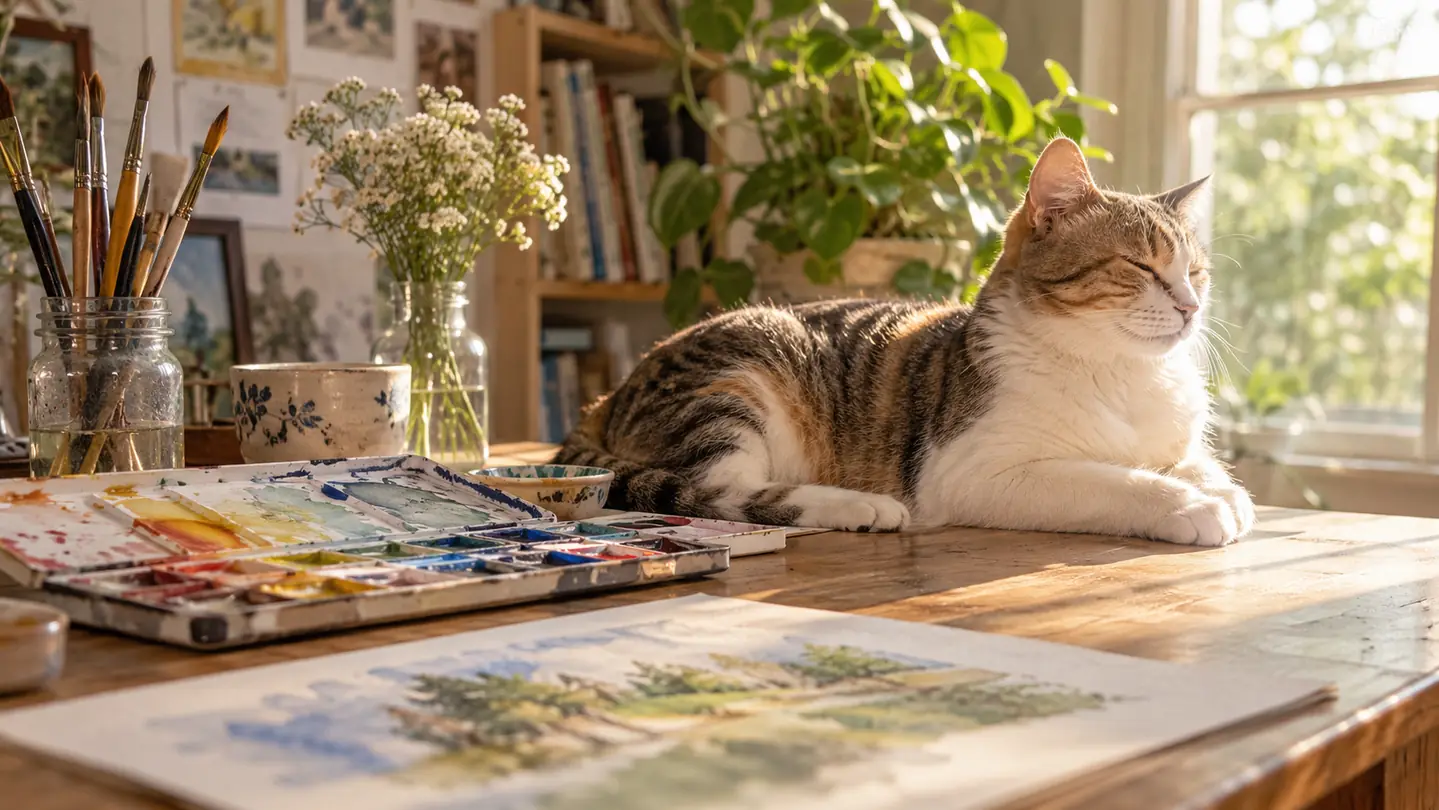
Six adults, most of them past fifty, most of them starting from nothing. I tell them to buy the Mr. Pen. Not because it is the finest palette ever made, but because a beginner leaves paint in the wells for two weeks, comes back, and finds it rock hard, and that one small disappointment is enough to make somebody stop coming. A palette that keeps paint soft removes one of the four or five reasons people quit. That is the entire recommendation. It is not about the palette making anyone good.
I also give them three habits to go with it. Squeeze tube paint into the wells and let it set overnight before the first session. Mist the surface with a spray bottle before you start, not during. Close the lid the moment you stand up, even if you think you are coming right back. And keep the palette level on the table, because a domed puddle in one of the mixing areas will tip and run if you are working at the edge of the table with your elbow on it, which is exactly where I work.
One student brought a Meeden to class because she liked the look of it, and she has been perfectly happy, because she paints from pans and closes it the instant she stops. That is the right reason to own one. The people who end up frustrated with it are the ones squeezing tubes into it and expecting the paint to behave like it does under a seal.
Who Should Buy Which
Buy the Mr. Pen if you squeeze tube paint into wells and want it soft next Saturday. If your painting table sits in a room with a cat, a dog, or a person who dusts, a lid that clasps is not a luxury, it is the difference between a palette and a mess. If you paint in short stretches, twenty minutes here and there, and you cannot spend the first ten of them rewetting, this is the one. It is also the one I would hand a beginner without a second thought.
Buy the Meeden if you work from half pans, if you paint away from home and want a metal body that folds shut, or if you mix large washes and want a flat rigid panel under them. If you like the feel of a real tool in your hand and you do not mind rewetting your pans, it will outlast you. Mine has a dent in one corner and four years of use on it, and I would happily paint from it tomorrow. What I would not do is squeeze fresh tube paint into it and walk away for a month.
The palette I reach for every morning, with the lid shut behind me
18 wells, two mixing areas, and paint that is still workable a week later. For a home painter who cannot afford to lose a session to rewetting, that is the whole case for the Mr. Pen.
Amazon Check Today's Price on Amazon →