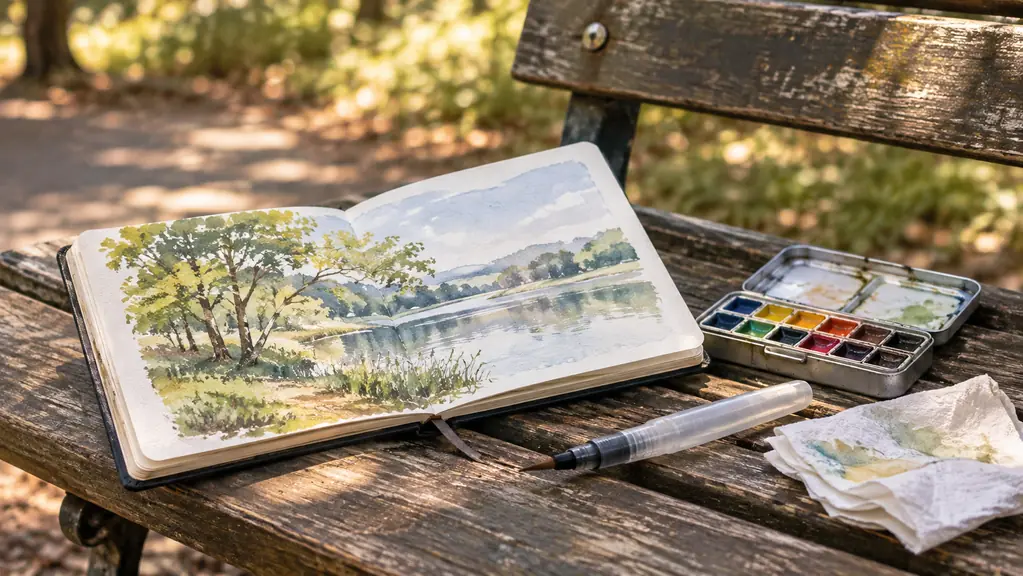
I taught middle school art for thirty-one years, and for most of that time my watercolor kit stayed in one place: a folding table in the spare bedroom, north window, everything within arm's reach. The trouble started after I retired and discovered how much waiting was built into an ordinary week. The doctor's office. The bench outside the library branch before my Thursday beginners show up. My sister's kitchen in Hagerstown while she finishes a phone call. For a while I just sat there with my hands folded. Then I started carrying a Pentel Aquash water brush in a zip pouch with a pocket sketchbook and a few half pans rattling around in an old mint tin, and those dead hours turned into the best painting practice I get.
Here is the honest version of what a water brush is, because the name makes it sound like a gadget. It is a brush with a barrel for a handle. You fill that barrel with plain water, squeeze gently, and the water comes down through the tip while you work. No cup, no jar, nothing to knock over on a train seat. The one I carry is a medium nylon tip, which is a good middle size: pointed enough for a stem or a fence post, wide enough to lay in a sky if you press and drag.
Four years, one Pentel Aquash, and no cup to spill
The medium tip is the size I would choose again. Pointed for the small things, wide enough for a wash when you press. Fill the barrel, wipe the tip, and it lives in the pouch by the door.
Amazon Check Today's Price on Amazon →Step 1: Fill the Barrel and Learn the Squeeze
Fill the barrel at the kitchen sink before you leave the house. Plain water, nothing added. Close it up and give the barrel a gentle squeeze until a bead of water shows at the tip, then drag that tip across a paper towel once to take off the excess. That wipe is the whole trick. A brush that is dripping will dump a puddle the moment it touches paper, and a puddle on a small sketch is not a happy accident. It is a flood you will spend ten minutes pretending was intentional.
The first few times you use one of these, squeeze harder than you mean to and watch what happens. Water runs down through the tip and spreads in a ring that pushes the pigment out to the edges. That ring is a bloom, and painters spend years learning to make them on purpose. On a pocket sketch you mostly do not want them, so you learn the pressure: a light pinch, not a clench. The Pentel I carry has taken four years of that pinching without the barrel cracking or the tip going soft. Nylon is forgiving that way.
Do not fill it to the very top. Leave a little air so the water has somewhere to go when you squeeze. Overfill it and every pinch delivers more than you asked for, and you will be wiping the tip on your jeans in a parking lot. I know this because I have done it in a parking lot.
Step 2: Pick Up Color and Keep the Tip Honest
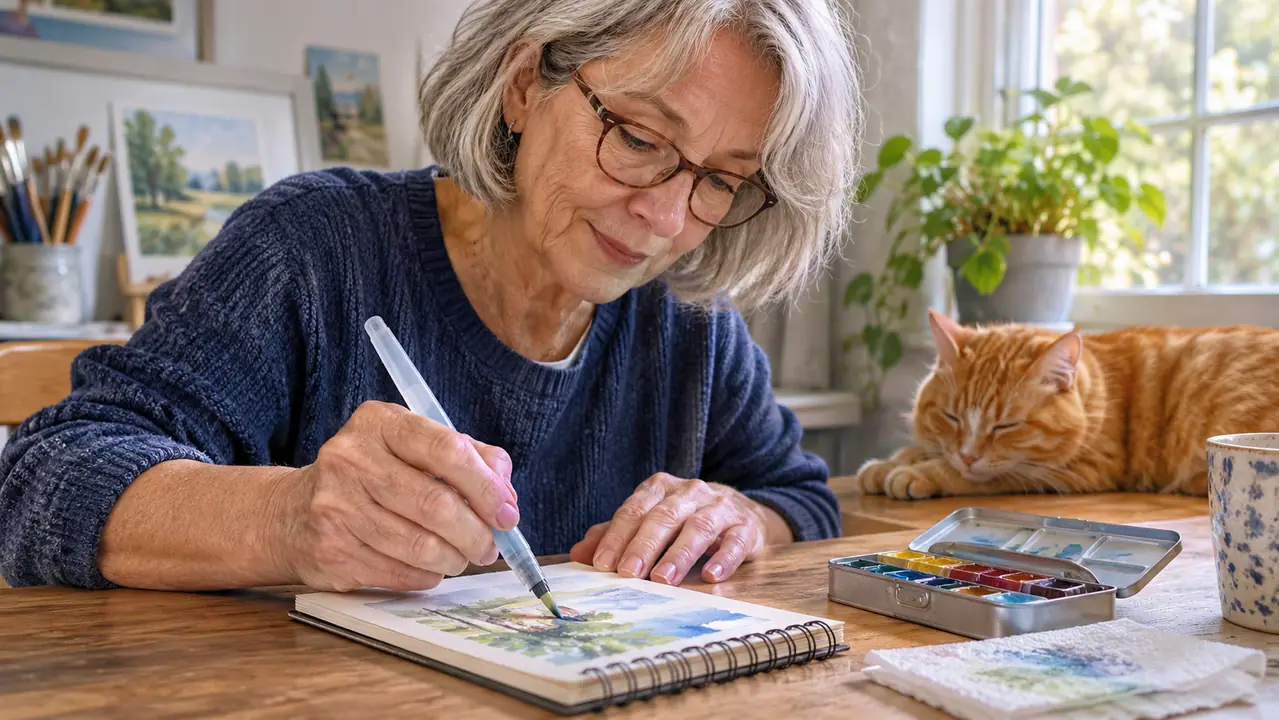
At home I paint from a Winsor and Newton Cotman 45 half pan set. On the road I carry something much smaller: six or eight half pans in an old mint tin. A couple of earth colors, a blue, a red, a yellow, one green. Touch the damp tip to the pan and swirl two or three times. That is enough to load it. Any more and you are carrying a puddle of pigment to the paper, which goes down too dark and stays too dark.
The water in the barrel dilutes as you work, so your mixes get lighter whether you want them to or not. That is the one real limitation of painting this way and it is worth saying plainly. If I need a strong dark, I dip the tip into the pan again rather than squeezing the barrel. Squeezing adds water, and water is the opposite of what a dark mix needs.
To change colors, squeeze once and wipe the tip on the paper towel until the mark runs clean. Two wipes usually does it. Skip the wipe and you get a muddy in between color for the first several strokes, which on a small sketch is a quarter of your sky. My Thursday beginners do this constantly. I did it this morning.
Step 3: Big Shapes First, Details Last
Work from the largest shape to the smallest. Sky, then the mass of trees or the side of a building, then the windows, then the fence posts. On a small page the big shapes are only a few strokes, so a wet edge can dry before you get back to it. On a dry September morning a wash stays workable for maybe forty-five seconds. On a humid July afternoon you get two minutes, and you have to be patient or you will smear what you just laid down.
This is where the water brush earns its place in the pouch. Because the water comes from the handle on demand, you can keep a wash moving without stopping to reload from a jar. The tip stays damp, so the edge you paint at the end of a stroke meets the edge you painted at the start while both are still wet. That is how you get a soft sky instead of a hard band across the middle of your paper.
What you cannot do is control how fast the paper dries. Nobody can. If the air is dry and the sun is on your bench, paint faster and simplify. A five minute sketch with three confident shapes looks better than a twenty minute one where you fought the paper and lost. I have thrown away plenty of both, and I know which ones I keep.
A wash stays workable for maybe forty-five seconds on a dry September morning. That number, not the brush, is what decides how much detail you can put in.
Step 4: Learn to Take Water Back Out
A water brush can add water and it can take water away. To dry the tip, touch it to a paper towel and drag until it stops leaving a mark. Now you have a thirsty brush. Pull that across damp paper and it lifts color, softens a hard edge, and puts a little light back into a shadow that went too dark.
Lifting is where paper matters more than the brush does. On a cheap spiral student pad, a damp brush dragged twice will start to pill the surface and leave gray bits in your wash. On the Arches cold press block I use at home, the same move lifts cleanly because the paper has size in it. If you plan to sketch away from the house, a small book of decent paper is worth more than a fourth color.
The mistake I make most often is impatience. I touch a shadow with a wet tip before the wash under it has lost its sheen, and the two merge into one flat tone with a hard ring around the outside. Nine times out of ten the fix is to close the sketchbook and look at the trees for a minute. The tenth time the fix is to accept it and paint a darker shape on top.
Step 5: Stop While It Still Looks Like a Sketch
Stop before it is finished. A travel sketch is a note, not a painting. If it has the shape of the hill and the value of the shadow, it has done its job. Mine run ten to twenty minutes, and the ones I like best are almost always the fast ones. Write the place and the date on the back with a pencil and put it away before you talk yourself into another layer.
Cleanup takes about ninety seconds and it is the thing that decides whether you keep the habit. Rinse the tip, squeeze the barrel empty if the brush is going to sit for a few days, and let it dry lying flat. Wipe the half pans. Put the lid on the palette. That last one is not optional in my house. Biscuit, my orange tabby, walked through an open palette once, and I spent a whole evening finding paw prints across a finished painting on the other side of the room. The airtight palette with the lid has lived on the table ever since.
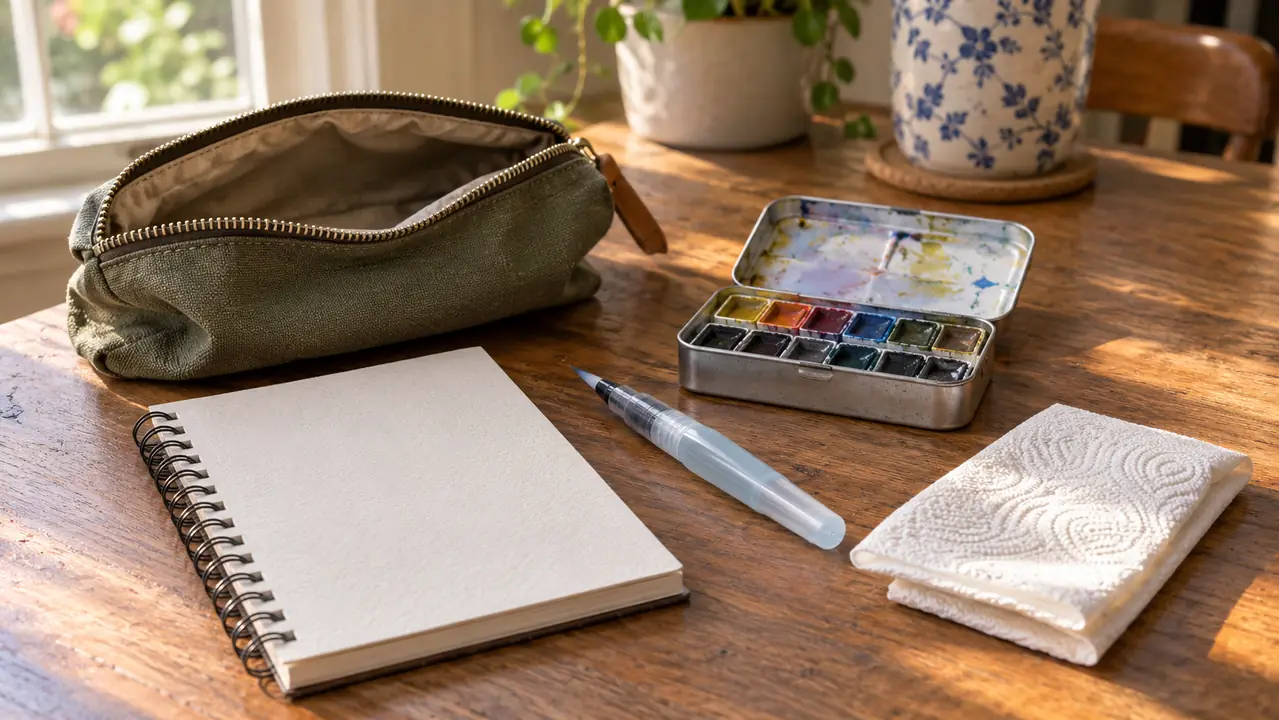
The other rule is to keep the pouch packed. Brush in the pouch, sketchbook in the pouch, tin in the pouch, one paper towel folded in thirds. If you unpack it at home and leave pieces on the counter, the next trip you will walk out with a sketchbook and nothing to paint with. I learned that one during a forty minute wait at a doctor's office with a blank book and no water.
Three Things That Went Wrong for Me
The flood. I was talking to a friend on a bench and squeezed the barrel while I was mid sentence. Water went down through the tip and pooled at the bottom of a sky I had just laid in. The paper had already lost its sheen, so the puddle pushed a ring of blue to the outside and left a pale hole in the middle. I painted a dark tree line over the worst of it. Now I squeeze before the tip goes anywhere near the paper, never while it is on it.
The mud. For about a month I could not figure out why my greens kept going gray. It was the wipe. I was going from a blue straight into a yellow with a tip that still had blue in it. One extra pass on the paper towel fixed a problem I had blamed on the paint.
The wrong paper. I sketched on a thin notebook in a café because it was what I had, and the first wet stroke turned the page into a wave. The paint gathered in the low spot and dried there. Nothing about that was the brush's fault. A small book of heavier paper costs a little more and saves you the whole experience.
What Else Helps
The brush is one piece of a small kit and it will not rescue bad paper. A pocket sketchbook of 140 lb cold press, or a small block, gives you enough tooth to lift color and enough weight to take a wash without buckling. For real practice I paint on an Arches cold press block at home and use a cheaper spiral pad for class demonstrations, and the difference in how the paint sits is not subtle. Bigger shapes at home I do with the Transon goat hair rounds. The water brush handles everything the size of a postcard.
A palette with a lid matters more than people expect, especially if you paint on a bench or a kitchen table where someone else will set down a coffee cup. I squeeze tube color into the wells of an 18 well palette, let it set, and mist it before a session. It travels fine. A folded paper towel is the other essential: it dries the tip, it changes your color, and it catches the drip you did not plan for. Beyond that, sit with your back to the wind if you can. A breeze will dry a wash faster than any paper will hold it, and you will be painting edges whether you meant to or not.
The sketch you finish in ten minutes is the one you keep
Start with one brush and one small book. The Pentel Aquash medium tip has been in my zip pouch for four years and it is still the first thing I reach for. Everything else you can add later.
Amazon Check Today's Price on Amazon →