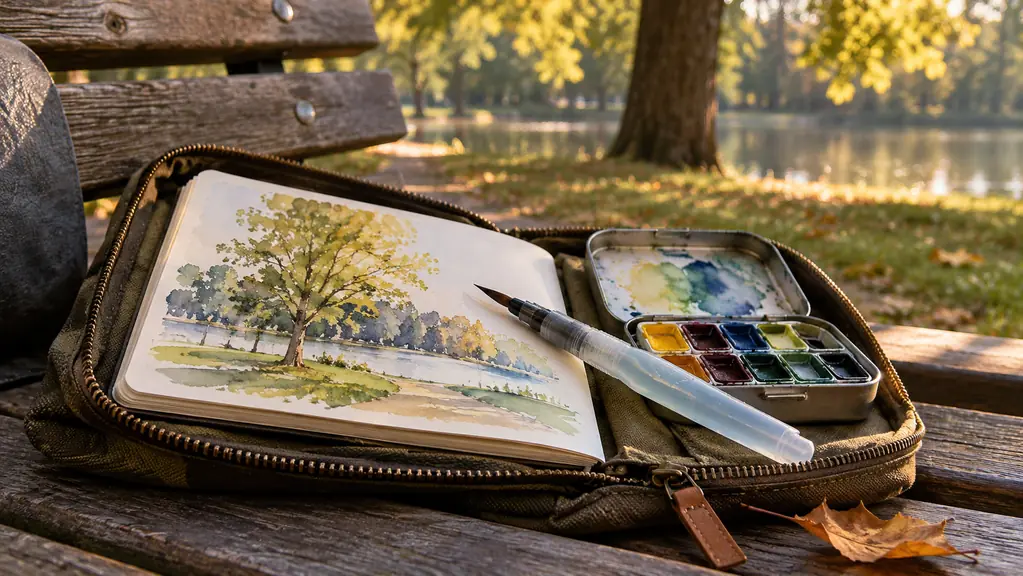
If you want the short version, the Pentel Aquash in medium is the one that lives in my zip pouch, and the Zebra water brush is the one I borrow from a student when I want to make a point about tip firmness. I have carried the Pentel for about four years, in waiting rooms, on park benches, and at my sister's kitchen table in Hagerstown. My time with the Zebra is one afternoon with a brush borrowed from a woman in my Thursday class at the library. That is a lopsided test and I will say so again before I finish.
Here is why the lopsidedness matters less than it sounds. A water brush is a barrel of water with a nylon tip on the end, and there are only four things that can go right or wrong with one. How the water arrives. How the tip holds up over an hour. How the thing feels in your hand. And whether it leaks into your bag. You can learn the first three in an afternoon. The fourth takes years, and I will be honest about where I am guessing.
| Pentel Aquash (Medium) | Zebra Water Brush | |
|---|---|---|
| Water flow | Squeeze the barrel, water moves, release and it stops | A steadier feed that keeps moving between squeezes |
| Tip point late in a session | Softens and opens up by the second hour | Held its point through a long afternoon |
| Fine lines and drybrush | Doable, but the soft tip rounds the marks | Firmer tip catches the paper tooth cleanly |
| Tip sizes | Fine, medium and broad | One tip size |
| Wet into wet blooms | Holds a water shape while you place the pigment | Water keeps arriving, so the shape keeps spreading |
| Weight in the hand | About nine grams, held like a pencil | More body in the hand, a matter of taste |
| Leaks in a bag | No leaks in four years, just a damp tip now and then | Not enough time with it to say |
| Best for | Painting on location, skies, wet into wet | Small marks, drybrush, tight detail |
Where the Pentel Aquash Wins
The water arrives when you ask for it. That sounds like faint praise until you have used a brush where it does not. The Aquash works on a squeeze. You press the barrel, water moves down through the tip, you let go and it stops. I can hold a wash open on a wet sky for as long as I want, then lift off and let the edge set. When I want a second pass, I squeeze again. The whole exchange sits under my fingers the way a loaded round brush sits under my wrist.
The second thing is the range of tips. It comes in fine, medium and broad. I own the medium and have for four years, and if I were buying again I would add the fine, because the small dark accents in a treeline are the one place my medium has to work harder than it should. A brush that only comes in one tip makes the size you bought do every job. A brush that comes in three lets you pick up the one the painting needs.
And the blooms. This is the part I care about most and the part that is hardest to explain without sounding like a poet. A bloom is what happens when wet paint meets wet paper and pushes outward on its own. You cannot start one with a brush that is too dry, and you cannot steer one with a brush that keeps dribbling. With the Aquash I lay a clear water shape, drop one loaded touch of pigment into the middle of it, and then set the brush down and let the paper do the work. The Pentel stops when I stop. That is the whole trick.
At about nine grams it weighs nothing, so I hold it like a pencil and my hand does not tire the way it does after an hour with something heavier. And for whatever it is worth, the listing says it is also suitable for cake decorating. I have never tried that and I am not going to pretend I have, but I believe it. A barrel you squeeze with a soft tip on the end is exactly the tool you would want for painting a vine up the side of a cake.
Where the Zebra Wins
The Zebra's tip is firmer, and that is a real advantage, not a consolation prize. A firmer nylon tip holds a point longer. My medium Aquash softens as a long session goes on, and by the second hour the point has opened enough that my thin lines come out thicker than I planned. The Zebra held its point through the whole afternoon I had it. If your painting lives in the small marks, the grass blades and the bare branches and the rigging on a distant boat, that firmness is worth a great deal.
Firmer also means it pushes back when you press. I have beginners who bear down as if they are signing a mortgage, and a soft tip rewards that with a fat splayed mark. A firm tip resists. For drybrush, dragging a nearly dry tip across the top of cold press paper to catch the tooth, the Zebra is simply the better tool. I got a nicer scraggly edge on a stand of dry grass with it in ten minutes than I have managed with my Aquash in a season of trying.
The barrel is the other place it earns its keep. The borrowed brush had more body in the hand, closer to a marker than to a pencil, and two of my Thursday students with stiff fingers told me they find that easier to hold for a long stretch. I paint with a light grip so it makes little difference to me, but I noticed it, and I would not wave it away if your hands ache after an hour at the table.
The brush that stops when your fingers stop
The medium Aquash is what has ridden in my zip pouch for four years, through waiting rooms and park benches and one very windy afternoon by the creek. If you want a water brush that keeps the water under your hand instead of ahead of it, this is the one I would put in yours.
Amazon Check Today's Price on Amazon →What the Water Actually Does on the Paper
The thing nobody tells you about water brushes is that they change how long a wash stays workable. With a cup and a round brush you load once, and the wash starts setting the moment you stop adding water. With a water brush you can keep feeding it. I have held a sky open for six or seven minutes with the Aquash, coming back along the edge to keep it damp while I decided where the cloud shapes should sit. That is the difference between painting a sky and racing one.
Where it goes wrong is at the edge. A wash needs a boundary, and a brush that dribbles gives you a soft feathered edge whether you wanted one or not. A backrun, that pale cauliflower bloom that shows up when water pushes into a half dry wash, is easy to make on purpose and nearly impossible to stop once it starts on its own. The Aquash gives me enough say to decide. I can put a bead of water exactly where the sky meets the treeline and walk away. With the Zebra I spent more of that afternoon chasing the bead than placing it.
Granulation and lifting are the other two places the two brushes separate. Granulating colors, the ones that settle into the tooth of the paper and leave a speckle, want the water to sit still for a moment. Squeeze too much and the speckle runs downhill. Lifting, which is what I do when a sky comes out too dark, wants a clean damp tip and a light hand. The soft tip lifts a stain without scrubbing the surface of the sheet. The firmer tip lifts harder, and on a softer student pad it took a little paper with it. On the Arches block I paint on, it was fine.
A brush that stops when you stop is the fastest way to teach a beginner to leave a wash alone.
What My Thursday Beginners Get Wrong With Both
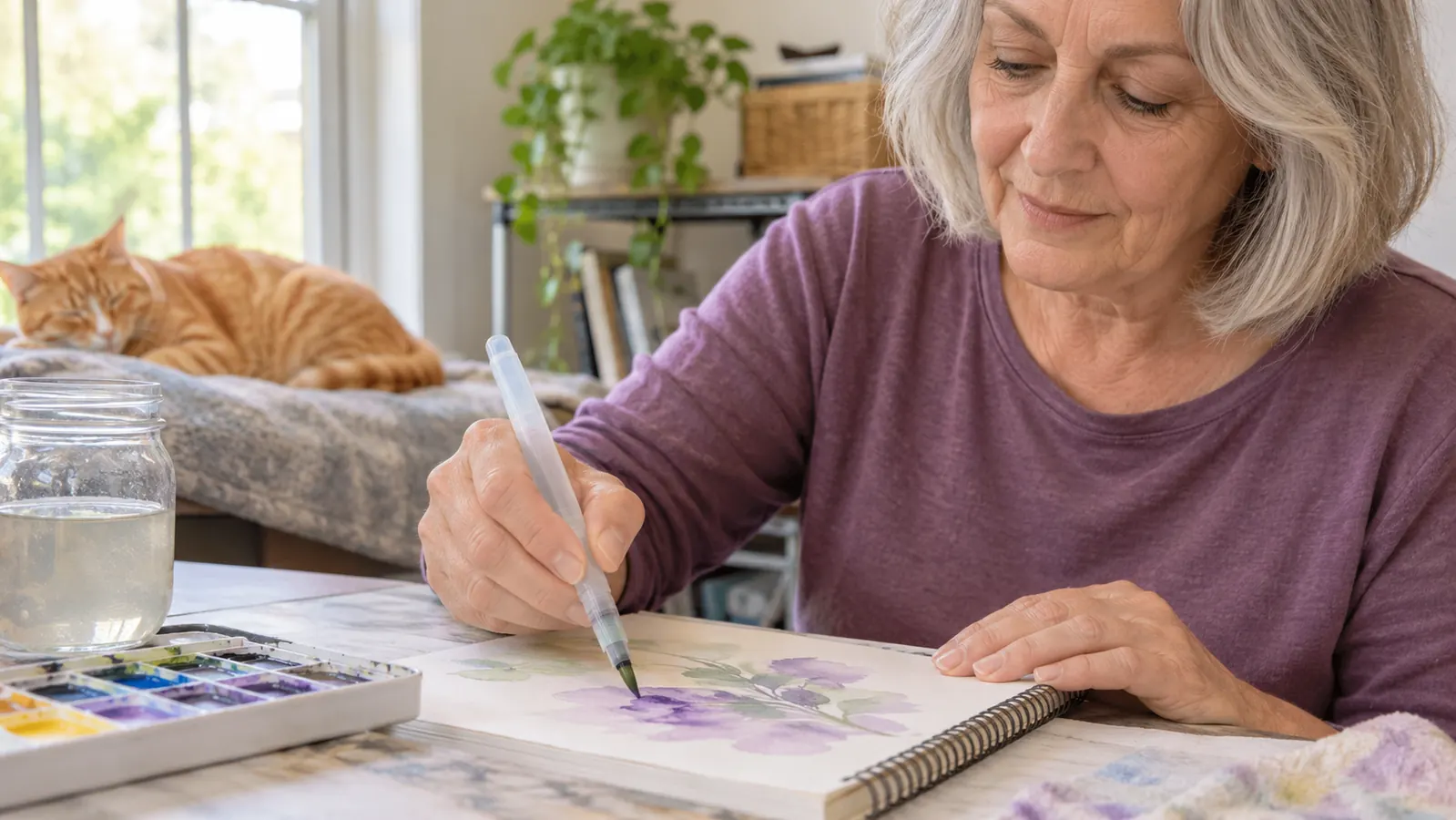
Six adults, one long table at the library branch, and the same three mistakes every term. The first is over squeezing. A water brush does not need a firm hand, it needs a pulse. Squeeze the barrel like you are holding a bird, ease off, and let the tip do the carrying. Half my class floods the paper in the first ten minutes and then wonders why nothing will dry before the hour is out.
The second is wiping the tip on a dry paper towel and calling it clean. Wet paint sits at the base of the nylon, not just on the point. I give mine a small squeeze while I wipe, so fresh water pushes the old color out ahead of the towel. That takes about four seconds and it saves you from a muddy sky. The third mistake is filling the barrel with something other than plain water. I once had a student load hers with cold tea. It did not go well, and that brush smelled of it for a month.
None of this is the brush's fault, and that is the point. Both of these tools are simple enough that the painter is the variable. What separates them is how much forgiveness they build in. The Pentel forgives a heavy hand because the water only comes when you ask. The Zebra forgives a heavy hand because the firm tip will not splay no matter how hard you lean on it. Neither one forgives a wash you refuse to leave alone.
How I Compared Them
Same paper, same paint, same subject, because that is the only fair way to do it. I tore a practice sheet off a student pad and worked one half with the Aquash and the other half with the borrowed Zebra, both filled from the same jar of tap water, both dipped in the same Cotman half pans. Two small bunches of dry grass and a wedge of sky, twice over. Then I did it again the next morning, because a brush can behave differently on a second day and I wanted to be fair to the Zebra before I wrote anything down.
What I am not doing is pretending to a long test I did not run. My Zebra experience is one borrowed brush and two sessions. That is enough to judge the tip and the water flow. It is not enough to judge how it lasts, and I have left those rows in the table blank rather than fill them with something I made up. My Aquash has been in the pouch for four years, has been dropped on a gravel path, and still holds water without a leak. If you want a durability verdict on the Zebra, read the reviews of people who have owned one for a year. I would rather leave a hole here than guess.
Who Should Buy Which
Buy the Pentel Aquash medium if you paint on location, if you work wet into wet, if you like to hold a wash open while you think, or if you paint in places with no sink within reach. It is also the brush I hand to a beginner who is learning to leave a wash alone, because a tool that stops when you stop is the fastest way to teach that lesson. Add the fine tip if your paintings are mostly small.
Try the Zebra first, or borrow one for an afternoon, if your work is built on fine lines, drybrush texture, or a great many small marks. If you find the Aquash tip too soft and springy for your taste, you are not imagining it, and the Zebra answers that specific complaint. My honest suggestion for most people is to keep one of each in the pouch. They do different jobs, and between the two of them you are covered for detail and for washes.
Four years in a zip pouch and it still holds water
Fill the chamber with plain water, squeeze gently, and the tip does the rest. It is the brush I reach for on the bench, in the waiting room, and at my sister's kitchen table, and it is the one I tell my Thursday beginners to start with.
Amazon See the Pentel Aquash on Amazon →