

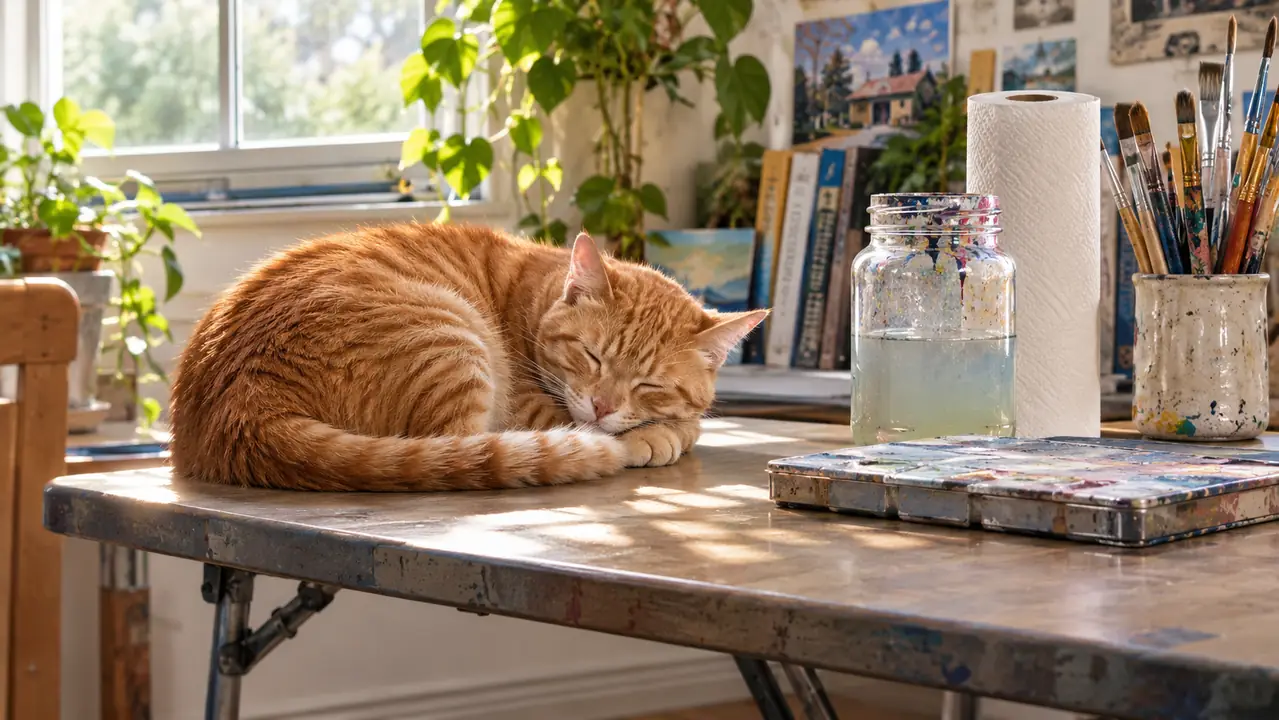
The painting was finished, or I thought it was. A hedgerow, a strip of sky, the kind of thing I can do in about two hours on a Tuesday morning at the folding table in my spare bedroom, with the north light coming in over my shoulder. I got up to answer the phone. I came back to orange paw prints walking straight up through the wet foreground and off the edge of the paper.
Biscuit is nine years old, about twelve pounds, and has never regretted a single decision in his life. The warm end of the table is his spot and always has been, and I have known that for years. But the fault was mine that morning. I left a tray of wet paint open in a room I know he owns, then walked out of it. I got exactly what I had coming.

I bought the Mr. Pen airtight watercolor palette with lid the following week, and I will admit there was some spite in the purchase. It is a rectangular plastic tray, ten and a half inches long, five wide and one deep, with eighteen wells inside and two mixing areas, and the lid has a clasp across the front. Before it I used a Meeden metal palette for about four years, painting most mornings on that same table. I liked that palette. It simply had no lid, and I have a cat.
A year of mornings later, here is my honest accounting. The lid is the whole reason I keep it. Everything else about the thing is ordinary in the way good working tools are ordinary, which is to say you stop noticing it after a week, and that is the compliment.
What the lid actually does is slow everything down. Paint squeezed from a tube into the wells and left to set will stay soft for weeks on the Mr. Pen tray if the lid goes back on when I leave the table. Before a session I mist the wells, wait a minute, and the color wakes up under the brush. Left open, that same paint skins over in two or three days and I am digging it out with a toothpick, which is a small chore that somehow ruins a whole morning.
A wash that stays workable for four minutes instead of two is the difference between a soft edge and a hard one, and the lid is what buys those minutes.
The 18-well palette that keeps a Tuesday morning's paint soft until Friday
Eighteen wells, two mixing areas, and an airtight lid with a clasp. It is what I load up on Monday and still paint out of at the end of the week.
Amazon Check Today's Price on Amazon →The two mixing areas earn their keep more than I expected. I keep one for greens and one for everything else, which sounds fussy until you have mixed a clean purple in the wrong puddle and watched it turn to mud. They are shallow enough that a loaded brush still picks up color, and deep enough that a wet wash does not climb the wall between them. On the Arches block I can lay a sky, walk away for ten minutes, and the mix is still sitting there when I come back to soften an edge.
Size is the quiet part. The Mr. Pen palette is ten and a half by five by one inch and about a quarter of a kilogram, small enough to sit at the corner of the table without taking the space where I actually work. It goes into my bag on Thursday evenings for the beginner class at the library. Six adults around one long table, and I have watched three of them spill water in a single evening. A clasped lid has already saved me there once.
The plastic is plastic. It will not feel like the metal I used before, and a strong phthalo left sitting will stain the polished surface. The care note says hand wash only and no soaking, and I would take that seriously. I rinse mine under the tap, wipe it out, dry it, and after a year the tray is still flat with no warped corners and no lid that needs convincing.
What I gave up in the move is the feel of metal and the way the old one folded into a square you could slide into a coat pocket. I still keep it in a drawer for sketching away from home. But it could not do the one thing I actually needed, which was hold paint for a week without drying into chips. Once you have painted a full morning without remixing a single green, going back is hard.
What I'd Tell You If We Were Sitting at My Kitchen Table
I would tell you that the Mr. Pen palette will not make anyone a better painter. Nothing on the supply list does that. What it does is take away one small daily friction, and friction is what actually stops the adult beginners I teach. They set up, they paint for forty minutes, they clean up badly, and by Thursday the paint has dried into little rocks and the whole hobby feels like a chore they invented for themselves. A lid turns a two hour session into something you can walk away from and come back to. Put the lid on before you stand up, every time, not only when the cat is in the room. Mist the wells before you start, not after. Keep to one or two colors per puddle and you will waste less paint than you think. And if your table has a warm end that a cat has claimed, the lid was never optional in the first place.
Load it once, close the clasp, and paint out of it all week
Eighteen wells and two mixing areas under a lid that shuts. Mine has lived on the corner of my table for a year and the paint still moves under the brush.
Amazon See It on Amazon →