
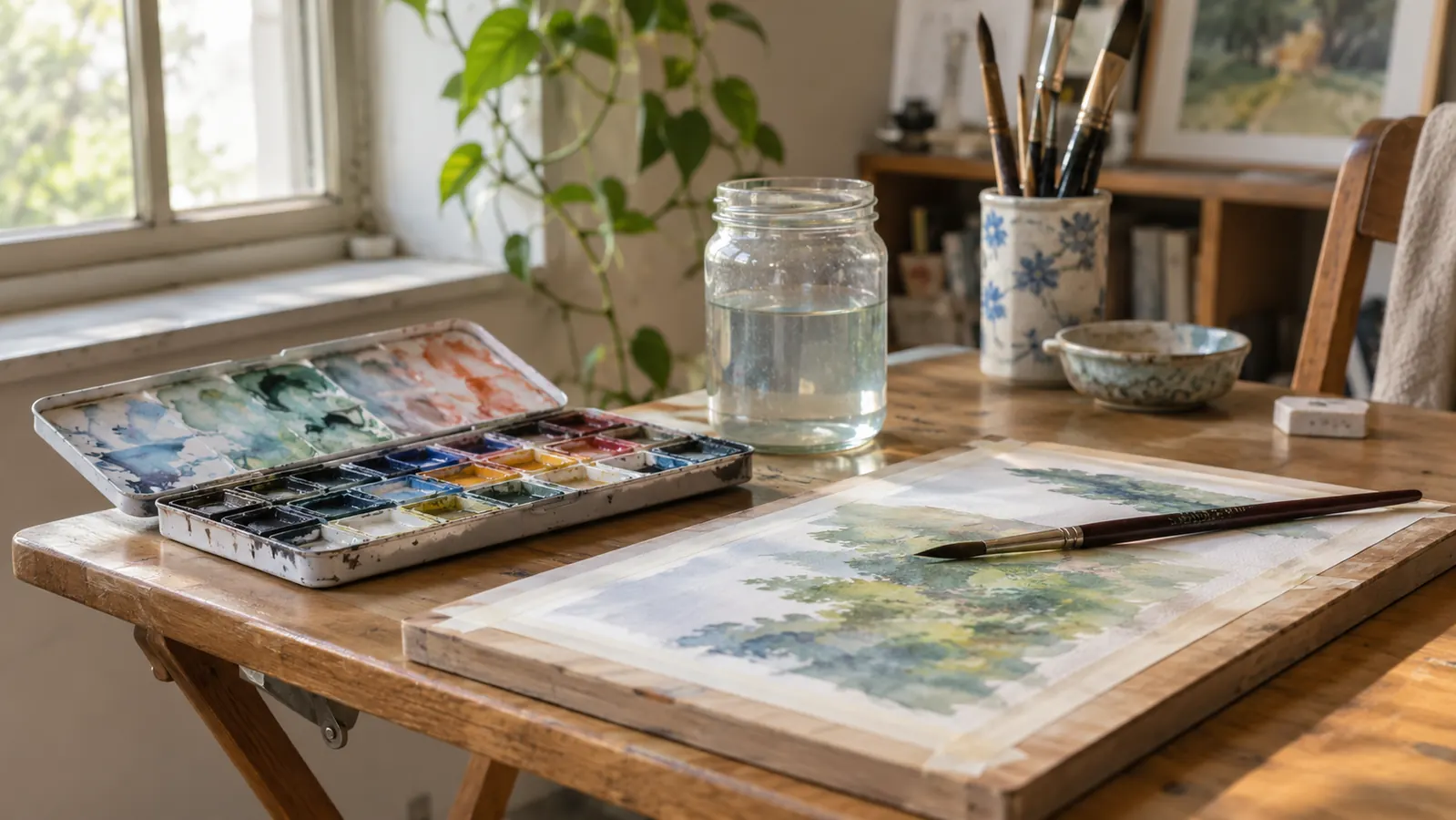
Nobody warns you that the expensive part of watercolor is the paint you scrape out of the well three days later because it dried into a chip and you are too stubborn to throw it away. I taught middle school art for 31 years and I still did that. Old habits are hard to break.
For most of my painting life I used a metal palette that folded shut. It looked serious sitting on the table. It also rusted along the hinge, and every time I closed it the lid pressed into three of the wells and pushed burnt sienna into the yellow ochre. I put up with that for years because a palette is not paint, and I did not think it mattered much.
Then my cat walked through an open tray of ultramarine and tracked it across a finished painting of the Catoctin ridge, and I ordered the Mr. Pen airtight watercolor palette with lid that same week. I have painted out of it nearly every morning since, about two hours at the folding table in the spare bedroom, and I have enough time on it now to tell you plainly what it does well and where it annoys me.
The Quick Verdict
A cheap plastic tray that keeps squeezed paint usable for days and gets out of your way on the table. The lid earns its keep. Permanent staining is the trade, and you should decide about that before you order.
Amazon Check Today's Price →Buy it for the lid, not the wells
Mr. Pen's 18-well palette closes flat and stays closed, so the color you squeezed out on Sunday is still workable on Thursday. Check today's price and read the size line before you commit.
Amazon Check Today's Price on Amazon →How I've Used It for a Year
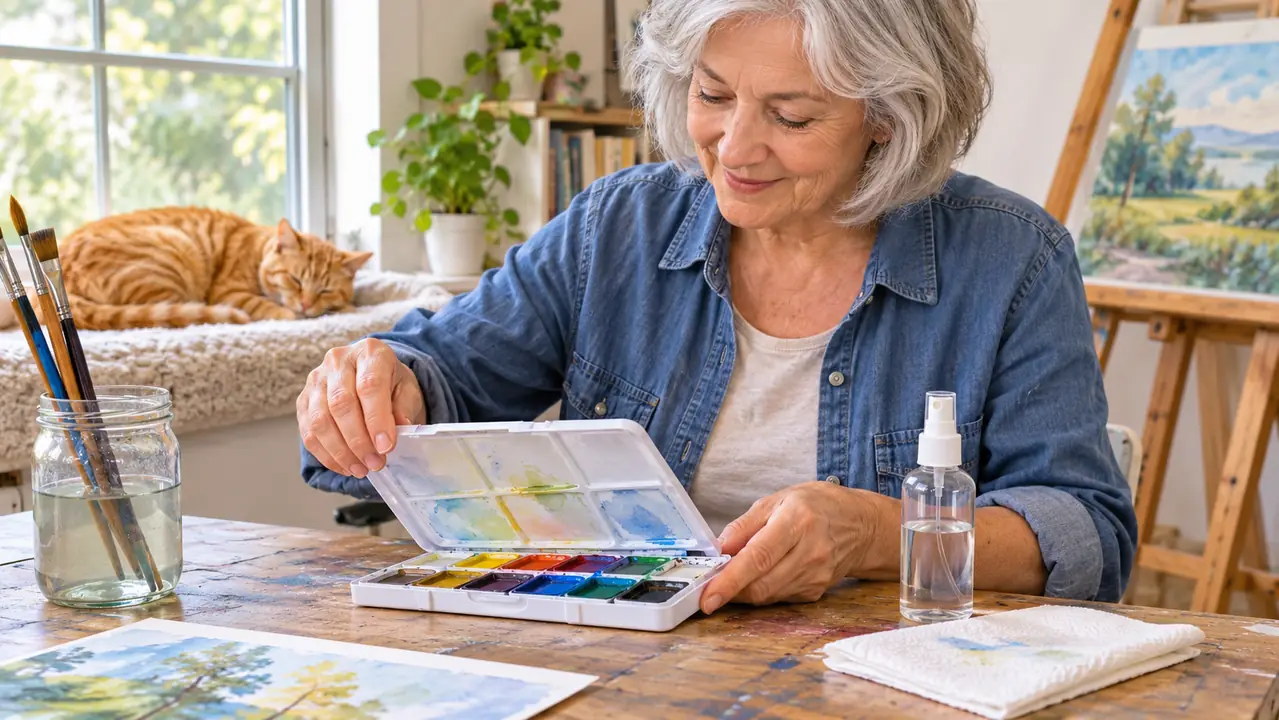
I did not switch palettes to be tidy. I switched because I was throwing paint away. My morning routine has not changed in twenty years except for the tray itself: fill a jar, set a block of cold press paper on the table, open the palette, mist the wells with a spray bottle, and load a brush. The paint in this one is squeezed from tubes. I keep all eighteen wells filled with the colors I reach for constantly and top up the ones that run low every couple of months.
Eighteen wells sounds like more than a person needs until you count what you actually mix with. I keep a warm and a cool version of the same blue, two reds, two yellows, and the earth colors, and that is most of the tray. Because each color lives in the same spot, my hand finds it without my eyes leaving the paper. That sounds like nothing. It changes how you work when a wash is sitting there drying and you have about twenty seconds to decide what goes into it.
The two mixing areas are the part I underestimated. I use one for greens and one for skies, and I stop rinsing the brush between colors because the space is already spoken for. A puddle of sap green and yellow ochre will sit in there overnight with the lid closed, and one squirt from the mister brings it back in the morning. Going back to a single shallow tray would feel like cooking in a kitchen with one pan.
What the Airtight Lid Actually Buys You
The listing calls the lid airtight. I cannot test that with a gauge, so I will tell you what happens on my table instead. I closed the palette on a Friday morning, drove to Hagerstown to see my sister, and came back Sunday afternoon. The paint in all eighteen wells was still soft enough to load a brush with no water at all. Two days. I have not left it shut for a month and I am not going to claim what I have not done.
The clasp matters as much as the seal. The lid is held down flat and the clasp locks it there, and in a tote bag going to the library branch on Thursday evenings it has not popped open once in a year. Before this I carried the Meeden in a plastic grocery bag, and a plastic bag is not a lid. I learned that the expensive way, on a painting that was already finished.
Here is the part nobody mentions. When the lid is shut, the mixing areas stay wet too. The wash you mixed at ten in the morning is still there at four in the afternoon at very nearly the same value. Anyone who has watched a wash dry two steps lighter than they intended knows exactly why that matters.
I closed the palette on a Friday morning and opened it Sunday afternoon. The paint in all eighteen wells was still soft enough to load a brush.
What I Liked
- The lid keeps squeezed paint usable for days, not hours
- Eighteen wells let you hold warm and cool versions of the same color at once
- Two mixing areas wide enough for a full sky wash, and they stay wet while the lid is shut
- The clasp holds in a tote bag on a weekly trip across town
- Light enough and short enough to sit on a folding table without crowding the paper
Where It Falls Short
- Staining pigments leave a faint shadow in the plastic that soap will not lift
- At 10.5 by 5 by 1 inches it is a table palette, not an outing one
- Hand wash only with no soaking, so cleanup is a minute at the sink every session
- The wells are built around squeezed tube paint and do not suit half pans as a main system
How It Behaves With Real Paint
A palette cannot make a pigment granulate and it cannot stop one. Ultramarine separates in the well the way it always does, and the plastic tray has nothing to say about it. What the tray does affect is how much water you carry into the mix. The wells are deep enough that a wet brush does not slosh color into its neighbor, which means your greens stay green instead of turning into a muddy average of everything on the tray.
Rewetting is the honest test of any palette. Paint that has dried in a well and been brought back with a spray is slightly weaker than paint squeezed that morning, and it lifts a little more easily off the paper. That is true of every palette I have owned, metal or plastic. What Mr. Pen gives you is paint that has not dried out in the first place, which is a different thing and a better one.
Backruns are my favorite accident and I still get them the same way I always did, by dropping clean water into a wash that has lost its shine. The palette has no opinion on the paper. Where it helps is speed. Because the mix is already sitting wet in the mixing area, I can drop it in at the exact moment the paper is right instead of stopping to mix while the window closes. Blooms are timing, and timing is what a wet palette gives you.
Lifting is where a wet palette spoils you. With paint that never dried out, a damp brush and a clean paper towel will pull color back toward the white of the paper, and you can soften an edge that got away from you. When I was fighting a dry tray I used to overcorrect and scrub, which fuzzes the paper and shows up later under the next wash. The palette did not teach me to lift. It removed my excuse to scrub.
A wash stays workable longer than it used to, and that is the honest headline of this whole review. Not because the palette touches the paper. Because I am not stopping in the middle of a sky to remix a color that dried in the well. The sky goes down in one pass. The backruns happen where I meant them to happen. Twenty-two years in, that is still the thing I am chasing.
Where It Falls Short
Phthalo blue will stain this palette and it will not come out. So will alizarin crimson. I have scrubbed with a soft cloth and a drop of dish soap, which is all the care instructions allow, and the wells keep a faint shadow of the pigment no matter what I do. It does not affect the paint that goes into them. It does mean the tray will never look new again after the first month, and if that bothers you it will bother you every single morning.
The size is worth saying out loud: ten and a half inches long, five wide, one inch deep, about nine and a half ounces. That is a table palette. It does not go in the zip pouch with the water brush and the mint tin of half pans, and it is not the thing you carry to the park. I use this one at home and the small tin when I am out. Two different jobs, and I stopped expecting one object to do both.
Cleanup is the daily tax. Hand wash only, no soaking, which I understand because a long soak is how plastic trays warp. So every session ends with a minute at the sink, a soft cloth, and the lid propped open to air dry overnight. If you are the painter who leaves everything until the weekend, this tray will teach you about staining pigments faster than any teacher could.
Compared with the Meeden metal palette I used for four years, this one is lighter and it closes far better, and the metal one had a nicer feel in the hand. The Meeden lid never sealed. Color migrated between wells every time I folded it, and the hinge is where the rust started. I do not miss it. I do miss the weight of it, which is a silly thing to miss, and I am telling you anyway.
What Nobody Tells You About a Cheap Plastic Palette
The craft store version of this advice is to buy the expensive metal palette because it lasts. Mine did last. It lasted four years of rust at the hinge and color moving between wells every time I closed it. A palette is a container. The real question is not what it is made of, it is whether it keeps paint workable and keeps one color out of the next. Plastic does that. Metal with a weak seal does not.
The second thing nobody tells you is that you will overfill the wells. Every beginner in my Thursday class at the library branch squeezes out a fat rope of paint on the first night. It takes about three days to learn that half a well is plenty, and that a well filled halfway rewets faster than one filled to the brim.
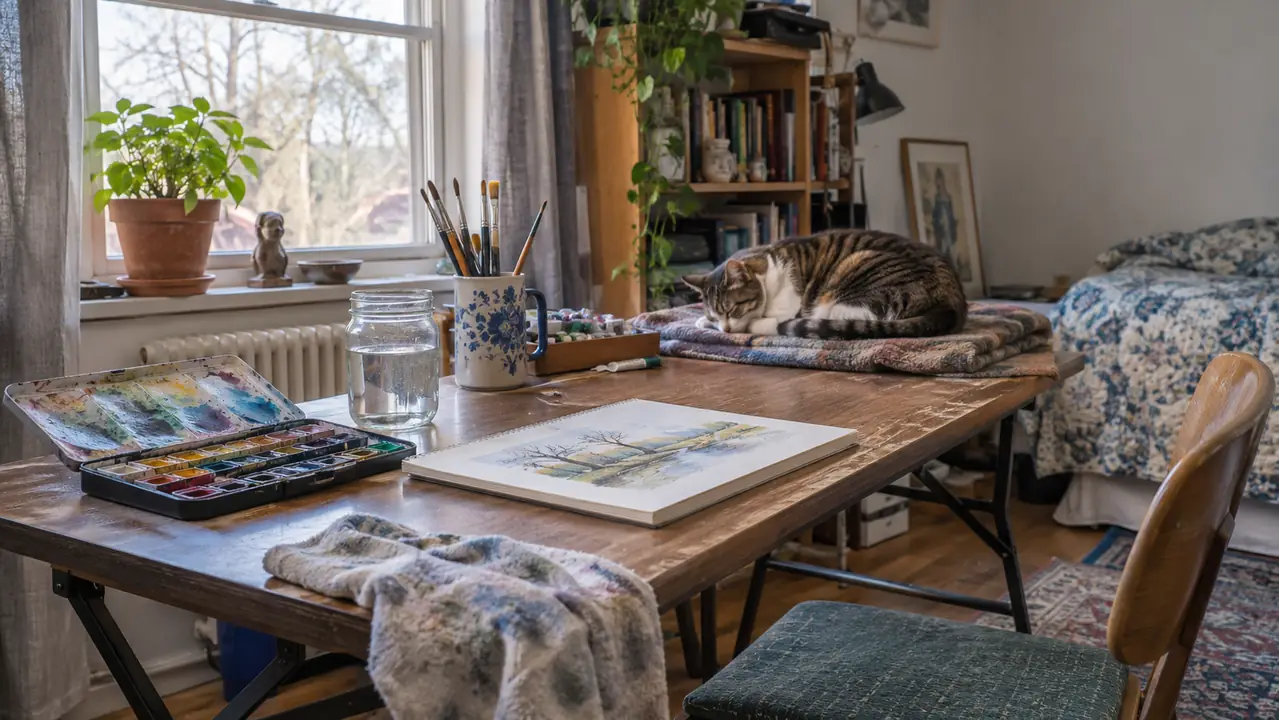
The third thing is about the mixing areas. They hold more than you expect. A wash for a seven by ten sky fits in one with room to spare, which is more than I could say for the shallow tray on the metal palette. But a big puddle in a plastic tray will run to one corner if the table is not level, and my folding table is not level. I keep a folded newspaper under one leg and I check it before I begin a sky. That is not the palette's fault. It is the table's.
What My Thursday Class Told Me
I brought the Mr. Pen to class one evening last fall because I wanted the two mixing areas on the demo table. Two people ordered one the same week. The complaint I heard from both of them was the same complaint I have: it is too long for the bag they carry. Neither of them wanted to give up the lid, so they both ended up with a second small tin for outings, which is exactly what I did and exactly what I told them to do.
The student who paints birds loves it for a different reason. She keeps her grays mixed in one of the two areas and leaves them there while she works the body color in the other, and the lid keeps both alive between Tuesday and Thursday. That is a two day gap. Her grays came back soft both times, and she has stopped mixing them fresh out of habit.
The one fair complaint came from a woman who loads her wells with half pans and found them sliding around. I looked at it with her and I could see the problem. The wells are shaped for a squeezed rope of paint, and a half pan sitting in one of them will not stay put. She went back to her old tray and I did not argue with her, because she was right.
Who This Is For
This is for the painter who works at a table most mornings and is tired of watching paint dry out between sessions. It suits someone who squeezes tube paint, keeps a fixed order of colors, and wants a lid that closes without a fight. It is also a sensible first real palette for an adult beginner, because the wells are generous and the mixing areas forgive a heavy hand with water. If you are in my Thursday class, this is the tray I would tell you to get before you buy another tube of anything.
Who Should Skip It
Skip it if you paint on location. It is ten and a half inches long and it is built to sit on a table, not to ride in a bag. Skip it if half pans are your main system, since the wells are shaped around squeezed paint. Skip it if a permanently marked tray would eat at you, because that is what it becomes. And skip it if you want a palette that feels like an heirloom, because this one feels like a tool. Mine has been marked since last spring and I have made my peace with it.
If your paint keeps drying into chips, start here
Eighteen wells, two mixing areas, and a lid that stays shut through a weekend away. Read the size line first so you know exactly what is arriving at your door.
Amazon Check Today's Price on Amazon →