There is a small zip pouch that lives in the door pocket of my car, and inside it is a Pentel Aquash water brush I have carried for about four years. It has been to the park on Tuesday mornings, to a waiting room while my sister had a checkup in Hagerstown, and to my Thursday evening class at the library more times than I can count. I have filled that barrel from a drinking fountain, from a bottle rolling around on the passenger seat, and once from a puddle I would rather not describe. So when someone asks me whether the Aquash is a handy tool or a gimmick, I have a long answer. The short one is that it is a genuinely useful thing that people expect to do far more than it can.
That is the piece the listing photographs leave out. A water brush looks like a brush and behaves like a brush only part of the time. The water comes from behind you instead of from a cup beside you, and that single change touches everything: how wet the paper gets, how long a wash stays workable, whether a color lifts cleanly, and whether the tip still holds a point after twenty minutes of use. Go in expecting a brush in a cup and you will blame the paper. So here is what I have actually found over four years, including the parts that still irritate me.
The Quick Verdict
A real tool for sketching away from your table. It is not a replacement for a brush in a water cup, and it will not keep a fine point forever.
Amazon Check Today's Price →Four years, one barrel of water, and it still rides in the car door
If you sketch away from your table, this is the piece of gear I would replace the same day I lost it. Medium nylon tip, a barrel you fill yourself, no jar to carry.
Amazon Check Today's Price on Amazon →How I've Used It, and What I Actually Asked of It
I am not a traveling watercolorist. I am a retired teacher who paints at a folding table in the spare bedroom most mornings, with a north window and a cat who believes the warm end of the table belongs to him. The Pentel Aquash is not part of that setup. It lives in the pouch for the other kind of painting: the ten minutes on a bench, the half hour before class starts, the sketchbook page I do while waiting for someone.
That distinction matters, because most of the disappointment I hear from students comes from using a water brush as their only brush at their regular table. At the table you have a jar, clean water, a paper towel, and room to load a real round properly. The Aquash cannot do what a loaded round does. What it can do is let you put down a wet wash, soften an edge, and lift a little color when there is no jar anywhere near you and no intention of setting one up.
What I asked of it, plainly: fill the barrel before I leave the house, squeeze once to dampen the tip, sketch, wipe the tip on a paper towel between colors, come home. On those terms it has been dependable for four years. The barrel has never leaked in the pouch. The nylon tip has held together. The only thing that has changed is that the point is not what it was when it was new.
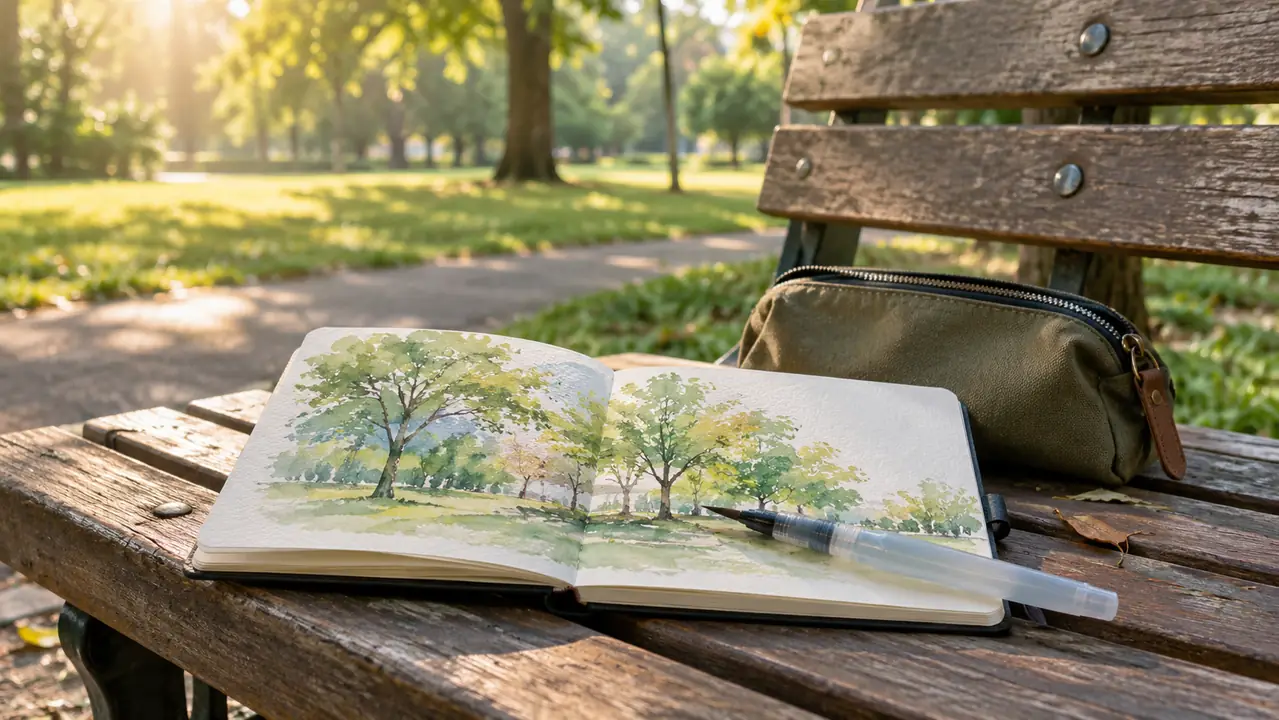
The kit itself is small enough that I forget it is in the car: a 5 by 7 pocket sketchbook, a mint tin holding six half pans, a folded paper towel, and the brush. On a Tuesday in October I sat on the bench by the creek in Baker Park and did a page of the treeline in about eighteen minutes, start to finish, counting the wiping between the greens and the browns. I would not have walked to the car for a jar to get eighteen minutes of painting. That is the entire argument for the tool, and it is a good one.
What the Water Chamber Really Does
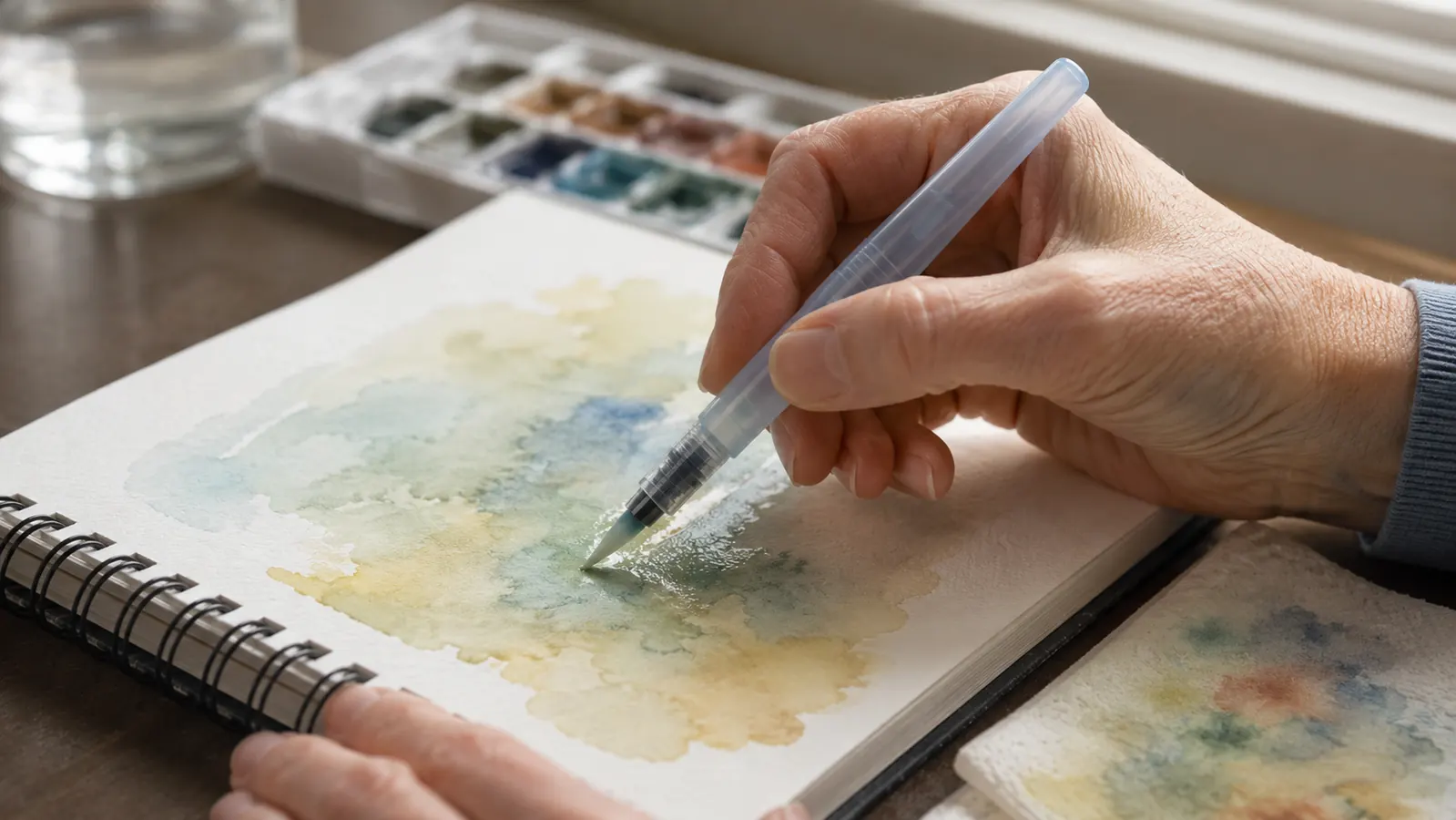
The idea is simple. You fill the chamber with water, squeeze gently, and water comes down through the tip as you paint. That is exactly how it works, and it is worth understanding what it does to the paper. With a brush and a jar you control water in two places: how much is in the brush, and how much lands on the page. With the Aquash you control it with your fingers on the barrel, and that is a coarser control. A light squeeze is a lot of water. A hard squeeze is a small flood.
The first thing beginners do is squeeze too hard. I did. You get a bead of water sitting on the tip and then it lands in one place, and if the paper is a light student grade the bead sits on top and dries with a hard edge you did not ask for. On the Arches block I paint on at home, water sinks in more gradually and I get a few seconds to move it. That difference is the paper, not the brush, but the brush makes the paper's behavior much more obvious.
I timed it once out of curiosity, on a cool morning with the north window open. One gentle squeeze on the block gave me roughly forty seconds of workable damp surface before the edge began to set. Two squeezes gave me closer to a minute and a half, and a wetter edge that traveled further than I meant it to. The same two squeezes on the student pad were dry in well under thirty seconds, which is why the class demonstrations keep going wrong when I borrow a student's paper. That is the whole calibration, and it is feel, not a number printed anywhere.
The second thing is that you cannot get clean water back. Once the tip has color in it, everything you squeeze is tinted. With a jar you rinse. Here you wipe. A paper towel, the back of your hand, an old rag, and you accept that the next mark will be slightly contaminated. For a sketch that is fine. For a clean pale wash it is not, and that is the honest limit of the tool.
The Tip Is Softer Than a Round, and That Changes Things
The bristles are nylon and the tip is medium. In the hand that means a brush that carries water well and points decently, but does not have the spring of a good sable or the snap of a stiff synthetic round. Press it and it spreads. Try to draw a long thin stem with the very point and it will give more than you want. I do stems and small marks with the corner of the tip instead of the point, and that works better for me.
I tried to prove myself wrong about the point one afternoon and drew a row of bare branch twigs on a scrap of cold press. Twelve lines, all with the very tip, all at what felt like the same pressure. Four of them held. The other eight thickened through the middle where the nylon gave, and two of them forked outright. I redid the row with the corner of the tip held at a slight angle and got nine clean lines out of twelve. That is the technique I use now, and it is not what the photographs suggest you can do.
It also means the tip does several jobs badly and one job well. The job it does well is a soft wash with a wet edge you can drag. Skies, distant water, the shadow under a hedge. If I want a crisp edge or dry brush texture, this is not the tool and no amount of technique will make it one. That is worth saying out loud because the photographs suggest a versatility the tip does not have.
After four years the point has gone slightly splayed. Not ruined, just not new. I would not call that a defect, because I have put a great many hours on it, but a person should know that a water brush tip is a wear item. It will not hold a fine point the way a well cared for round will, and a medium tip does not become a fine one with use.
Color Changes Are Where It Shows Its Age
This is the part I wish someone had told me in year one. Working light to dark inside one color family, the Aquash is a pleasure. Yellow into orange into a soft red is easy, and the slight contamination actually helps the transitions along. Bouncing between a strong blue and a warm yellow is a different story. You will spend more time wiping than painting, and the blues will drift toward green in a way you did not plan.
The page that taught me was a simple one: a blue vase holding yellow flowers. I painted the vase first, wiped the tip four times on a paper towel until the towel stopped showing blue, and went into the yellow. The first flower was fine. The second had a green cast along one edge I could not lift out. The third was green enough that I set the page aside and started over on a fresh sheet. Two brushes would have saved that page and about twenty minutes. I carry two now.
My workaround is exactly that. One for cool colors, one for warm, both in the same pouch. That doubles the weight, which is still almost nothing, and it solves most of the problem. The other workaround is to plan the page so I do all the cool passages first, wipe thoroughly, then move into the warm ones. That is what I teach my Thursday class and it works, but it is a constraint, and someone deciding whether to buy should know it is a constraint.
For lifting, the tool is better than I expected. A damp, nearly clean tip will lift color out of a wash while it is still damp and leave a soft light shape, which is exactly what I want for a path or a strip of light on water. It will not scrub back to white on rough paper the way a stiff brush will. It coaxes rather than erases.
What Paper Does to It
I did not expect paper to matter as much as it does. On the cheaper spiral student pad I keep for class demonstrations, the surface is sized hard and the water sits high. A squeeze that feels gentle on Arches will bead and then dry with a dark ring on that pad. On the block, the same squeeze sinks in and gives me a soft edge with a little bloom at the boundary, which is usually what I want anyway.
The practical result is that a water brush flatters rough and cold press papers and punishes smooth ones. If you sketch on a smooth plate surface, keep your squeezing to almost nothing and build the wash in layers instead of one pass. That took me two summers to figure out and it would have saved me a few ruined pages.
How I Clean It, and How It Has Held Up
Cleaning is a two minute job and I do it after every session, mostly because of the cat. Fill the barrel, squeeze until the water runs mostly clear, wipe the tip on a paper towel, stand it tip up to dry. That is the whole routine. Four years of that and the barrel threads still seat properly and I have never had a leak in the pouch.
What I do not do is leave strongly staining colors sitting in it for weeks. I learned that the summer I left a strong phthalo blue in the barrel and came back to a tip that tinted everything for a month. It recovered, gradually, but I was not patient about it. If you paint with staining pigments, empty and refill before you put it away.
Where It Falls Down
Two places, and both are honest limits rather than flaws.
First, it cannot lay a large even wash across a whole sheet. The chamber holds a modest amount and the flow is whatever your fingers give it. A 7 by 10 sky in one pass is not happening. You can build it in overlapping bands and it looks perfectly fine, but it is a different technique and it takes longer than it would with a big loaded brush.
Second, it is not a detail tool in the way the photographs imply. The medium tip is a medium tip. If you want a window frame or a cat's whisker, you want the fine, and that is a separate purchase rather than something you can force out of this one by pressing harder.
There is a third thing that is not the brush's fault but is worth saying plainly. A water brush makes it easy to paint, not to paint well. I have watched students buy one thinking it would simplify the decisions. It simplifies the logistics. The questions about value, edge and when to stop are still yours, and they are most of the work.
What I Liked
- The barrel has never leaked in four years of living in a car door pocket
- The nylon medium tip holds water well and drags a soft wet edge nicely
- No jar, no spill, no setup, so the ten minute sketch actually happens
- Lifts and softens color on damp paper better than I expected
- Weighs about 9 grams, so it disappears in a shirt pocket
Where It Falls Short
- The tip splays after heavy use and will not keep a new point
- Squeeze control is coarse, and it is easy to flood a light paper
- No way to rinse, so color contamination is constant
- The medium tip is not a detail tool and cannot be made into one
- It cannot lay a single large even wash across a full sheet
A water brush makes it easy to paint, not to paint well. The decisions about value and edge are still yours, and they are most of the work.
Who This Is For
If you sketch away from your table, this belongs in the pouch. Park benches, waiting rooms, a hotel room, the passenger seat while someone else drives. The Pentel Aquash weighs almost nothing, it needs no water source you did not bring, and it turns a blank page into ten useful minutes. On a value basis I would put it ahead of a fancier sketchbook.
It is also a good teaching tool for a beginner class, because it forces the student to think about how much water is on the paper instead of reaching for the jar out of habit. I pass mine around on Thursdays for exactly that reason, and the lesson lands faster than any explanation I have given with a brush and a cup.
Who Should Skip It
If your painting happens at one table with a jar and a paper towel, skip it. A real round loaded with clean water will do everything this does and more, and you will not spend half your session fighting contamination you cannot rinse away.
If you want fine detail, skip the medium and buy the fine, or skip the category and use a real brush. And if you expect it to lay a full sheet wash, it will not, and you will be annoyed with a tool that is otherwise doing its job properly.
The one piece of gear I would replace the same day I lost it
Medium nylon tip, a barrel you fill from any tap, and no jar to carry. Four years in a car door pocket and it still earns its space in the pouch.
Amazon Check Today's Price on Amazon →