
I did not want to like this paper. That is the honest place to start. For the first several years I taught middle school art, I bought whatever watercolor paper the district budget allowed, and I told myself the differences between papers were mostly a matter of marketing. Then a colleague left a part used Arches block on my desk at the end of a school year, and I spent one long afternoon quietly annoyed at how much more cooperative the paint was on it. I have painted on Arches blocks for about eight years now. I go through roughly one a month, which works out to a sheet most weekdays and a couple of false starts. I am sixty four, I paint at a folding table in the spare bedroom with the north window, and I teach a Thursday evening beginner class of six adults at the library branch. Nobody pays me for an opinion, so here is the honest version, including the parts the listing does not tell you.
The short answer, before I get into all of it: the paper earns its cost if you are painting often enough to work through twenty sheets in a few months, and it does not earn its cost if you are still deciding whether watercolor is for you. That is not a dodge. That is the actual dividing line, and it is the thing I wish somebody had said to me before I bought my first block and then let half of it sit in a drawer while I told myself I was saving it for something good. Paper you are afraid to use is the most expensive paper you will ever own.
The Quick Verdict
Gives you working time, holds a wash without going chalky, and forgives a brush that is a little wetter than you meant it to be. It will not fix a drawing, and the glued edges mean you cannot work the way you work on a pad.
Amazon Check Today's Price →If you are still painting on student paper, the 7 by 10 block is the size to start with
Small enough to finish a study in one sitting, large enough to finally see what a wash is supposed to do. Twenty sheets, cold press, 140 pound, glued on all four sides.
Amazon Check Today's Price on Amazon →How I Have Actually Used It
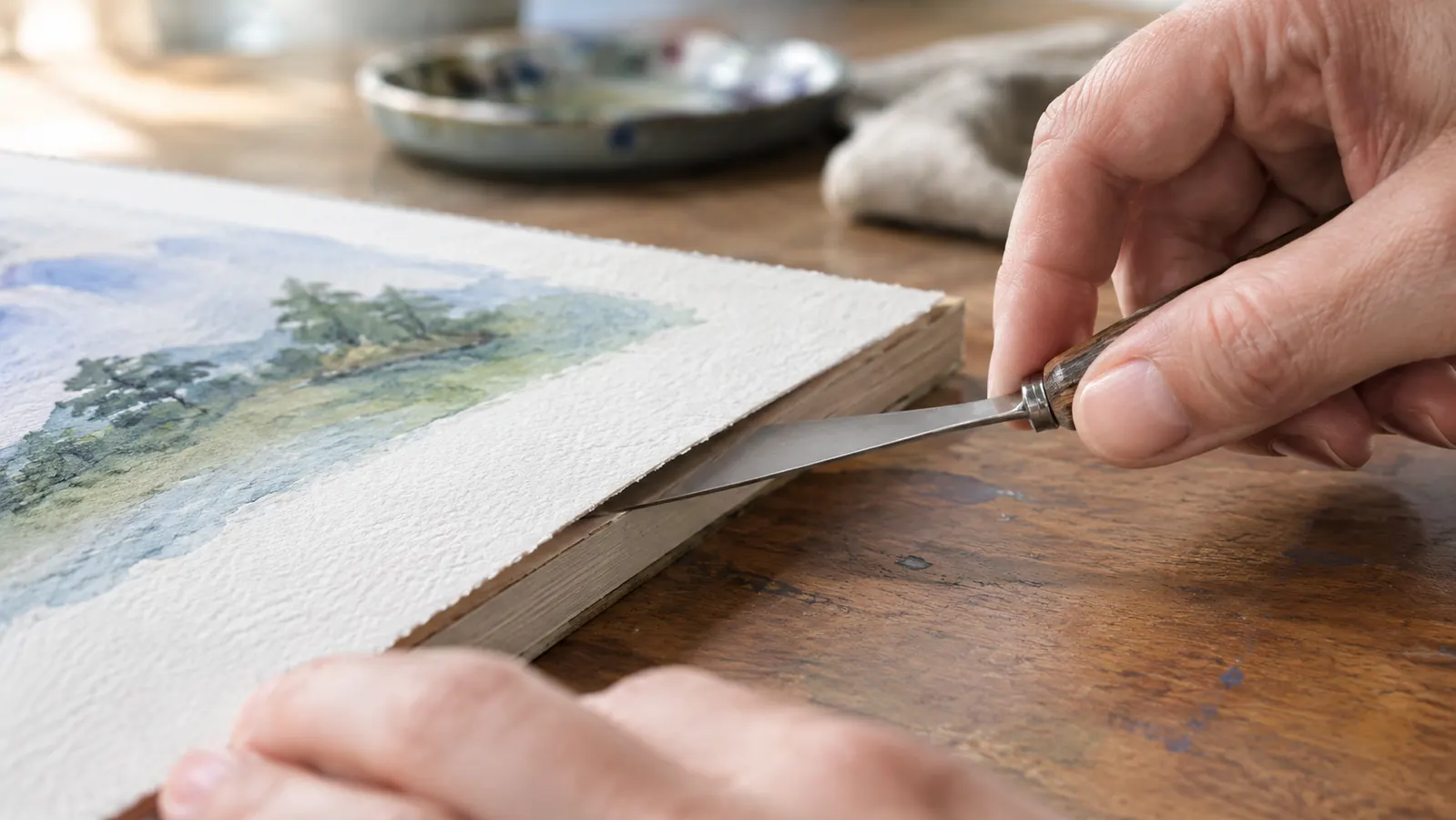
The block lives on the left side of my table and the routine has not changed in eight years. I paint on the top sheet. I let it dry completely, which in a Maryland summer is most of a day and in February is overnight near the radiator. Then I slide a palette knife flat around all four edges, work it under one corner, and lift the sheet off. The first time you do this you will be certain you are about to tear a painting in half. You are not, as long as the paint is genuinely dry and not merely dry to the back of your hand. I learned that the hard way on a wash of ultramarine sky that looked set and was not, and I have never made that mistake twice.
Seven by ten is a deliberate size for me, not a compromise. It is small enough that I can finish something in the two hours I have most mornings, and large enough that a sky does not feel cramped. Twenty sheets in the block, 140 pound, 300 GSM if you read the metric on the label. In the hand it feels like a decent piece of card stock, not like the flimsy spiral pad I keep on the shelf for practice sketches and class demonstrations. That pad is my comparison point for everything in this review, because it is what most of my beginners bring to the first class and it is what I used for years before anyone handed me anything better.
One sheet at a time is the rhythm, and it is worth understanding before you buy. You cannot work on the second sheet while the first is wet, because the first is the top of the stack and the stack is glued shut. So a block is not a stack of loose paper. It is a single working surface with nineteen more waiting underneath, and your whole session is shaped around that one sheet and how long it takes to dry. Some mornings that suits me fine. Some mornings I want to start something new while the first thing is still damp and I cannot, and I go make a second cup of tea and stare out the window instead.
What Cold Press Does Under a Wash
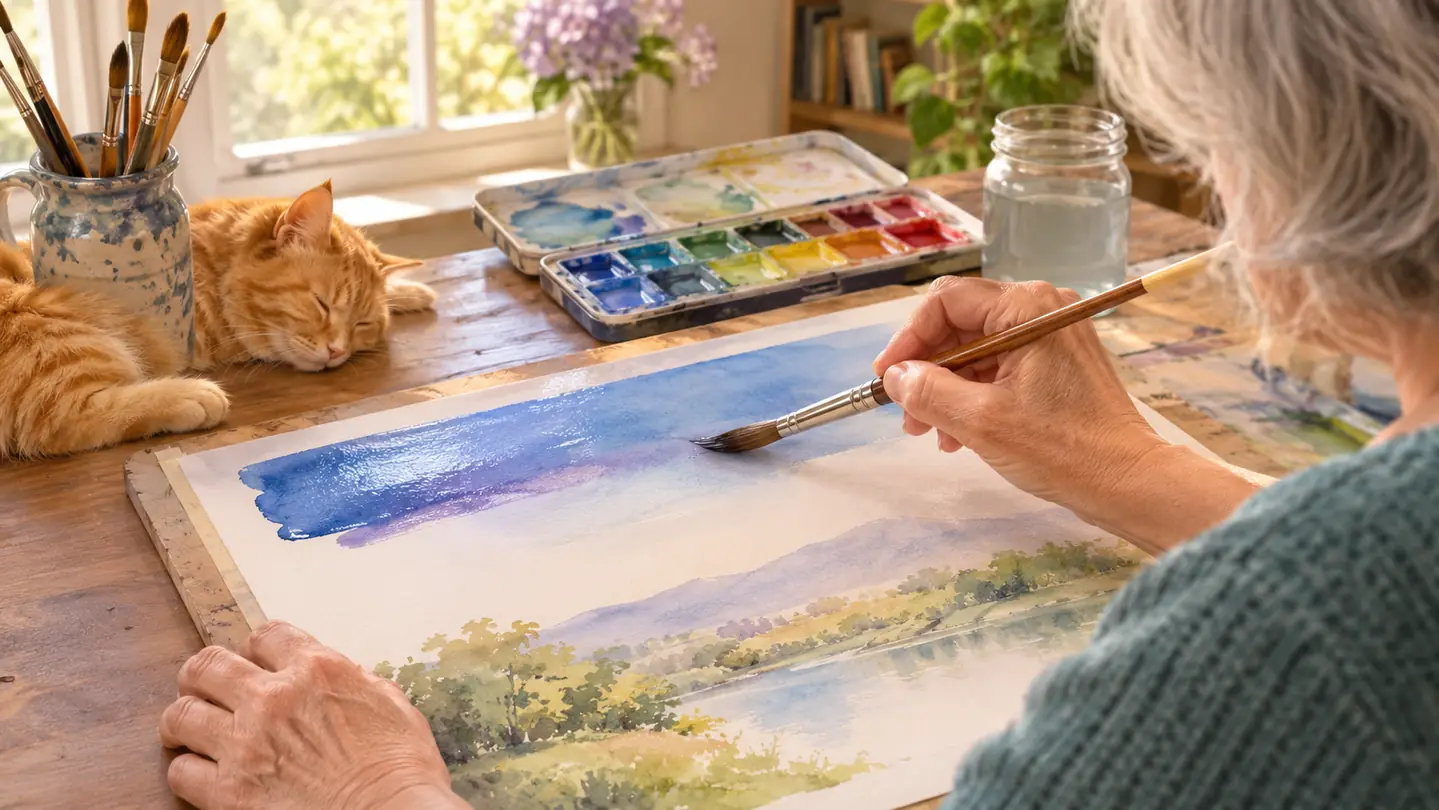
Cold press is the finish most people mean when they say watercolor paper. It has a light texture, a fine tooth you can feel with a fingertip, and that texture is the reason a wash does not look like colored water poured on cardboard. The paint settles into the low spots and sits on the high ones, so a single pass of a loaded brush dries with variation in it. On a smooth surface the same wash goes flat and even, which is useful for illustration and deadly for a sky. Arches cold press reflects light well and keeps the transparency of the pigment, so a thin glaze of phthalo still reads as light passing through color rather than color painted on top of a surface.
The other thing it does, and the reason I keep paying for it, is time. A wet wash on this paper stays workable long enough that I can get back into it with a damp brush and soften an edge I do not like. On the student pad, by the time I decide an edge is too hard it has already set and I am left scrubbing at it. That difference matters more than any texture claim, because most of watercolor is deciding things a few seconds too late. If you want to learn how to control a wash, you need a surface that gives you those seconds. That is the entire practical argument for this paper.
Backruns and blooms behave the way the books say they will. If you drop clean water into a wash that is damp but no longer shiny, you get a cauliflower edge, a hard irregular line with a lighter center. On cheaper paper the same move gives you a muddy patch instead, because the water sinks in before it can push pigment outward. Lifting is the other test I run on any new paper. A damp thirsty brush pressed into a dry wash will pull color back off this block and leave a soft, believable cloud edge, with the tooth of the paper intact. On the student pad the same brush takes the surface with it and leaves a fuzzy spot that no amount of glazing will hide.
Where the Block Genuinely Falls Short
The glue is the whole point of a block and it is also the whole aggravation. Because all four edges are bound, the paper cannot buckle while it dries, which is exactly why you buy it. The cost of that is you cannot work into the margins the way you would on a taped sheet. Paint pools against the glue line and dries with a hard edge right where the binding is, so the outer quarter inch of every sheet is essentially lost. If you like to paint loose and run a wash off the edge, the block will fight you for the first inch and you will learn to plan your composition inward by about the width of your thumb.
You also cannot use the back. That sounds trivial until you count it. A sheet of this paper is a serious purchase per sheet, and every mistake is a whole sheet consumed, not a half. On loose paper I would turn a failed study over and use the reverse for a value sketch. Here I cannot, so the failed studies go in the recycling and I feel it. And when the block is down to the last sheet, what is left under your brush is a stiff board with nothing to give, which is a different feel from the soft cushion of a full block. Not a problem, just a difference worth knowing on the day you are trying to work fast.
The waiting is the third thing. Bone dry means bone dry, and a block of this weight will hold moisture in the middle of a thick wash longer than you expect. I have ruined more sheets by releasing early than by any other mistake in twenty two years of painting. Set the block somewhere with air moving and go do something else. If you are the kind of painter who works in fifteen minute bursts before dinner, this paper will spend most of its life drying and you will spend most of your time waiting for it.
What I Liked
- A wash stays workable long enough to correct an edge, which is the skill most beginners are trying to learn
- The cold press tooth gives variation inside a single stroke instead of flat, even color
- Glued on all four sides, so the sheet does not buckle while a wet wash dries
- Lifting and glazing both work cleanly, with the paper surface still intact afterward
- Twenty sheets of 140 pound paper at seven by ten, a size that suits a two hour session
Where It Falls Short
- The glue line eats the outer edge of every sheet, so you cannot paint off the margin
- You cannot turn a failed study over and use the back, so mistakes cost a full sheet
- Only one sheet is available at a time, and the block must dry before you release it
- Releasing a sheet early will tear it, and thick washes stay damp longer than they look
- The last sheet sits against a stiff backing and feels different under the brush
The Details the Listing Does Not Tell You
Arches papers are cylinder mould made, which is the old slow method, and each sheet is tub sized in a bath of pure natural gelatin and then air dried. That sentence on the listing sounds like marketing and is actually the most useful thing on the page. Sizing is what keeps the paper from drinking your paint like a paper towel. Because this paper is sized through rather than coated on the surface, you can rewet a dried passage and it comes back to life. I can come back to a wash the next morning, dampen it, and lift almost all of it out. On a surface sized paper, that same move takes the coating with it and leaves a scar.
The practical trick nobody mentions is the knife. Use a thin one, keep it almost flat against the sheet, and go around all four edges before you try to lift anything. Do not pry at a corner first. If the sheet resists at one edge, it is not dry, and the right response is to walk away for an hour rather than to push harder. The first sheet off a new block is always the one people ruin, because the block is at its stiffest and nobody has told them to be patient. I now tell my Thursday class this before they touch the paper, and the number of torn sheets in that room dropped to almost none.
Eight years, roughly one block a month, and the only sheets I have ruined were ruined by me being impatient about drying time. Not one was the paper's fault.
What I tell the six adults at the library branch is the same thing I will tell you. Do not buy this block to find out whether you like watercolor. Buy one pad of something cheap, paint four or five studies, and see whether you keep coming back to the table. If you do, then buy the block, because at that point the cheap paper has become the thing standing between you and the next skill. What beginners get wrong is not the brush and it is not the paint. It is that they are trying to learn control on a surface that grabs the water before they can move it.
What Eight Years Has Taught Me About Whose Fault It Is
There is a version of this review where the paper is a marvel and every bad painting becomes the painter's fault. That is not honest either. The paper is a good surface and it is not a teacher. It gave me time to fix edges, and for about two years I used that time to overwork everything into mud, which is a painter problem that better paper simply made more visible. If your instinct is to keep fiddling with a passage until it dies, a longer working time will let you do more damage, not less. I say that as someone who did exactly that for a long stretch.
What changed for me was not the paper at all. It was learning to stop. The block gave me the window, and the discipline of three or four hundred sheets is what taught me to use it and then leave the thing alone. So the fair claim is this: the paper removes one obstacle, a real one, and the rest is the work. Anyone who tells you a block of Arches will change your painting is selling something. Anyone who tells you it makes no difference has not painted on it next to a student pad in the same afternoon. Neither of those is the truth, and the truth is more useful than either.
Who This Is For
This is for the painter who has already decided to keep going and is tired of fighting the surface. You paint most weeks. You have noticed that your washes dry before you can shape them and you suspect it is not entirely your fault. You want to work on lifting, on soft edges, on glazing a color over a dried passage without destroying it, and you need a paper that will let you practice those things instead of punishing the attempt. The seven by ten size suits a hobby painter with a couple of hours and a small table, and the block format means you do not have to learn to stretch paper first, which is a whole separate skill and a whole separate set of boards and tape.
It is also a reasonable choice for a class or a small group, with one caution. If you are buying for six people, buy loose sheets or pads for the exercises and keep one block for the demonstrations. Beginners will tear sheets off a block before they are dry, and no amount of instruction prevents it entirely. I learned to keep the block on my own table and hand out the cheap pad for the first three sessions. That is not a knock on the paper. It is just what happens when six people are nervous and in a hurry at the same time.
Who Should Skip It
Skip it if you are still in the first month. Skip it if you paint once a month and the block would sit in the drawer between sessions. Skip it if what you actually want is to make a quick, loose sketch in twenty minutes before bed, because you will spend more of that twenty minutes waiting for the sheet to dry than painting on it. And skip it if the cost per sheet would make you hesitant to put a brush on the paper. Hesitant painting is bad painting. A block of anything that you are afraid to use is worse for your progress than a cheap pad you are happy to ruin.
Skip it too if you work big. Seven by ten is a study size. If your instinct is to fill a half sheet with sky, this will feel like painting through a letter slot, and no amount of quality makes up for a size that fights your hand. I paint small on purpose and I still notice the constraint on a breezy landscape. There is a place for this block on most hobby painters' tables. It is just not the only thing that belongs there, and it is not the first thing I would buy with a fixed budget and a beginner's uncertainty.
One block, twenty sheets, and about a month of mornings
If you have already put in the studies and you know you are staying, this is the surface that stops being the reason a wash goes wrong. Cold press, 140 pound, glued on all four sides so the sheet stays flat while it dries.
Amazon Check Today's Price on Amazon →