

Most of the beginners in my Thursday evening class at the library branch hand me the same painting and say the same sentence. The sky is streaky. The petals look colored in, like a child went at them with a marker. And then they tell me they need better brushes. Sometimes they do. More often the TRANSON rounds already in their roll are perfectly fine, and the real trouble is that one brush is being asked to do two jobs by a hand that has not yet learned which part of the brush does which. That is the whole lesson. Everything after this is just the detail on top of it.
I have painted in watercolor for about 22 years and taught middle school art for 31 before I retired, so I have watched a great many hands hold a brush for the first time. These days I paint most mornings, about two hours, at a folding table in the spare bedroom with the north window, and I keep that small class of six adults going on Thursday nights. The set that lives closest to my right hand is the TRANSON 8 piece round goat hair set, which I have owned for about 18 months. It runs from a #1 up to a #16, with #4, #5, #8, #10, #12, and #14 in between. That spread is the point. A wide set of rounds lets one brush hold a sky and another hold a stem, and it means I am not trying to make a single mid-size round do everything badly.
Eight rounds, from a sky down to a stem
The spread of sizes matters more than the number of brushes in the roll. A #16 with a full belly carries a wash across a whole sheet. A #1 puts the vein in a leaf. That is the whole reason this set stays on my table.
Amazon Check today's price on Amazon →Step 1: Load the Belly, Not the Tip
A round brush is a reservoir on a handle. The belly is the fat middle of the bristles, and it holds water and pigment. The point delivers them. When you dip only the tip into the paint, you get about two inches of stroke before the brush starts to run dry, and the stroke gets paler and more ragged as it goes. That is your streaky sky, and it has nothing to do with the quality of the brush. Dip to at least half the length of the hairs. Drag once on the rim of the water jar, once on the edge of the palette well, and roll the handle between your thumb and finger until the hairs gather into a point.
Goat hair is soft and holds a good deal of water relative to how fine a point it will take, which is why these rounds manage both jobs. Loaded properly, the TRANSON #16 will carry a stroke across the full width of a 7 x 10 sheet without a reload. The #1 does the opposite: a short touch, a thin mark, barely any flood at all. Sizes #8 and #10 are the middle of the road and, honestly, the ones I use most. When I am teaching, I hand a beginner the #10 and tell them not to touch anything else for a month.
The mistake I made for years was loading a big brush, painting the sky, and then going straight into the tree line with the same dirty brush. Everything came out grey. Now I keep two jars on the table, one for rinsing and one for clean water to load from, and I rinse between colors even when the colors are close. It takes four seconds and it saves the painting. The other thing I do is keep a paper towel flat beside the palette and touch the loaded brush to it if the mix looks too wet. A drier brush is easier to control than a wet one, always.

Step 2: Learn How Long Your Wash Stays Workable
On a 7 x 10 sheet of 140 lb cold press, a dampened wash stays open for a few minutes and then it does not. In July, with the window open and a fan going in the hall, I have maybe three minutes from the moment the paper goes from damp to tacky. In February, with the heat running and the air dry, I get closer to ninety seconds. That number is the skill. If you know it, you can plan a wash. If you do not know it, you will keep getting those pale hard rings where a stroke stopped mid paper.
So I plan before I wet anything. Two colors on a sky, three at the outside. I decide where the lightest area is and I leave it alone. Then I wet the paper with clean water and a big round, working in one direction, and I load the brush with the first color and lay it down while the sheen is still even. If I want the second color to blend, I touch it into the damp paper at the edge of the first. If I want a soft edge on a cloud, I rinse the brush, dry it on the towel until it is merely damp, and pull the color out.
When the paper starts to lose its sheen, stop. A wash that has gone tacky will not take a new stroke evenly, and dragging through it lifts the surface and leaves a dark rim that is very hard to fix. It is much better to let it dry completely and glaze a thin layer over the top. Watercolor dries lighter than it looks, by roughly a third, and I still forget that after 22 years. If a passage looks too dark while it is wet, leave it. Come back in ten minutes and look again. You will usually find it was right.
Step 3: Come Up on the Point for Fine Detail
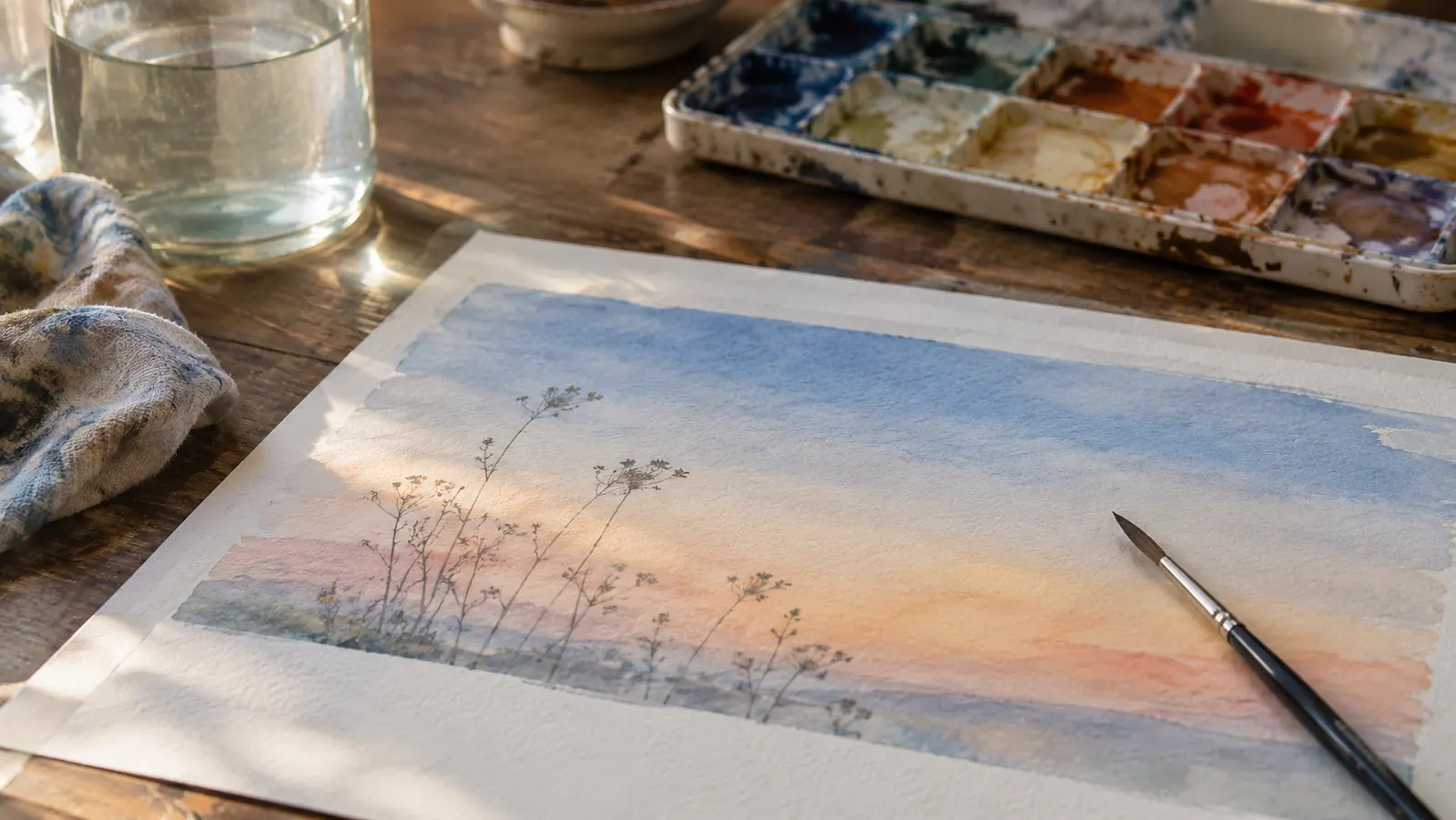
The point of a round brush is not a separate tool. It is what the belly becomes when the hairs are together and the brush is standing up. That means detail is mostly a matter of angle and pressure, not a different brush. Hold the brush more upright, closer to vertical, and let only the last quarter inch of the hairs touch the paper. More pressure widens the line. Less pressure gives you a hair. Rotating the handle a little between strokes keeps the point from flattening on one side, which is what makes a line go wide halfway through.
The #1 and #4 are my detail brushes. I use the #1 for the vein down the middle of a leaf, the fine stems on a sprig, the whiskers on my cat, who is a nine year old orange tabby and has walked across a wet painting more than once. I use the #4 for small shapes, the dark centers of flowers, the gaps between fence boards. What matters is that I load them and then touch the towel once so the point is damp rather than wet. A wet point spreads. A damp point stays where you put it. And I paint those lines in one motion rather than drawing them slowly, because a slow line wobbles.
Step 4: Fix Blooms, Backruns, and Hard Edges
A backrun, some people call it a bloom or a cauliflower, happens when you paint wet paint into a wash that is already drying. The water pushes pigment outward and it dries with a hard scalloped edge and a pale center. It is not a defect in the brush. It is a timing problem. I still make them, usually when I am talking to someone in class and my hand keeps going after the paper has started to close. The first thing to know is that you cannot fix a backrun while it is wet by adding more water. You will only make a bigger one.
Your options come after it dries. If you dislike it, wet the entire area evenly with clean water and a soft brush, blot it once with a clean towel, and let it dry flat. That will lift most of the pattern. Or leave it. In a sky, a soft cauliflower reads as weather, and some of my better skies are accidents I decided to keep. Lifting works the same way: a clean, damp brush and a light blot will pull color back toward white, but only on paper that has not been scrubbed. Cold press will take one lift. The second one starts to fuzz the surface.
Hard edges are the other thing beginners ask about. If you want a hard edge, paint it and leave it alone, and it will be hard. If you want a soft one, you have to soften it while the paper is still damp, or come back with a clean damp brush and run it along the edge once, then blot. Once only. Rubbing a hard edge with a wet brush pulls the color onto the clean side and makes a grey smear. Learning to leave an edge alone is harder than learning to fix one.
Step 5: Rinse, Reshape, and Dry Flat
Goat hair is animal hair, which puts it closer to your own hair than to a nylon filament. It does not want to stand in a jar of water overnight. At the end of a session I rinse each brush in cool water until the water runs clear, working the hairs gently against the palm of my hand, and I do that before the paint has a chance to dry down in the ferrule. Every few sessions I use a drop of mild soap, the same plain soap I would use on a wool sweater, and rinse it out thoroughly.
Then I reshape the point with my fingers, drawing the hairs together from the ferrule out to the tip, and lay the brushes flat on a paper towel with the heads over the edge of the table so nothing presses on them. Flat, not standing. A brush that dries point up will let water settle down into the ferrule and swell the wood, and a brush that dries with its head against a surface will dry bent. Neither one comes back. My TRANSON rounds have kept their points through 18 months of near daily use because of that one habit, and the cheap nylon set I owned before them lost theirs in about four months.
One more note on storage. I keep mine in a rolled mat rather than a cup, mostly because a cup on the table is a thing a cat can knock over. If you do keep yours in a jar, put them in head up and only after they are dry.
What Else Helps
The brushes are the smallest part of the setup. That is not modesty, it is just true. The TRANSON set does its job and I am glad to have it, but the paper matters more. I paint on an Arches cold press block, 7 x 10, 140 lb, and I go through about one a month. It is glued on all four sides, which keeps the sheet flat without stretching, and I paint on the top sheet, let it dry completely, then slide a palette knife around the edge to release it. For class demos I use a cheaper spiral student pad, and the difference is not subtle: washes sit on the surface longer and lift more easily on student paper, which is forgiving when you are learning and frustrating when you are not.
A palette with a lid is the other thing I would not give up. I use an airtight one with 18 wells, and I bought it the week my cat walked through an open palette and tracked ultramarine across a finished painting. I squeeze tube paint into the wells, let it set, and mist it before a session. The lid stays shut whenever I leave the table. Before that I used a metal palette for about four years, which was fine except that the paint hardened and had to be reconstituted every time. Beyond that: two jars of water, a flat paper towel, and a window with north light if you have one, because north light does not shift color through the day.
And a water brush in a zip pouch for anywhere that is not the table. I carry a medium one with a small sketchbook and a few half pans in an old mint tin, for the park, for waiting rooms, for visits to my sister in Hagerstown. It is not the same as a real brush and a jar of water. It is the difference between painting that afternoon and not painting.
A wash on 140 lb cold press stays workable for about three minutes in July and closer to ninety seconds in February with the heat running. That number is the whole skill.
The set I would put in a beginner's hand on the first night
Eight sizes of round, from a #1 for veins and whiskers to a #16 that carries a wash across a 7 x 10 sheet. Start with the #10, leave the rest in the mat, and add them as your hand asks for them.
Amazon See the TRANSON round set on Amazon →