

For the first three weeks I owned the TRANSON 8 piece round goat hair set, I used two brushes out of the eight. The #12 and the #10. The other six sat in the roll like substitutes waiting on the bench. That is the first honest thing I can tell you about this set, and it is the thing the listing photographs will never show you: it is not eight brushes in your hand, it is two or three that do the daily work and a handful that wait for a specific job. There is nothing wrong with that. But you should know it before you buy, not three weeks after.
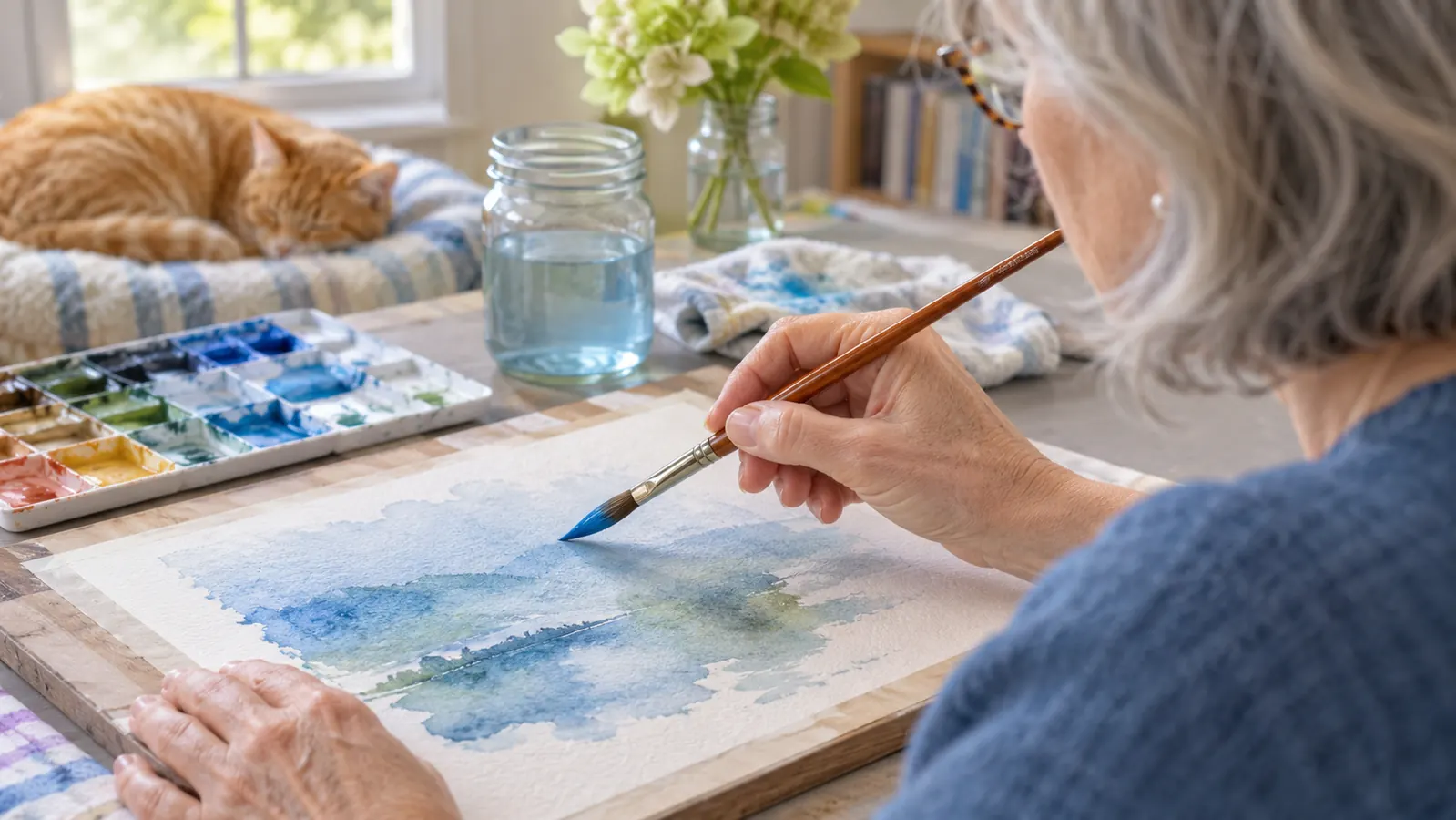
My name is Marjorie Pell. I taught middle school art for 31 years and I have painted in watercolor for about 22 of them. I paint most mornings at a folding table in the spare bedroom with the north window, about two hours at a stretch, landscapes and garden flowers, and a cat who insists on the warm end of the table. I bought the TRANSON set about 18 months ago to replace a nylon set that had gone splayed and scratchy at the tips. My entire care routine is a rinse after every session, a reshape of the point with my fingers, and lying them flat to dry. That has been enough. This is what I found out.
The Quick Verdict
A genuinely useful soft-hair set for wash-heavy watercolor, with real limits: no spring, no flat or rigger, and two sizes you will use while six wait.
Amazon Check Today's Price →If you want soft edges and a brush that carries a puddle, start here
Eight round sizes from #1 to #16, goat hair, gourd handles. It is the set I would hand a beginner who presses too hard, and the set I still reach for on skies.
Amazon Check Today's Price on Amazon →How I've Used It, Morning After Morning
Eighteen months, most mornings, roughly two hours. That is a lot of rinses. In that time I have painted almost entirely on Arches cold press blocks, with a cheaper spiral student pad for class demos, using a Cotman half pan set I have had for about three years. So these brushes have been asked to do one job: move watercolor pigment across cotton paper. The listing says they are also for acrylic, ink and gouache. I have not used them that way, so I will leave that claim alone rather than repeat it back to you as though I had tested it.
I also put them in front of my Thursday evening class, six adults at the library branch, most of them new to watercolor. That is where a set like this gets found out. Beginners press. Beginners leave a brush standing up in the water jar. Beginners scrub at a passage that has already dried and then look surprised when the paper pills. Watching six people do all three to these brushes told me more about how they hold up than my own careful habits ever would.
What held up: the join between hair and handle never loosened on any of the eight, no hair shed into a wash after the first two sessions, and the points came back after a finger reshape every single time. What did not hold up: two of the smaller brushes now carry a slight curl at the tip from being left standing in water overnight, and no amount of reshaping has fully taken it out. That is on the student, not the brush. But it is worth knowing that goat hair forgives a great deal and does not forgive that.
What Nobody Tells You About Goat Hair
The listing says goat hair and then stops, which leaves you to find out what that means on your own. So here it is. Goat hair is soft. Softer than the nylon set I came from, softer than the sable blend a student once lent me for an afternoon. It has very little spring, and spring is the quality that snaps a brush back to a point the instant you lift it off the paper. Press a goat hair round down and it stays pressed for a heartbeat longer than you expect. Then it comes back. Slowly.
That sounds like a complaint. It is not, because low spring and a large belly are the same trait seen from two different sides. The listing mentions large bellies built to hold pigment and water for long strokes, and that is precisely what happens on the table. I can load the #14 and pull a band of color clear across a half sheet without reloading, and the far end of that band is still damp when I finish. With nylon I would have reloaded twice, and the first reload would have dried into a hard edge I then had to spend five minutes softening.
The trade is control. A soft brush gives you a soft edge whether you asked for one or not. On a landscape that is a gift. On the rim of a roof or the tight edge of a petal it is a problem, and you solve it by reaching down to the #1 or the #4 and accepting a thinner line than you wanted. Most reviews say the brushes are soft, which is true and useless. The useful version is this: soft hair will not let you draw a crisp line with a big brush, so plan your shapes around that instead of fighting it every painting.
What It Does to the Paint: Blooms, Backruns, Lifting
Watercolor behaves differently depending on how much water arrives with the pigment, and a brush that carries a lot of water changes the timing of everything downstream. With these rounds I found a wash stayed workable noticeably longer than it did with nylon. On a humid morning in Frederick that was maybe 40 extra seconds before the sheen went matte. On a dry morning in January it was closer to 15. Small numbers, and yet in watercolor 15 seconds is the difference between a soft blended sky and a sky with a seam running down the middle of it.
The other side of that is backruns. A backrun, the cauliflower bloom that shows up when wet paint meets a damp area that is already drying, is easier to cause with a wet-loaded soft brush. I got more of them in my first month with this set than I had in the previous year, and it took me a while to admit the brush was half the reason and not just my handling. Once I started wringing a little water out of the #12 between my fingers before laying a wash, the blooms settled right down. Now I can make one on purpose, which is the only version of that skill worth having.
Lifting is where I miss a stiffer brush. If you lay a passage too dark and want to blot it back, a soft goat hair round gives up its water but does not really scrub. It lifts perhaps half of what a firmer synthetic lifts from the same spot on cold press, and it leaves a softer, muddier footprint. My workaround is a damp tissue and a light touch, which honestly has always worked better than any brush. If lifting and scrubbing are central to how you paint, this is not the set for that job and no amount of technique will change it.
Granulation has nothing to do with the brush, and I mention it because people buy soft hair hoping for granulation and then blame the brush when it does not appear. Granulation is pigment settling into the valleys of the paper. Ultramarine does it. Phthalo blue mostly does not. A soft brush can leave more water behind, and more water means more settling, but no brush in the world will make a non-granulating pigment granulate. Buy the pigment, not the brush, for that.
The Sizes That Actually Earn Their Keep
Eight sizes: #1, #4, #5, #8, #10, #12, #14 and #16. The #16 is the big one, and it is what I reach for on skies, loaded once and laid down in two passes. The #14 does most of my landscape work, tree masses, hillsides, the general blocking in. The #12 is my water brush, the one that gets the most rinses. Below that, the #8 and the #5 handle stems and smaller shapes, the #4 does eyes and the fine ends of branches, and the #1 comes out roughly once per painting, for a signature line or a whisker.
Now the honest part. There is no #2 and no #6, and nothing at all between #1 and #4. Those gaps are real. A #6 is a workhorse size for a great many painters, large enough to hold water, small enough for a petal, and it simply is not in this roll. I cannot tell you a #6 would beat the #5 here, because there is no #6 to hold beside it. What I can tell you is that I have wished for one more than once, usually halfway through a small flower when the #5 is a touch too wide and the #4 a touch too thin.
The gap between #1 and #4 is the one that surprises people. If you are coming from a set that had a #2 in it, you will notice, and you will notice it at the worst possible moment, which is while painting something small. My advice is to decide before you order whether you paint small and tight. If you do, the bottom end of this set will feel like a jump and you should plan to add one brush. If you paint loose and large, you will never miss it.
The Handle, and Other Small Things Nobody Mentions
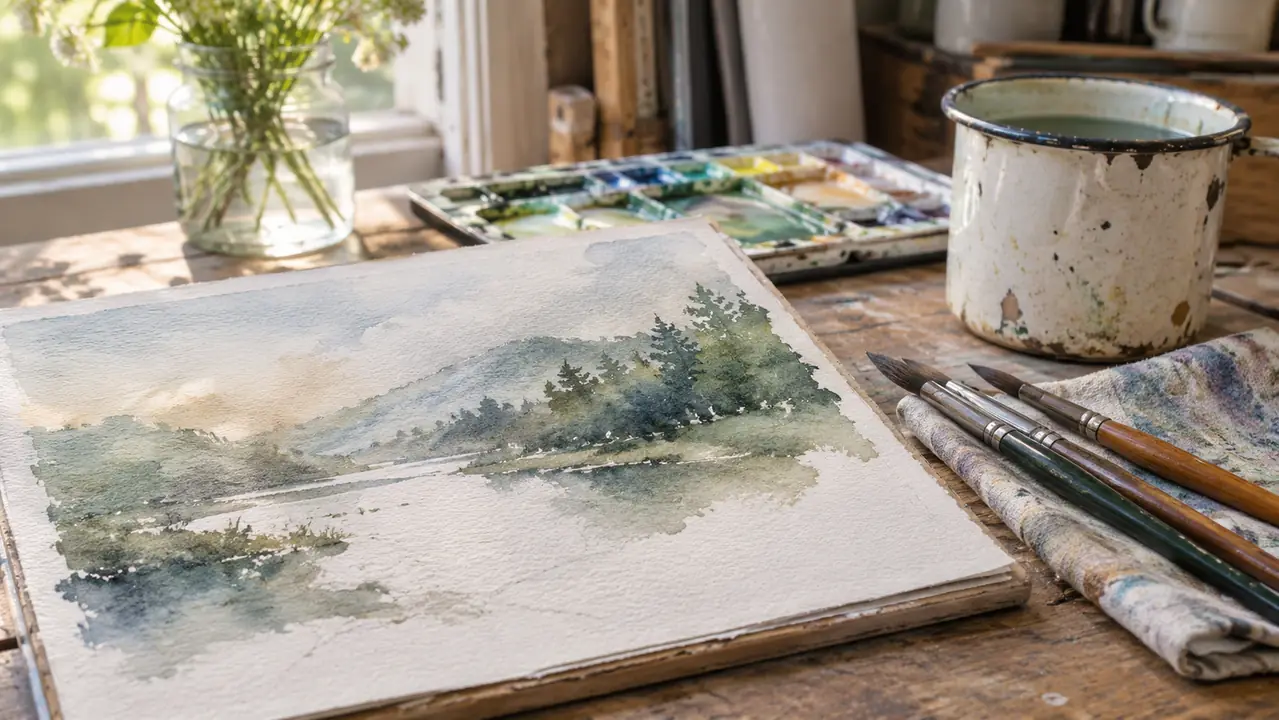
The listing calls it a gourd handle, balanced in weight and well finished. Gourd means the handle swells slightly through the middle and tapers toward both ends. That swell lands right under my fingers, and after 18 months the #12 feels like a brush I have owned for a decade. Two of my students disliked it on the first night, said it felt fat and slippery in a beginner grip, and then stopped mentioning it by the third week. It is a preference, not a defect, but it is a real thing to know before you order eight brushes with the same shape.
The set is rounds only. No flat, no wash brush, no rigger, no fan. If you are building a kit from nothing, you will still need at least a one inch flat for skies and something small and pointed for branches or a boat mast, and neither is in this box. That is the largest limitation here and the easiest one to miss when a listing says professional. It means eight sizes of one brush type. That is a sensible way to sell a set and a poor way to describe a complete kit.
One more small thing: they are light in the hand. If you are used to a heavier brush, the first session will feel like painting with nothing at all. A friend who paints with old sable picked up the #14 and said it felt like a toy. She was not wrong about the weight and she also borrowed it for a full afternoon, which tells you what she actually thought.
What I Liked
- Soft hair holds water and pigment right through a long stroke
- The #12, #14 and #16 do real wash work across a half sheet
- Points come back with a finger reshape, no soap or conditioner needed
- Eight round sizes run from a #1 detail tip up to a #16 for skies
- The gourd handle stays comfortable through a two hour session
- No shedding into a wash after the first couple of sessions
Where It Falls Short
- Almost no spring, so a big brush cannot draw a crisp line
- Soft hair barely lifts dried color when you try to blot back
- No flat, rigger or wash brush anywhere in the eight
- Gaps at #2 and #6 that small-work painters will feel immediately
- Tips curl if a brush is left standing in the water jar overnight
- Rounds only, so it is not a kit on its own
A soft brush will not fix a hard hand. What it will do is buy you another 15 seconds of workable wash, and 15 seconds is most of the game in watercolor.
Who This Is For
This set suits a hobby painter who works wet and loose: landscapes, skies, soft garden flowers, anything where a blended edge is welcome and a crisp one is not. It suits beginners, and I do not say that lightly. A soft brush is forgiving of a heavy hand because it delivers water slowly and will not gouge the paper the way a stiff synthetic does when someone presses. Six adults in my Thursday class proved that to me over a term. It also suits anyone who wants to find out what soft hair feels like before spending real money on a sable, and a teacher filling a class bin with something that will not be ruined in a month.
Who Should Skip It
Skip it if you paint botanical studies, architectural subjects or anything else that lives on a crisp edge, because you will spend the whole session working around the softness and wishing for a #2. Skip it if drybrush texture is part of your vocabulary, since low spring and a soft belly give you almost nothing there. Skip it if lifting and scrubbing are how you correct a passage. And skip it if you want one purchase that covers everything, because a rounds-only set is not that, no matter how many sizes are in the roll. If any of those describe you, buy a smaller mixed set and one good flat instead, and come back to TRANSON later when you want a dedicated wash brush.
Two of the eight will do 80 percent of your painting. The other six are worth having for the other 20.
Eighteen months of mornings on cold press, six beginners, and not one loose handle. If your watercolor runs wet and soft, this is a sensible place to start.
Amazon Check Today's Price on Amazon →